


Seller disclosure: DigiRake Store Private Limited sells the DigiRake Retail products linked in this guide. Prices and availability can change; verify the live listing before ordering.
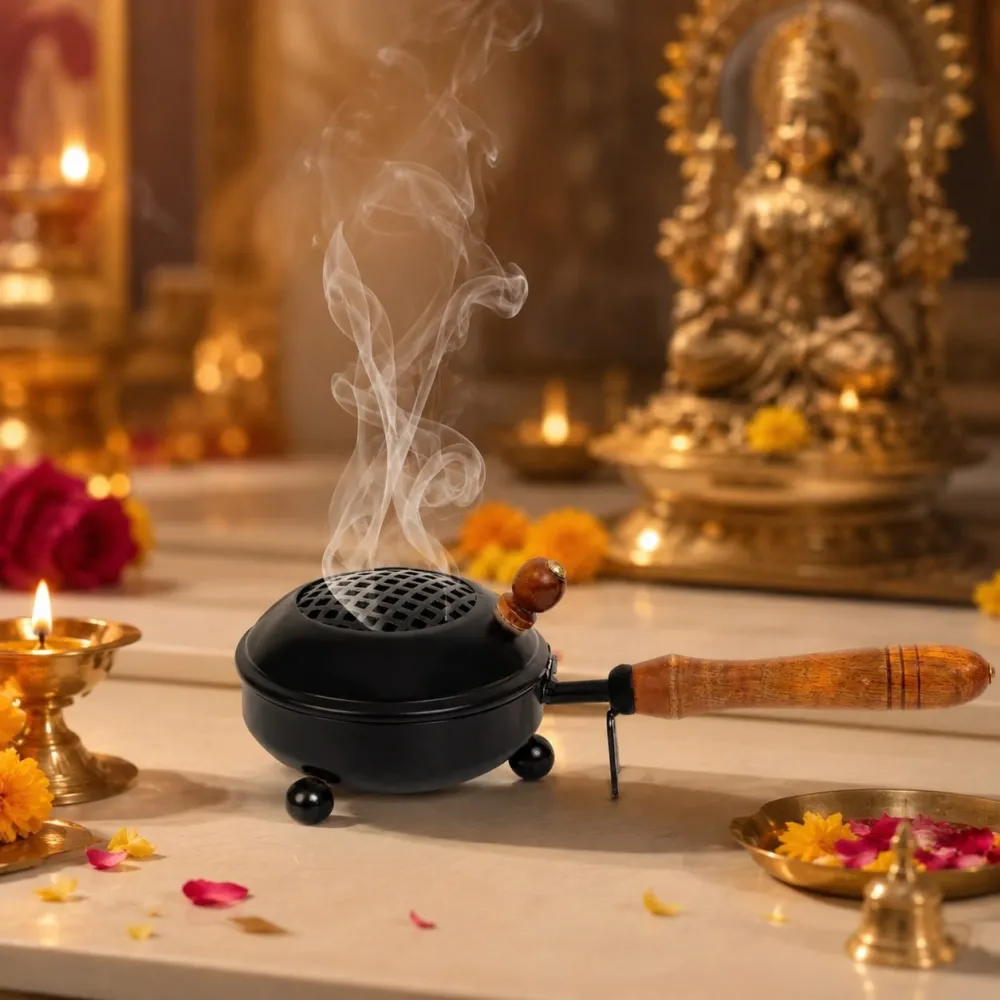
A dhoop dani is a vessel used to hold or burn dhoop, sambrani, loban or another incense format. It may also be called an incense burner, dhoop burner, dhoop holder or censer. Those names overlap, so the label alone does not tell you what can safely go inside.
The correct choice depends on the fuel: a self-burning cone, ready-made sambrani cup, thick dhoop stick, loose resin on charcoal, backflow cone and ordinary agarbatti all need different support, airflow and heat handling. This guide explains the differences and shows how to compare current options without assuming that one burner is universal.
Quick answer
Choose a dhoop dani only after confirming that its current instructions name the incense format you use. A lidded metal burner may suit specified cones, dhoop, sambrani or loban; a wooden stand may suit compatible ready-made cups; and a backflow burner needs hollow backflow cones. Ordinary agarbatti normally needs a stick holder and ash catcher, not a deep burner.
Dhoop dani, incense burner and holder compared
| Product type | Typical role | Suitable incense direction | Critical check |
|---|---|---|---|
| Dhoop dani / metal burner | Contains a hotter burning format inside a chamber | Only formats explicitly named by the maker | Heat-safe base, ventilation and handling instructions |
| Dhoop stand | Supports a compatible cup, cone or thick stick | Format and size stated on the listing | Heat-contact insert and physical fit |
| Incense-stick holder | Grips agarbatti and catches linear ash | Ordinary incense sticks | Hole diameter, angle and ash coverage |
| Backflow incense burner | Guides smoke down a decorative channel | Hollow backflow cones | Cone alignment and clean smoke path |
| Charcoal censer | Holds a separate high-heat charcoal system | Resin or powder only as directed | Explicit charcoal approval and suitable tools |
Compare current DigiRake burner options
These items were in stock when this guide was updated. They solve different jobs; confirm the permitted incense and current specifications on each live page.
- Iron Incense Burner Medium — lidded metal dhoop-dani format ↗
- Dhoop Stand 3 Inch — compact sambrani-cup stand ↗
- Cup Saucer Dhoop Stand — dhoop-and-agarbatti design ↗
- Adiyogi Backflow Incense Holder — waterfall-smoke system ↗
Seller disclosure: DigiRake Store Private Limited sells these products. A product shown here is not automatically compatible with every dhoop or sambrani format.
What can you burn in a dhoop dani?
Self-burning dhoop or incense cones
A cone lights at the tip and burns down toward its base. Its final stage concentrates heat where it touches the burner. Use a purpose-built platform or chamber whose listing permits cones. Do not place a burning cone directly on decorative wood, resin, paint or a thin plate intended only for sticks.
Ready-made sambrani cups
A ready-made cup is self-contained but still becomes very hot. It needs a stand or burner that supports its base without tipping, with enough clearance around the sides and above. Measure the cup and check the holder’s usable dimensions. Follow our cup sambrani use and safety guide for lighting and disposal.
Loose sambrani resin or loban
Loose resin is often heated on charcoal or another dedicated heat source rather than lit like a cone. Charcoal creates intense, long-lasting heat. Use only a charcoal-compatible burner with the specified medium, tools and ventilation. A lidded metal appearance does not prove charcoal compatibility; the current instructions must say so.
Dhoop sticks
Coreless dhoop sticks can be thicker and more fragile than agarbatti. They need a support sized for their diameter and an ash path wide enough for the full burn. A deep bowl without a stick support may let the burning stick fall. See how to use dhoop sticks safely.
Ordinary agarbatti
Agarbatti usually needs a small hole to grip its uncoated end and a tray or plate to catch ash. A 2-in-1 dhoop stand can include that feature, but a burner chamber alone does not. Compare dedicated formats in our incense-stick holder guide.
Metal dhoop dani: advantages and limits
A metal dhoop dani can provide a durable chamber, removable lid and smoke openings. It may be easier to empty than a detailed decorative holder, and a lid can help contain ash. Metal also conducts heat efficiently: the body, feet, handle and surrounding surface can all become hot.
A handle is useful for carrying a cold, empty burner. It is not permission to walk around with burning dhoop or charcoal. Hot residue can shift, fall through an opening or ignite nearby material. Leave the burner on its stable surface until everything is fully extinguished and cool.
Check whether the finish needs dry cleaning, whether the lid detaches and whether the base transfers heat. If the metal is bent, the lid no longer sits securely or the stand wobbles, stop using it.
Wooden dhoop stand versus metal burner
A wooden stand can complement a pooja room and keep a compact cup visually enclosed. The wood should remain an outer body, with the burning item supported as the design intends. Never improvise by placing a hot cup or cone directly on bare wood.
A metal burner may be the better direction when the live instructions allow the higher-heat incense you use. It still needs surface protection and cooling time. Neither material is universally safer: correct compatibility, undamaged construction and careful placement matter more. Read the full dhoop stand buying guide for stand shapes and cup fit.
What about electric dhoop dani?
An electric dhoop dani heats incense with a powered element instead of an open ember or charcoal. Electrical ratings, plug type, temperature control and the manufacturer’s approved material become essential. Do not put resin, oil, camphor or powder onto an electrical device unless its instructions explicitly permit that substance.
DigiRake Retail does not currently list an electric dhoop dani in the product module above. An electric camphor diffuser or night lamp is a different category and should not be presented as an incense burner. If you buy an electrical model elsewhere, look for applicable safety certification, intact wiring and clear operating instructions.
Backflow burner versus regular dhoop dani
A backflow holder is built around a visual smoke route. A special cone has a hollow channel that aligns with an intake hole, allowing some smoke to descend. A regular cone will not reliably create that effect. A conventional dhoop dani instead focuses on containing heat, ash and smoke from the formats it supports.
Choose backflow for the decorative waterfall effect and willingness to clean its channels. Choose a regular burner for a simpler daily dhoop routine. Our backflow incense burner guide explains cone selection and residue care.
How to choose a dhoop dani
- Identify the incense. Note whether it is a cone, thick stick, ready-made cup, loose resin or charcoal system.
- Demand explicit compatibility. Do not infer use from photographs, shape or the generic word “burner.”
- Compare dimensions. Check chamber width, usable depth, cup clearance and overall height.
- Inspect airflow. Lidded models need unobstructed openings designed for their approved use.
- Check stability. The base should sit level before any incense is lit.
- Plan surface protection. Consider how much heat can reach furniture or a pooja shelf.
- Review cleaning access. A removable lid or insert can simplify ash and soot removal.
- Confirm package contents. Do not assume cups, cones, charcoal, tongs or sand are included.
How to use an incense burner safely
- Read the burner and incense instructions completely.
- Place the empty burner on a level, appropriate heat-protected surface in its final position.
- Keep curtains, paper, garlands, cables and loose clothing well away.
- Insert only the permitted incense using the designated support.
- Light it exactly as directed and extinguish any open flame that is not intended to remain.
- Keep the burner supervised and the room suitably ventilated.
- Do not touch, carry, refill or clean it while hot.
- Confirm all embers are out before disposing of cooled residue.
Smoke and ventilation
A lid or decorative smoke path does not filter emissions. Burning incense releases particles and gases into the room. Use ventilation, avoid breathing smoke directly and reduce frequency or stop use if anyone experiences irritation. Keep the burner away from children, pets and people who are especially sensitive to smoke or fragrance.
People with asthma or other respiratory conditions may need to avoid incense and seek advice from a healthcare professional. For more context, read are incense sticks harmful?
Cleaning a dhoop dani
Wait until the burner, lid and residue are completely cold. Remove loose ash with a soft dry brush. Clean a removable insert separately only as its instructions allow. Use non-abrasive tools on coated metal, dry metal thoroughly and avoid soaking wood or unknown composite parts.
Resin residue can be sticky and backflow smoke can leave an oily film. Do not attack deposits with a knife or strong chemical cleaner that may damage the finish. Follow material-specific care in our incense-holder cleaning guide.
Common mistakes to avoid
- Assuming every dhoop dani supports charcoal, resin and cups.
- Using a stick plate as a high-heat cone or charcoal burner.
- Blocking lid openings to reduce visible smoke.
- Carrying a burning vessel because it has a handle.
- Placing a hot burner directly on polished furniture.
- Using oil or camphor in a product approved only for dry incense.
- Discarding ash before confirming the centre is cold.
Frequently asked questions
Is dhoop dani the same as an incense burner?
Often yes in retail language, but neither term guarantees a particular operating method. Check the exact compatible incense and instructions.
Can I burn loban in any metal dhoop dani?
No. Loban resin may require charcoal or another heat system. Use only a burner that explicitly permits that method.
Can I put a sambrani cup in a dhoop dani?
Only when the cup fits securely and the product instructions approve ready-made cups. Never wedge a cup into a small chamber.
Is a lidded incense burner smoke-free?
No. The openings release smoke into the room. A lid may contain ash or shape the smoke, but it is not a filter.
Can I use an incense burner on a wooden pooja shelf?
Only with adequate clearance and surface protection appropriate to the product. Heat and soot can damage the shelf, so follow the manufacturer’s placement guidance.
Can I use camphor in a dhoop dani?
Only if the live instructions explicitly permit camphor. A camphor burner, electric diffuser and dhoop dani are not automatically interchangeable.
Final recommendation
Buy by fuel and operating method, not by name. Choose a stick holder for ordinary agarbatti, a verified stand for compatible cups, a purpose-built burner for the dhoop or resin system stated in its instructions, and a backflow holder only for hollow backflow cones. Confirm fit, ventilation, cleaning and surface protection before the first use.