


Seller disclosure: DigiRake Store Private Limited sells the DigiRake Retail products linked in this guide. Prices and stock can change; confirm the live listing before ordering.
An agarbatti stand—also called an agarbatti holder, incense-stick stand or incense-stick holder—supports the uncoated end of a burning incense stick and catches the ash. The best stand is not simply the most decorative. It should grip your usual stick, keep the ember over the ash-catching surface, sit steadily and be easy to empty after cooling.
Open plates, long wooden stands, bowls and ventilated bamboo-shaped holders solve different problems. Some support one stick; others have several holes or a separate cone recess. This guide compares the formats, materials, sizes and safety checks, then maps them to currently stocked DigiRake products.
Quick answer
For one daily agarbatti, choose a stable single-hole stand with enough usable length or width for the ash path. For several sticks, use a purpose-built multi-hole plate or ventilated holder with a broad base. Choose a 2-in-1 model only when the listing explicitly supports your cone or dhoop format. Never force a stick into an undersized hole or assume decorative gold/silver colour indicates precious metal.
Agarbatti stand types compared
| Type | Best suited to | Main advantage | Check before buying |
|---|---|---|---|
| Long wooden stand | One angled stick | Follows a long ash path | Distance from hole to far edge |
| Small bowl holder | One stick in a compact space | Small footprint | Stability, hole angle and usable ash area |
| Stainless-steel plate | One to several sticks | Open visibility and simple cleaning | Plate diameter and hole spacing |
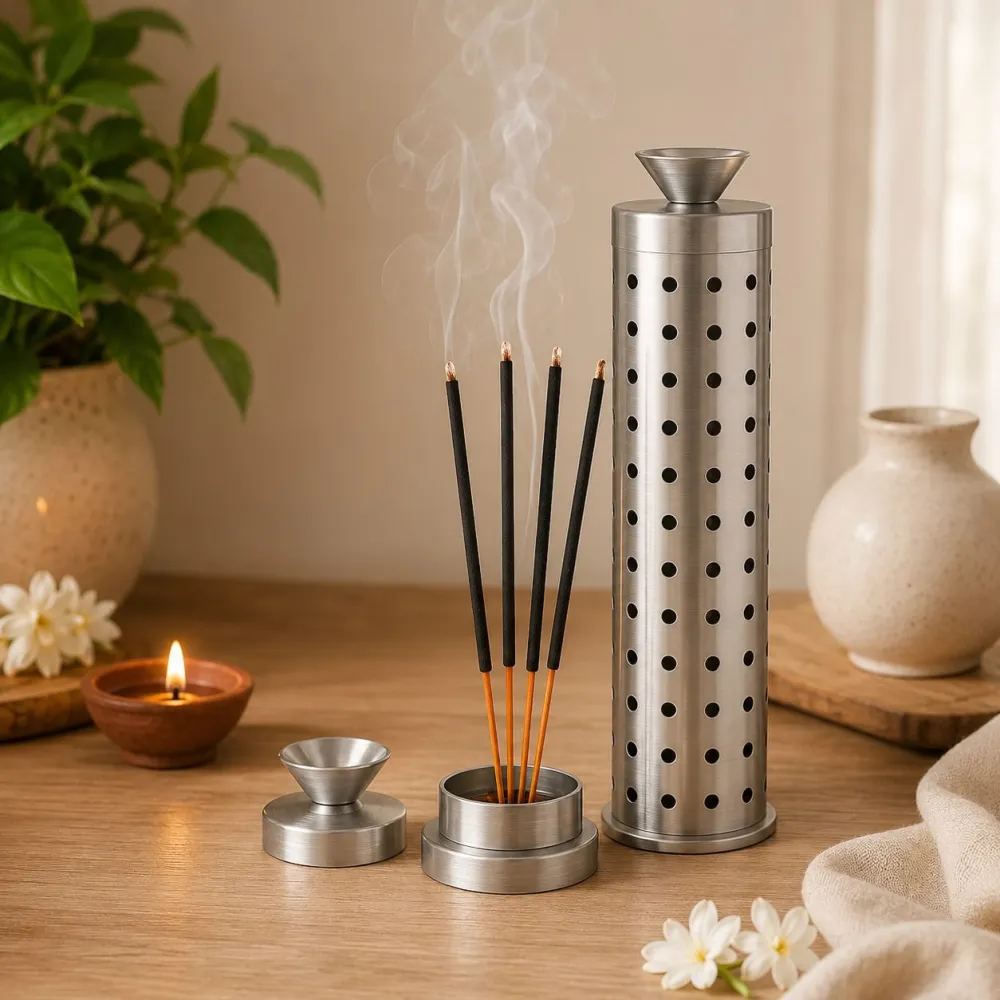
| Ventilated bamboo shape | Multiple sticks where specified | Contained ash-catching form | Base stability, vents and cleaning access |
| 2-in-1 stand | Agarbatti plus compatible cone or dhoop | Two functions in one footprint | Separate heat-safe recess and exact compatibility |
| Box or tower | Partly enclosed stick burning | Decorative enclosure | Internal stick clearance and ventilation |
Compare current agarbatti stands
These products were in stock when this guide was updated. Check the live page for dimensions, supported incense, package contents and current availability.
- Agarbatti Stand 10 Inch — long wooden ash-catching format ↗
- Bowl Shaped Single Agarbatti Holder — compact one-stick option ↗
- Agarbatti Stand Simple — wooden stick-and-cone design ↗
- SS Agarbatti Stand Plate 10 CM — open multi-hole plate ↗
- SS Designer Incense Stick Holder — decorative steel format ↗
- SS Bamboo Agarbatti Stand — stainless-steel finish ↗
- SS Gold Bamboo Agarbatti Stand — gold-colour finish ↗
- SS Copper Bamboo Agarbatti Stand — copper-colour finish ↗
Seller disclosure: DigiRake Store Private Limited sells these products. Finish names describe appearance unless the product specifications explicitly state material composition or purity.
How an agarbatti stand should fit the stick
The hole should hold the uncoated bamboo end without crushing it. If the hole is too loose, the stick may lean beyond the plate or tray. If it is too tight, forcing the stick can crack the incense coating or make the stand shift. Test one unlit stick before the first burn and confirm that its burning length remains over the intended ash catcher.
Sticks vary in core diameter, straightness and total length. A holder that works with one brand may not grip another identically. Do not drill, widen or pack the hole with combustible paper. Choose a different stand when the fit is unreliable.
Choosing the right ash-catching size
Overall dimensions can be misleading. For a long stand, measure from the stick hole to the far edge in the direction the stick points. For a plate, compare its diameter with the projected path of the angled stick. A raised decorative rim does not count as usable coverage if ash can fall through cut-outs or beyond the edge.
Air movement can shift light ash sideways. A wider tray or plate gives more tolerance, but no holder guarantees that every particle stays inside. Place it away from a strong fan and check the surrounding surface after the first burn. See the dedicated incense ash-catcher guide for measurement examples.
Wooden agarbatti stands
A wooden stand provides a traditional appearance and can offer a long ash-catching path. Look for a level base, smoothly finished edges and a metal or other designated insert wherever the burning format requires one. The glowing portion of a stick should never touch decorative wood.
Wood can absorb moisture and fragrance residue, so use minimal moisture during cleaning and dry it promptly. A long wooden stand also needs full shelf support; do not let one end project into a walkway. For material and finish care, read the wooden incense-holder guide.
Stainless-steel agarbatti stands
A stainless-steel plate or ventilated holder can be durable and straightforward to wipe after the ash is cold. Steel still conducts heat, and thin parts or decorative finishes can scratch. Use a soft cloth and avoid abrasive powders unless the manufacturer permits them.
For a multi-hole plate, check both the number and spacing of holes. Physical capacity does not mean every hole should be filled. Several burning sticks increase smoke, heat and ash. For a bamboo-shaped enclosure, confirm how the top and base separate and how residue is removed from inside.
Silver, gold, copper and brass wording
Search results often use “silver agarbatti stand” to mean either silver-colour appearance, silver-plated construction or solid silver. Those are not equivalent. Likewise, gold or copper colour does not establish precious-metal content, and a small brass-colour insert does not make the whole stand brass.
Read the material field and composition statement, not only the colour in the title. The DigiRake bamboo options above are identified as stainless-steel products with stainless-steel, gold-colour or copper-colour finish choices. They should not be described as solid silver, gold, copper or brass.
Single-stick versus multi-stick holders
A single-stick stand is usually enough for a small room, short ritual or meditation corner. It is easier to position and produces less total smoke than several sticks. A multi-hole stand can be useful for a larger pooja arrangement, but spacing must keep sticks from crossing or leaning into one another.
Use only the number needed and appropriate for the room. Burning more incense does not make the holder more effective; it simply increases emissions and cleaning. If smoke or fragrance causes irritation, extinguish the sticks safely and ventilate the area.
When to choose a 2-in-1 stand
A 2-in-1 holder combines one or more agarbatti holes with a separate recess for a compatible cone or dhoop format. Choose it when you genuinely alternate between those formats and the live listing explicitly identifies both. A central recess is not proof that every cone, sambrani cup or charcoal system will fit.
Confirm the heat-contact surface, recess diameter and cleaning access. Do not burn several sticks and dhoop together merely because the holder can physically carry them. Compare the format in the 2-in-1 incense and dhoop holder guide.
Open plate, box or tower?
An open plate keeps the ember visible and is easy to inspect. A box or tower partly encloses the stick and may contain more ash, but it adds internal-clearance, ventilation and soot-cleaning checks. The stick must not touch the lid, wall or decorative openings.
Choose an enclosed format for its footprint and appearance only after checking the supported stick length and how the chamber opens. It does not filter smoke or make unattended burning safe. Our incense box and tower guide covers those details.
Agarbatti stand buying checklist
- Identify your stick. Measure total length and inspect the uncoated core diameter.
- Check the hole. Confirm the listing supports ordinary agarbatti and the intended number of sticks.
- Measure usable ash coverage. Compare the projected stick angle with the tray length or plate diameter.
- Test stability. Prefer a broad, level base that does not rock when empty.
- Verify material. Distinguish solid material, plating and colour finish.
- Plan placement. Leave clearance from cloth, paper, shelves, lamps and cables.
- Review cleaning access. Check removable parts, narrow vents and finish-specific care.
- Confirm package contents. Do not assume sticks, cones or dhoop are included.
Where to place an agarbatti stand
- Use a stable, level and suitable heat-protected surface.
- Keep the full burning stick and ash path away from shelf edges.
- Leave space above it so heat and soot do not collect under a low shelf.
- Keep curtains, paper, garlands, loose clothing and electrical cables away.
- Position it beyond the reach of children and pets.
- Avoid strong fan or air-conditioner flow that can scatter ash.
- Never leave burning incense unattended.
Smoke and ventilation
An agarbatti stand controls the stick and some ash; it does not remove smoke from indoor air. Use appropriate ventilation and avoid breathing directly above the ember. People with asthma, respiratory conditions or fragrance sensitivity may need to avoid exposure and seek advice from a healthcare professional.
Burn fewer sticks rather than filling every hole by default. Read the evidence-based incense smoke guide for a fuller discussion of ventilation and exposure.
How to clean an agarbatti stand
- Wait until the ember, ash and entire stand are completely cool.
- Lift loose ash with a soft brush or dry cloth rather than blowing it into the room.
- Clear holes gently without widening or scratching them.
- Use minimal moisture on wood and dry it promptly.
- Use non-abrasive cleaning on coated or coloured metal finishes.
- Dry removable metal parts before reassembly.
- Stop using a stand that is cracked, warped, unstable or unable to grip the stick.
Common mistakes to avoid
- Choosing by colour without verifying material and dimensions.
- Forcing a thick stick into a small hole.
- Using a short tray for a long angled stick.
- Filling every hole in a small or poorly ventilated room.
- Assuming a stick holder can burn charcoal, loose resin or any cone.
- Placing a long stand partly over a shelf edge.
- Emptying ash before checking for a live ember.
Frequently asked questions
What is an agarbatti stand called in English?
Common English terms include incense-stick holder, incense holder, incense stand and ash catcher. Product names overlap, so verify that the item supports sticks.
Which agarbatti stand is best for daily use?
A stable stand that fits your usual stick and catches its full ash path is usually best. A simple plate or long tray is often easier to inspect and clean than an elaborate enclosure.
Is a wooden or steel agarbatti stand better?
Wood offers a traditional appearance and long tray forms; steel can be easy to wipe and form into plates or ventilated holders. Correct fit, stability and care matter more than material alone.
Can I burn a cone in an agarbatti stand?
Only if the product has a purpose-built cone recess and explicitly permits cone use. Never place a hot cone directly on decorative wood or a stick-only plate.
Why does ash fall outside the stand?
The tray may be too short or narrow, the stick may lean incorrectly, or airflow may shift the ash. Reposition an unlit stick and reduce draughts.
Does a covered stand reduce incense smoke?
No general reduction should be assumed. A cover changes the smoke path and may contain ash, but smoke still enters the room.
How many agarbatti sticks should I burn at once?
Use only what is needed and appropriate for the room. More sticks create more smoke, heat and residue even when the holder has spare holes.
Final recommendation
Choose an agarbatti stand by stick fit, usable ash coverage, base stability, material truthfulness and cleaning access. Start with a single-stick tray or plate for simple daily use; choose a multi-hole, 2-in-1 or enclosed model only when its additional function matches your routine and its instructions are clear.