


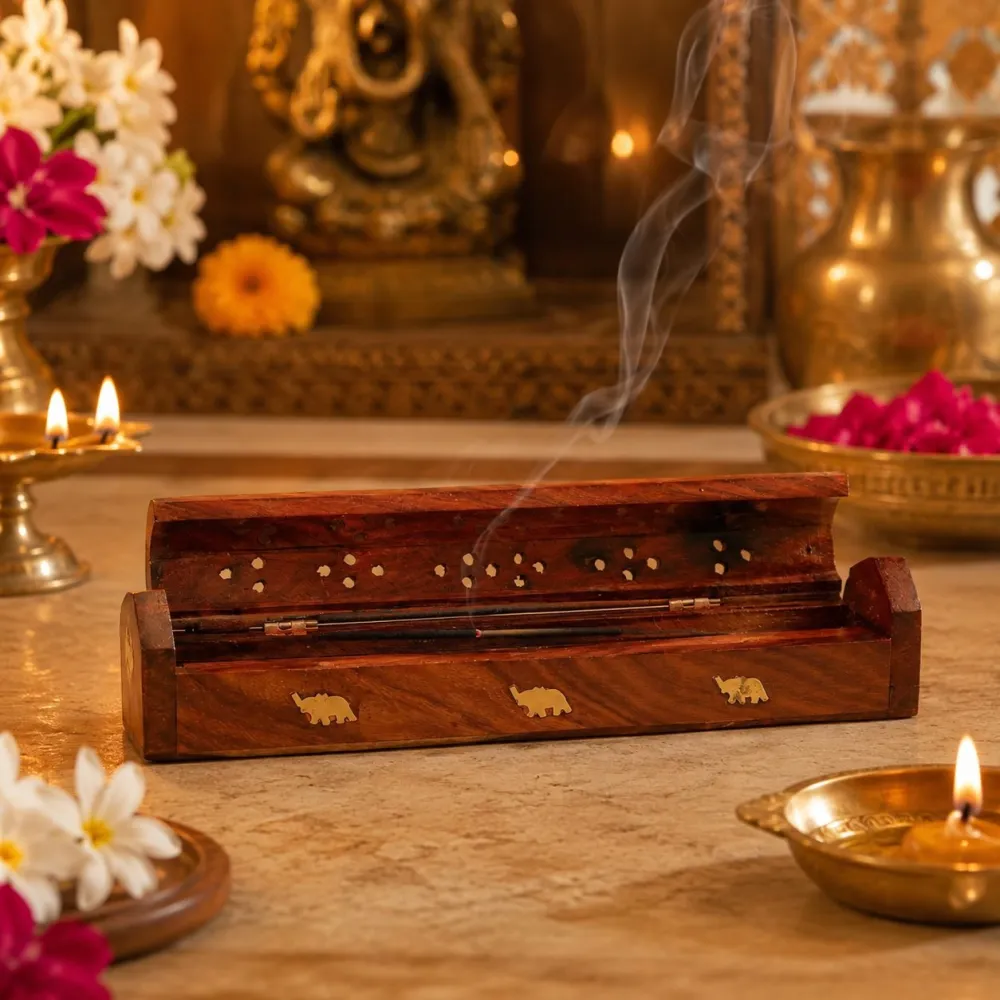
Current wooden incense-holder options
Compare the live measurements and supported incense format rather than selecting by appearance alone:
- Wooden 10-inch agarbatti stand ↗
- Bowl-shaped 2-in-1 holder ↗
- Cup-saucer dhoop stand ↗
- Mini flower-shaped incense holder ↗
Seller disclosure: DigiRake Store Private Limited sells the products linked above. Prices and stock can change; verify the live listing before ordering.
Why choose wood?
Wood works well in home décor because it pairs naturally with pooja shelves, brass accessories and traditional interiors. It can be shaped into detailed cut-outs and covered forms that are difficult to achieve with a flat metal plate. Many wooden holders are also lightweight enough to move after they have cooled.
The material also requires more care than plain stainless steel. Moisture can affect the finish, ash can settle in carved openings and direct heat can mark an unprotected surface. A well-designed wooden holder manages these issues through a metal bowl, brass cup, internal tray or designated burning area. Check the actual product rather than assuming every wooden model includes the same protection.
Wooden tray-shaped incense holders
A wooden tray is one of the simplest designs. The incense stick enters a small hole and leans over the length of the tray. Its success depends on geometry: the hole must hold the stick securely, and the tray must extend under the likely ash path. A narrow decorative tray may look elegant but provide little tolerance for airflow.
Before use, insert an unlit stick and check where the tip sits. If the tip projects beyond the far end or leans to the side, use a different stick size or holder. Do not widen the hole with force, because this can make future sticks unstable.
- View DigiRake Wooden Tray Shaped Incense Holder on Amazon ↗
- View the verified Prakrima wooden incense tray ↗
Wooden box and pipe-shaped incense holders
A horizontal covered holder can conceal the stick behind a patterned lid and direct smoke through cut-outs. Some designs also store unlit sticks in a separate compartment. Confirm that the storage area is isolated from the ember and ash. A covered product should be operated with the lid in the position specified by the seller; do not improvise by closing an open tray inside a random wooden box.
The interior should be long enough for the supported stick and accessible enough to remove ash. Check hinges, magnets, catches or sliding lids before lighting. A lid that does not sit correctly can contact the stick or restrict the intended airflow.
View DigiRake Wooden Incense Holder on Amazon ↗ and compare it with the verified Prakrima 10-inch wooden agarbatti stand ↗.
Wooden tower-shaped holders
A tower uses vertical space and creates a strong decorative silhouette. The stick may stand inside the tower or attach to a base before the cover is placed over it. Check the instructions, because placing a lit stick through the wrong opening can cause contact with the wood.
The base must sit flat. Tall products amplify small wobbles, so inspect for warping, loose feet or an uneven surface. The ventilation cut-outs should remain unobstructed, and the ash chamber should be emptied after cooling.
- View DigiRake Wooden Tower Shaped Incense Holder on Amazon ↗
- View the verified Prakrima 12-inch tower holder ↗
Wooden flower and bowl holders
A flower-shaped holder can combine several stick holes with a central recess for compatible dhoop. The outer petals are decorative; the central heat-contact area determines whether dhoop can be used. Check for a metal or brass insert and verify the supported cone or cup size.
Multiple holes allow a symmetrical pooja arrangement, but they do not require you to burn all sticks simultaneously. More sticks increase smoke and ash. Maintain ventilation and use the minimum number suitable for the ritual or room.
- View DigiRake Wooden Flower Shaped Incense & Dhoop Holder on Amazon ↗
- View the verified Prakrima flower-shaped holder ↗
- View the verified Prakrima mini flower incense holder ↗
Wooden dhoop stands
A wooden dhoop stand must separate the concentrated heat of the dhoop from the decorative body. Look for a metal bowl or designated inner cup. The top openings release smoke, while the flat base protects stability. Do not cover or move the stand while it is hot.
Dhoop cups and cones vary. Confirm the maximum supported size and whether the stand is intended for a ready-made sambrani cup, standard cone or another product. Charcoal and loose resin require a burner specifically designed for that method.
- View DigiRake Wooden Dhoop Stand on Amazon ↗
- View the verified Prakrima 3-inch wooden dhoop stand ↗
- View the verified Prakrima octagonal hut dhoop stand ↗
Cup-saucer and compact dual-use holders
A cup-saucer shape can place the dhoop recess in the “cup” and use another point for agarbatti. It is compact and visually distinct, but shoppers should confirm how each component is used. The saucer may catch ash rather than act as a cone platform.
View DigiRake Wooden Cup Saucer Dhoop & Incense Holder on Amazon ↗. A direct Prakrima URL for this exact product has not been verified, so use the current catalogue homepage ↗ rather than an invented SKU link.
How to assess wood quality without overclaiming
- Inspect the surface: look for cracks, splinters, deep dents and rough cut-outs.
- Check the base: it should rest evenly without rocking.
- Test moving parts: lids and hinges should open without forcing.
- Examine inserts: metal cups or trays should sit securely.
- Check hole alignment: an unlit stick should remain over the ash area.
- Review finish consistency: natural variation is expected, but peeling or sticky finish is not.
- Confirm dimensions: product photos cannot establish scale.
Do not claim a particular species such as Sheesham unless the live listing confirms it. “Handcrafted,” “eco-friendly,” “fireproof” and “heatproof” also require product-specific evidence.
Cleaning wooden incense holders
- Wait until every ember and insert is completely cool.
- Brush loose ash into a bin with a soft dry brush.
- Use a cotton swab or soft brush in carved openings.
- Wipe the exterior with a dry or barely damp cloth, according to the finish.
- Remove a detachable metal insert and clean it separately if instructions permit.
- Dry all parts before reassembly.
- Do not soak, place in a dishwasher or use strong solvent cleaners.
Oily residue from some incense products may need repeated gentle cleaning. Scraping can remove finish or enlarge stick holes. See how to clean incense holders by material.
Storage and long-term care
Store wooden holders in a dry cabinet after all residue has been removed. Do not close a box or tower while damp. Keep heavy objects away from carved lids and decorative cut-outs. If the holder contains a separate brass or steel part, wrap or position it so it does not scratch the wood during storage.
Inspect the holder before reuse after a long period. Look for loose hinges, warped parts, blocked ventilation, insects, mould or a damaged heat-contact insert. A product that no longer sits securely should not be used with burning incense.
Safe use
- Place the holder on a stable surface with adequate clearance.
- Keep it away from paper, fabric, dried flowers and electrical cords.
- Do not place a hot cone directly on bare wood.
- Do not leave burning incense unattended.
- Keep children and pets away.
- Allow the holder to cool before moving or cleaning.
- Ventilate the room; wood does not reduce smoke emissions.
Read our guides to safe incense-holder use and home and pooja-room placement.
Wood versus steel
Wood is often chosen for traditional aesthetics, carved forms and gift presentation. Steel is generally simpler to wipe and can be made into compact plates or covered tubes. Wood needs moisture-aware care; steel finishes need scratch-aware care. Neither is universally better. Choose according to incense type, cleaning routine, available space and décor.
Frequently asked questions
Can wooden incense holders burn cones?
Only models with a purpose-built cone or dhoop insert should be used. Do not place a cone directly on decorative wood.
How do I stop a wooden holder from getting ash stains?
Align the stick over the ash chamber, reduce drafts, remove ash after cooling and clean residue gently before it accumulates.
Can a wooden incense holder be washed?
It should generally not be soaked. Follow the product’s care instructions, use minimal moisture and dry promptly.
Are tower holders better than trays?
Towers use vertical space and provide an enclosed appearance; trays are simpler to inspect and clean. The better choice depends on space and maintenance preference.
Can I store incense sticks inside the holder?
Only when a separate storage compartment is designed for that purpose. Keep unlit sticks isolated from embers and ash.
Is every wooden holder handmade or made from Sheesham?
No. These are product-specific claims. Check the live listing and avoid assuming the species or manufacturing method.
Affiliate disclosure: This guide contains Amazon affiliate links. DigiRake may earn a commission from qualifying purchases at no additional cost to you.
A wooden incense holder combines a warm, traditional appearance with several practical formats: long trays, horizontal boxes, pipe-shaped covers, towers, flower bowls, dhoop stands and lantern-like enclosures. Wood is not one uniform category, however. The product’s construction, finish, ash chamber and heat-contact insert determine how it should be used and cleaned.
This guide helps you compare wooden holders without making unsupported assumptions about the wood species, handcrafting method, fire resistance or lifetime. Always rely on the live listing for the exact material, dimensions and compatible incense formats.
Quick answer
Choose a wooden holder with a stable base, a clearly defined stick support or dhoop insert, enough ash-catching space and easy cleaning access. Keep glowing material on the intended heat-contact area, avoid soaking the wood and never assume decorative wood is safe for direct cone or charcoal contact.
Wooden incense-holder types
| Type | Common use | What to inspect |
|---|---|---|
| Long wooden tray | One angled incense stick | Tray length, width and hole position |
| Horizontal box or pipe | Covered stick burning where specified | Ventilation, lid fit and ash chamber |
| Tower holder | Vertical decorative stick holder | Base stability and internal clearance |
| Flower or bowl holder | Several sticks or dual-use design | Hole spacing and heat-safe centre |
| Dhoop stand | Compatible cones or cups | Metal insert, airflow and cooling time |
| Cup-saucer holder | Compact stick and dhoop use where specified | Which part supports each incense format |
| Incense lantern | Decorative enclosed use | Ventilation, door or lid and ash removal |
Final recommendation
A good wooden incense holder balances appearance with heat management, stability and cleaning access. Select the format around your incense, confirm the designated heat-contact area and use gentle care that protects the finish. Compare the approved Amazon and verified catalogue products above using their current listings.