


Compare incense holders by format
DigiRake Retail lists open stands, enclosed towers, dhoop holders and backflow designs. Check the live page for dimensions, stock and the supported incense format:
- Wooden 10-inch agarbatti stand ↗
- Wooden 3-inch dhoop stand ↗
- Wooden 12-inch incense-holder tower ↗
- Adiyogi backflow incense holder ↗
Using ready-made cups? Read the cup sambrani use and safety guide.
Seller disclosure: DigiRake Store Private Limited sells the products linked above. Prices and stock can change; verify the live listing before ordering.
Incense holder, agarbatti stand and incense burner: what is the difference?
In everyday shopping, “holder” and “burner” are frequently used as synonyms. A practical distinction is that a holder normally supports a self-burning stick or cone, while a burner may include a chamber, lid, perforations or another heat source. An agarbatti stand is usually a stick holder. A dhoop stand is normally shaped for a dhoop cup, cone or other solid incense identified by the manufacturer. A censer is a broader historical and religious term for a vessel used to burn incense, sometimes with charcoal.
The safest approach is to ignore the marketing name for a moment and inspect the operating design. Look for the actual stick holes, metal bowl, cone platform, ventilation pattern and ash-catching surface. Our separate incense holder versus incense burner guide gives a format-by-format comparison.
Open plate and tray incense holders
An open tray is easy to understand: one end supports the incense stick while the long surface catches falling ash. It works best when the tray extends beyond the burning length and the hole holds the stick at an angle that keeps ash over the tray. A very shallow or short design can allow ash to fall outside when a fan, air-conditioner or cross-breeze changes the burn line.
Wooden trays offer a warm decorative appearance, while stainless-steel plates are simple to wipe after they have cooled. Neither material eliminates fire risk. Place any holder on a stable, non-combustible or suitably protected surface, away from curtains, paper, dried flowers and other items that can ignite.
- View DigiRake Wooden Tray Shaped Incense Holder on Amazon ↗
- View the verified Prakrima wooden incense tray ↗
- View DigiRake Stainless Steel Plate Incense Holder on Amazon ↗
- View the verified Prakrima stainless-steel incense plate ↗
Wooden box, pipe and tower holders
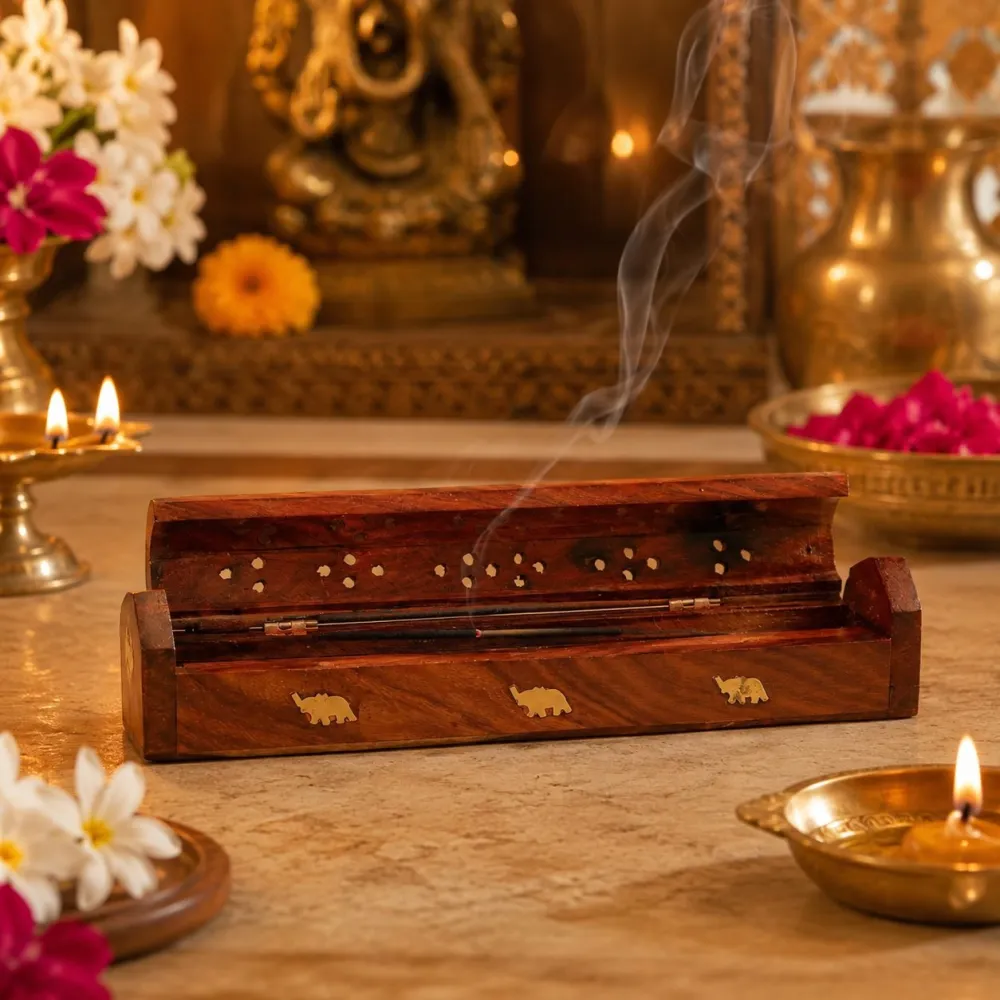
Wooden holders range from low box-like forms to tall towers. Some are designed to conceal part of the stick and direct smoke through patterned openings; others simply provide a decorative covered shape. Check whether the product is intended to burn incense with the lid closed, where the ash collects and how the interior is cleaned. A lid should never be assumed to make the holder smoke-free or suitable for unattended use.
A tower holder can provide more visual presence on a pooja shelf, while a horizontal wooden holder may fit more easily in a shallow cabinet. The tower should sit flat without rocking. If it separates into multiple pieces, verify that the base locks or seats correctly before lighting anything.
- View DigiRake Wooden Tower Shaped Incense Holder on Amazon ↗
- View the verified Prakrima 12-inch tower holder ↗
- View DigiRake Wooden Incense Holder on Amazon ↗
- View the verified Prakrima 10-inch wooden agarbatti stand ↗
Dhoop, cone and multipurpose holders
Dhoop cones and cups can create a more concentrated hot zone than a slender stick. The holder therefore needs a suitable insert or bowl, adequate ventilation and enough clearance around the burning material. A product described as “2-in-1” should identify the two supported formats; do not assume that it also supports charcoal, resin or every size of sambrani cup.
Compact bowl, flower and cup-saucer forms can be useful when a household uses both agarbatti and dhoop. They still require the user to select the correct recess or insert for each format. Our dhoop, cone and sambrani holder guide explains compatibility in more detail.
- View DigiRake Wooden Dhoop Stand on Amazon ↗
- View the verified Prakrima 3-inch dhoop stand ↗
- View DigiRake Wooden Flower Shaped Incense & Dhoop Holder on Amazon ↗
- View the verified Prakrima flower-shaped holder ↗
- View DigiRake Wooden Cup Saucer Dhoop & Incense Holder on Amazon ↗
Backflow and fountain incense holders
A backflow holder works with a compatible backflow cone that has a smoke channel. When conditions are suitable, denser smoke descends through the holder’s designed path. A normal incense stick or standard cone will not create the same waterfall effect. Air movement can also disrupt the display, so these holders work best on a level surface away from strong fans.
Backflow smoke can leave residue along the channels. Clean the holder only after it has cooled and follow the material-specific instructions. For a verified catalogue example, see the Prakrima Adiyogi backflow incense holder ↗. Read the backflow and fountain holder guide before comparing it with conventional holders.
How materials change daily use
Wood
Wood provides a traditional appearance and supports many carved forms. It should be kept dry, cleaned without soaking and protected from prolonged direct contact with hot embers. Check whether the burning area includes a metal insert or designated ash chamber.
Stainless steel and metal finishes
Steel can be easier to wipe and is available in plate, tube and covered forms. Decorative gold or copper-colour finishes may require gentler cleaning than plain steel. Avoid abrasive pads unless the product instructions permit them.
Brass, ceramic, stone and resin
These materials vary greatly. Brass may tarnish and require finish-aware care. Ceramic can tolerate heat in purpose-built products but may chip or crack if dropped. Stone is often heavy and stable, while resin is usually used for decorative backflow forms with a separate heat-contact point. Do not assume that every decorative material can directly support burning incense.
See our incense-holder material comparison for a detailed decision table. A current metal option is the DigiRake Stainless Steel Copper Color Incense Holder on Amazon ↗.
Seven measurements to check before buying
- Overall footprint: confirm the product fits the intended shelf without touching walls, fabric or other objects.
- Ash-catching length: for sticks, compare the tray length with the likely falling-ash path.
- Hole diameter: a loose hole can make the stick lean outside the tray.
- Vertical clearance: towers and covered boxes need enough internal space for the supported stick length.
- Base stability: the holder should not rock when lightly touched.
- Capacity: decide whether you need one stick, several sticks, a cone or a dhoop cup.
- Cleaning access: confirm that ash and residue can be removed without forcing tools into delicate cut-outs.
Safe placement and everyday use
An incense holder organises the burning product; it does not remove flame, heat or smoke hazards. Place it on a stable surface, maintain clearance from combustible items and keep it away from children and pets. Avoid using it under a low shelf where heat and soot can accumulate. Do not move the holder while the incense is burning or while the material remains hot. Extinguish the incense completely before leaving the room or going to sleep.
Burning incense contributes particles and gases to indoor air, so ventilation matters. People with asthma, allergies, respiratory disease, pregnancy-related concerns or sensitivity to fragrance may need to avoid exposure or seek medical advice. Read our evidence-based guide on incense smoke, ventilation and safer use. A holder catches ash but does not make smoke harmless.
Choosing an incense holder as a gift
For return gifts, prioritise a format that is easy to explain, pack and inspect. A simple plate or wooden stick holder is easier for a mixed guest list than a specialised burner. Dhoop and backflow products can work when recipients understand the compatible incense type. Confirm the exact SKU, dimensions, quantity, individual packing and complete delivered quotation before placing a bulk order.
Browse the current Prakrima return-gift catalogue ↗ and read the incense-holder return-gift and bulk buying guide.
Incense-holder buying checklist
- Identify the exact incense format you use.
- Check the product listing for supported formats.
- Measure the available surface and vertical clearance.
- Compare stability and ash-catching coverage.
- Inspect heat-contact surfaces and ventilation.
- Choose a material you can clean correctly.
- Keep specialised burners away from casual or unsupervised use.
- Confirm live dimensions, components, price and availability before ordering.
If ordinary agarbatti is your main format, use the focused agarbatti stand and incense-stick holder buying guide to compare stick fit, ash coverage and current stand styles.
Frequently asked questions
What is the best type of incense holder?
The best type is the one designed for your incense format and space. A long tray is practical for sticks, while a purpose-built dhoop stand is better for compatible cones or cups.
Can one holder be used for sticks and cones?
Only when the product listing identifies both uses and provides suitable supports. A stick hole alone is not a safe cone platform.
Do enclosed incense holders stop ash?
They may contain more ash than an open holder, but performance depends on the internal design, stick position and airflow. They still require cleaning and supervision.
Is wood safe for an incense holder?
Purpose-built wooden holders can be used as directed, often with a designated chamber or insert. Keep embers on the intended heat-contact area and never place a hot cone directly on an unprotected decorative surface.
Can an incense holder reduce smoke?
No general claim can be made. A holder supports incense and catches ash; it does not eliminate combustion emissions. Reduce exposure by limiting use and providing appropriate ventilation.
Where should an incense holder be placed?
Use a stable, uncluttered surface with clearance from curtains, paper, shelves and other combustible materials. Avoid strong drafts that can scatter ash or tip a stick.
How often should a holder be cleaned?
Remove loose ash after the holder has cooled. Perform deeper cleaning when residue builds up, using a method appropriate for wood, steel, brass, ceramic or resin.
Affiliate disclosure: This guide contains Amazon affiliate links. DigiRake may earn a commission from qualifying purchases at no additional cost to you.
An incense holder supports a burning incense product, keeps it stable and helps control ash. The term is often used loosely, so shoppers may see the same category described as an incense-stick holder, agarbatti stand, incense burner, dhoop stand, cone holder, ash catcher or censer. These products do not all perform the same job. A narrow hole made for an agarbatti stick may not safely support a cone, dhoop cup or charcoal-heated resin, while a deep burner designed for dhoop may be unnecessarily bulky for one everyday stick.
This buying guide explains the main formats, materials, sizes, cleaning needs and safety checks. It also shows where DigiRake’s verified wooden and stainless-steel products fit. Before purchasing, open the live product listing and confirm dimensions, supported incense type, included components and current availability. Do not infer compatibility from appearance alone.
Quick selection rule
Choose the holder around the incense you actually burn. Use a stick holder for agarbatti, a heat-tolerant cone or dhoop holder for solid incense, and a purpose-built backflow holder for backflow cones. Then compare stability, ash-catching area, ventilation, cleaning access and the space available on your shelf or table.
Incense holder types at a glance
| Holder type | Usually intended for | Main buying check | Typical strength |
|---|---|---|---|
| Plate or tray holder | Incense sticks | Tray length and stick angle | Simple ash collection |
| Box or pipe holder | Incense sticks; sometimes storage | Ventilation holes and internal clearance | Covered appearance |
| Tower or enclosed holder | Incense sticks where listing permits | Base fit, ventilation and cleaning access | Decorative vertical form |
| Bowl or flower holder | Sticks and, in some models, compatible dhoop | Hole size and heat-safe insert | Compact multipurpose design |
| Dhoop or cone stand | Dhoop cups, cones or sambrani as specified | Heat tolerance and airflow | Designed around hotter solid incense |
| Backflow holder | Backflow cones | Matching smoke channel and level surface | Downward smoke display |
| Incense burner | Varies: cones, resins, powders or charcoal systems | Exact fuel and operating instructions | Broader burning chamber |
Final recommendation
Buy an incense holder by function first and appearance second. Confirm compatibility, stability, ash coverage, cleaning access and safe placement before comparing decorative styles. Use the links above to inspect DigiRake’s approved Amazon products and verified Prakrima catalogue options, and always rely on the live listing for the final specifications.