


Seller disclosure: DigiRake Store Private Limited sells the DigiRake Retail products linked in this guide. Prices and stock can change; check each live listing before ordering.
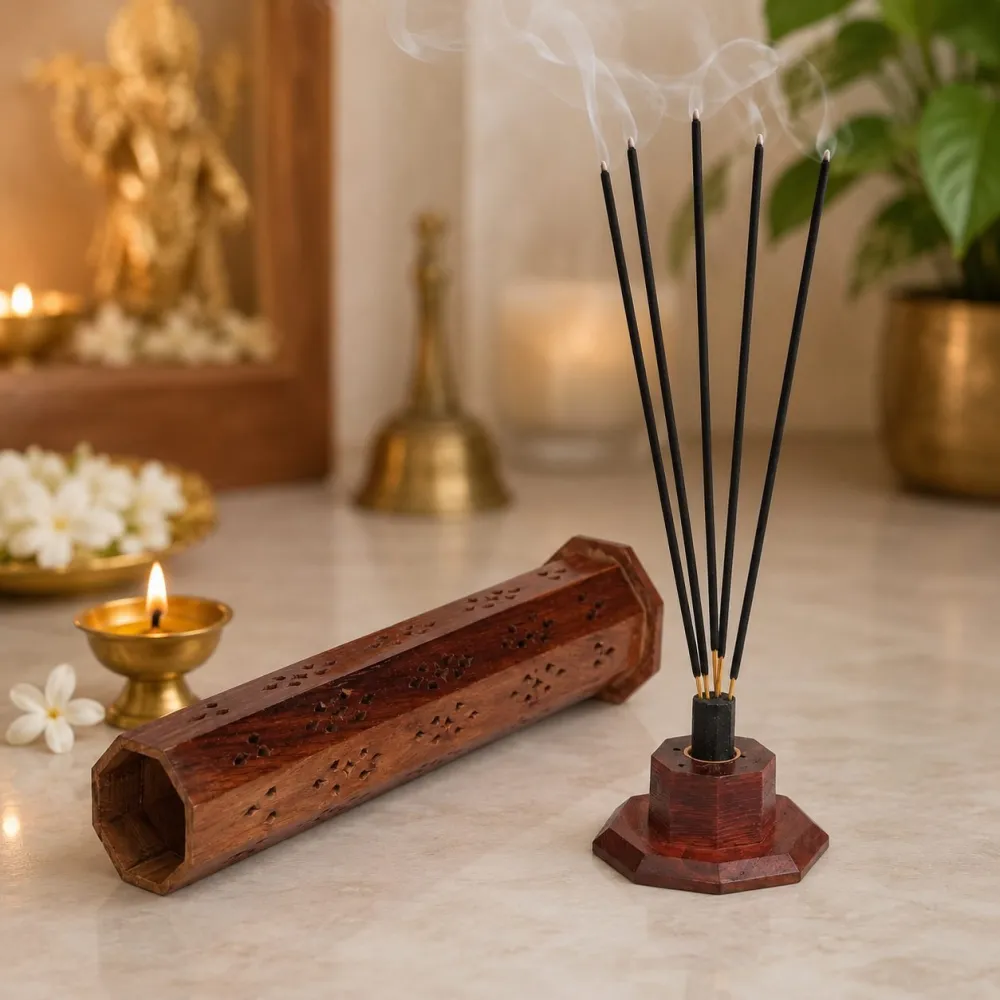
A tower-shaped incense holder places a burning incense stick inside a tall decorative shell. Horizontal enclosed holders use the same basic idea in a box or pipe shape. Patterned openings allow smoke to leave, while the base collects ash. These products can look more organised than an exposed stick, but they require careful attention to internal clearance, ventilation, stability and cleaning.
An enclosed appearance does not make incense smoke-free, child-safe or suitable for unattended burning. The holder still contains a hot ember and releases smoke into the room. This guide explains how to choose and use the format correctly.
Quick answer
Choose a tower with a broad level base, a clearly defined stick mount, enough internal height and ventilation openings that remain clear. Choose a horizontal box only when the stick fits without touching the lid. In both cases, confirm how the ash chamber opens before buying.
Tower versus horizontal enclosed holder
| Feature | Tower holder | Horizontal box or pipe |
|---|---|---|
| Space use | Small horizontal footprint, greater height | Greater shelf length, lower height |
| Stick position | Usually vertical inside shell | Usually horizontal or gently angled |
| Stability concern | Tipping from narrow or uneven base | Lid fit and rolling or rocking |
| Cleaning | Ash in removable base or bottom chamber | Ash along long internal tray |
| Best fit | Open-height pooja shelf or table | Wide shelf with limited height |
See a current enclosed tower holder
Confirm overall height, internal clearance, ventilation openings, supported stick length and cleaning access on the live listing:
Seller disclosure: DigiRake Store Private Limited sells the products linked above. Prices and stock can change; verify the live listing before ordering.
How a tower incense holder works
The incense stick is normally attached to a support in the base, then the tower shell is placed around it. In another design, the stick may enter from the top. These methods are not interchangeable. Follow the product instructions so the burning section stays away from the wall and decorative cut-outs.
As the incense burns, smoke exits through patterned holes and ash falls into the base. The openings do not filter smoke. If the internal stick leans against the tower, extinguish it and correct the setup after cooling.
Check internal height and stick length
Product height is not the same as usable stick clearance. The base thickness, top cap and internal mount reduce the available space. Compare the supported stick length on the live listing. Do not bend, cut or force a stick to fit unless the incense manufacturer permits it.
A stick that is too tall can touch the top, while a stick mounted too low may create concentrated soot around the base openings. Test with an unlit stick before the first burn and inspect the gap on all sides.
Base stability
A tower raises the centre of mass, so the base matters more than visual height. Set the empty holder on a flat table and lightly touch it from several directions. It should not rock. Inspect detachable bases, threads, grooves or magnets to ensure the pieces seat correctly.
Do not place a tower near the edge of a shelf or in a walkway. Keep cords, garments and garlands away. If the product is very light, strong airflow can still affect it even when the base appears level.
Ventilation and patterned openings
Decorative holes release smoke and provide airflow. They should not be blocked with cloth, paper, foil or decorative additions. Soot may collect around frequently used openings; clean it gently after the holder cools.
Do not assume that more holes make a product safer or that fewer holes create longer fragrance. The design should be used as supplied. If the stick repeatedly goes out, check that you are following the intended setup rather than modifying the tower.
Horizontal wooden box and pipe holders
A horizontal holder can use a hinged lid, sliding top or two-piece shell. The stick may sit inside a long chamber, with smoke leaving through cut-outs. Check the internal tray length, hinge movement and whether the stick support remains aligned when the lid closes.
Some products include storage for unlit sticks. The storage compartment should be separate from the burning chamber. Never keep loose incense beside hot ash merely because the outer box appears large enough.
Incense lantern designs
A lantern-style holder may use a door, lid or removable panel and patterned sides. It can create a strong decorative effect but has more joints and surfaces to clean. Verify how the stick or cone is supported; “lantern” describes appearance, not universal compatibility.
Are enclosed holders safer than open trays?
An enclosure can shield the ember from a casual sideways touch and contain more ash, but it introduces other checks. The stick can contact the interior, heat can build around the base and residue can be difficult to see. The outer shell may also become warm. It is therefore not accurate to call every enclosed holder safer.
Choose according to correct use, construction and placement. Open trays make the ember visible; enclosed holders make the setup more decorative and may control ash. Both require supervision and ventilation.
Can towers burn cones or dhoop?
Only a tower or lantern explicitly designed with a cone or dhoop platform should be used. A vertical stick tower is not a backflow holder and does not automatically support cones. Concentrated cone heat can damage a base intended only to catch cool ash.
For dhoop and cones, read the dhoop, cone and sambrani holder guide. For waterfall effects, use the backflow incense-holder guide.
Cleaning a wooden tower
- Extinguish the incense and wait until the entire holder is cool.
- Remove the tower shell from the base as instructed.
- Empty loose ash without shaking it through decorative holes.
- Use a soft brush for the interior and cut-outs.
- Wipe wood with a dry or barely damp cloth appropriate to the finish.
- Clean detachable metal parts separately when permitted.
- Dry every component before reassembly.
Do not soak the tower or insert a wet cloth into narrow cut-outs. Moisture can remain inside and affect the finish. Avoid sharp tools that can scratch or enlarge openings.
Cleaning a horizontal box
Open the lid carefully after cooling and brush ash from the internal tray toward a bin. Support the hinge rather than forcing it backward. Clear ventilation holes with a soft brush or dry cotton swab. If the product contains a storage compartment, wipe it separately and keep it free of ash.
Soot and residue
Dark marks near openings can result from smoke deposition. Frequent heavy buildup may indicate that the stick is too close to the wall or airflow is poor. Do not cover stains with combustible paper or fabric. Clean gently and recheck the setup with an unlit stick.
Placement guide
- Allow vertical clearance above a tower.
- Keep all sides away from fabric and paper.
- Use a stable level surface.
- Avoid shelf edges and busy walkways.
- Reduce strong fan airflow.
- Keep children and pets away.
- Do not place another item over the smoke openings.
- Do not leave incense burning unattended.
Choosing a tower for a gift
Towers offer stronger presentation than a flat plate and can suit a premium family or housewarming gift. They also occupy more carton space and contain detachable components. For a bulk order, confirm the exact SKU, height, individual packing, carton quantity and delivered quotation. Inspect samples from multiple cartons after delivery.
Read the incense-holder return-gift and bulk buying guide.
Buying checklist
- Measure shelf height and width.
- Confirm the supported stick length.
- Check the internal mounting method.
- Test base stability with the holder empty.
- Inspect ventilation cut-outs and lid fit.
- Confirm how ash is removed.
- Verify whether the holder is stick-only.
- Review material and care instructions.
If an enclosed tower is unnecessary, compare simpler open formats in the agarbatti stand and incense-stick holder guide.
Frequently asked questions
Does a tower incense holder contain all ash?
It may contain much of the ash, but performance depends on stick alignment, internal design and airflow. Clean the base regularly.
Can the tower be used with the top closed?
Use the product exactly as instructed. Do not close or cover openings that are intended to remain open.
Why does my stick touch the side?
The stick may be too long, bent or mounted incorrectly. Extinguish it and check compatibility after cooling.
Can a wooden tower catch fire?
Any combustible material can be damaged by direct ember contact or misuse. Keep the stick on the intended support, inspect the holder and never leave it unattended.
Is a tower suitable for a small pooja shelf?
Only when there is adequate height, side clearance and a stable base. A plate or low tray may fit better in a compact shelf.
How often should it be cleaned?
Remove loose ash after each cooled use and perform deeper cleaning when soot or residue becomes visible.
Final recommendation
A tower or enclosed holder should be chosen by internal clearance, base stability, ventilation and cleaning access. Decorative height is valuable only when the stick remains correctly supported. Use the current DigiRake Retail listings above to verify specifications and availability before ordering.