


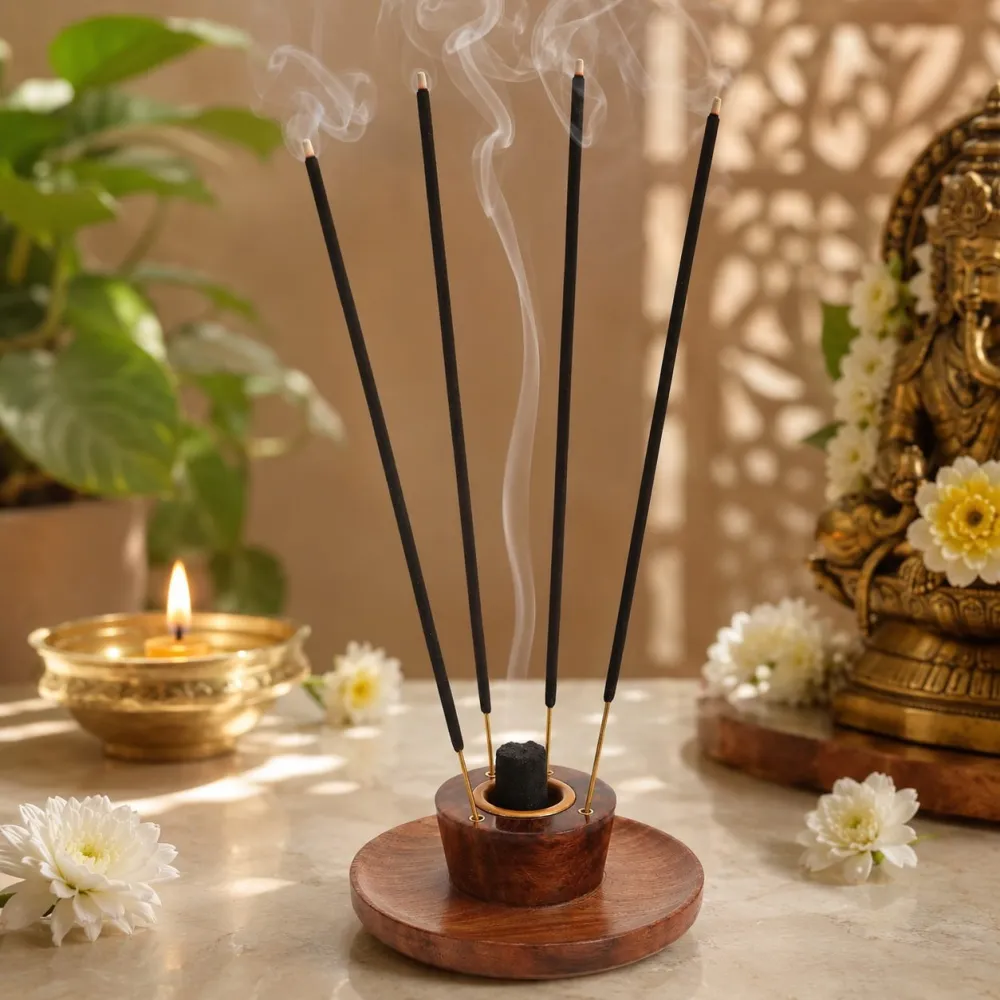
To use a dhoop stick safely, place it upright or at the angle specified by the manufacturer in a stable, compatible holder; light the tip; extinguish the open flame as directed; and let it smoulder only in a ventilated area under continuous supervision.
Dhoop sticks are often thicker than bamboo-core agarbatti and may produce more heat or ash. The exact lighting method and holder depend on the product, so use this guide alongside the instructions on your pack.
What is a dhoop stick?
A dhoop stick is a solid combustible incense form, commonly made without the bamboo core found in many agarbatti sticks. Its ingredients can include wood or plant powder, fragrance, binders, resins and other materials. Formulas are not standardised.
Some dhoop products are flexible or thick, while others resemble short rigid sticks. Do not assume every item called dhoop fits the same hole or burns for the same duration.
Dhoop stick versus agarbatti
| Feature | Dhoop stick | Common agarbatti stick |
|---|---|---|
| Core | Often coreless | Often formed around bamboo |
| Typical thickness | Can be thicker and shorter | Usually slender and long |
| Holder | May need a wider hole, clamp, cup or sand-filled support | Usually uses a narrow stick hole |
| Ash | Can fall in larger or less predictable pieces | Often follows the bamboo core |
| Instructions | Product-specific | Product-specific |
A holder that securely supports agarbatti may not hold a thicker coreless dhoop stick. Test the cold, unlit stick first.
Choose a compatible dhoop stand
The holder must support the complete stick without leaning or falling as it burns. Check the dhoop diameter against the holder opening and confirm the intended angle. The ash-catching area should extend under the full burn path.
For a cup or enclosed holder, verify that ventilation openings remain unobstructed and the interior height provides adequate clearance. Wood on the exterior does not prove the internal contact surface is safe for direct heat. Look for a metal, ceramic or otherwise specified heat-contact insert and explicit use instructions.
The dhoop, cone and sambrani holder guide compares the common formats.
Prepare the room and surface
- Open a window or otherwise provide appropriate ventilation.
- Set the holder on a level, non-combustible, heat-resistant surface.
- Move paper, cloth, flowers, oils, packaging and electrical cords away.
- Keep the setup beyond the reach of children and pets.
- Make sure you can remain present until the dhoop is fully extinguished.
Do not use a shelf with little overhead clearance. Rising heat and smoke can mark or damage the surface above.
How to light a dhoop stick
- Read the pack and inspect the stick for cracks or damage.
- Fit the unlit stick in the holder and confirm that it remains stable.
- Remove it only if the instructions require hand-lighting.
- Apply a flame to the specified end for the stated time.
- Extinguish the open flame according to the instructions, leaving a glowing smoulder rather than a continuing flame.
- Place it securely in the holder without touching the hot end.
Do not wave a burning stick near clothing or blow forcefully enough to scatter embers. If the product will not smoulder normally, extinguish it safely and check the instructions instead of repeatedly adding flame.
Smoke and ventilation
All burning incense creates combustion products. The US Environmental Protection Agency lists incense as a source of indoor particulate matter and recommends proper ventilation when it is burned. See the EPA indoor particulate-matter guidance.
Use the minimum amount needed and do not inhale smoke directly. Stop if anyone experiences coughing, wheezing, eye irritation, headache, breathlessness or another symptom. Avoid use around people whose asthma or other condition is triggered by smoke or fragrance; seek medical advice when appropriate.
Incense fragrance can mask odours, but burning dhoop does not purify indoor air.
How many dhoop sticks should be burned?
There is no universal number for safety or ritual use. Follow the product directions and the household’s religious practice. From an indoor-air perspective, more burning material generally means more smoke, so avoid burning multiple sticks simply to intensify fragrance.
One properly supported stick in a ventilated space is easier to supervise than several sources of hot ash.
How to stop a dhoop stick
Use the extinguishing method specified by the manufacturer. A purpose-made snuffer or container of clean sand may be appropriate for some solid incense, but water can create hot splatter, damage a holder or make residue difficult to remove. Do not improvise if the instructions prescribe a method.
After visible smoke ends, treat the stick, ash and holder as hot. Leave everything undisturbed on the heat-resistant surface until completely cool. Check for a remaining ember before disposal.
Cleaning the holder
Wait until every component is cold. Remove loose ash gently so it does not become airborne. Follow the material-specific care instructions: a removable metal cup may have a different cleaning method from a wooden body.
Do not soak wood or use abrasive cleaner on plating. Keep ventilation holes and stick openings clear, and stop using a holder that is cracked, charred, unstable or missing its heat-resistant insert.
Dhoop, sambrani and loban
Dhoop is a broad category, while sambrani and loban are resin-associated terms whose use can overlap across regions and product labels. A dhoop stick sold with a sambrani fragrance is still used according to its stick instructions; loose resin requires a different setup.
See what sambrani dhoop means for a comparison of resin, powder, stick, cone and cup formats.
Frequently asked questions
Can dhoop sticks go in a normal incense holder?
Only if the holder securely fits that stick’s diameter and safely catches its ash and heat. Test compatibility while everything is cold.
Why does my dhoop stick keep going out?
Possible reasons include moisture, insufficient initial lighting or restricted airflow. Follow the product instructions; do not add flammable liquid or repeatedly hold it over a flame.
Can I leave dhoop burning when I leave the room?
No. Burning or smouldering incense should remain under continuous adult supervision.
Is dhoop smoke safe for babies or pets?
Smoke and fragrance can irritate people and animals, and they may be more vulnerable to exposure. The cautious choice is to avoid exposing them and obtain professional health or veterinary guidance where needed.
Can I reuse partly burned dhoop?
Only if the manufacturer allows it and the remaining piece is dry, intact and can be securely held. Confirm it is completely extinguished and cold before storage.
Final safety checklist
- Product instructions read before lighting
- Cold stick tested in a compatible holder
- Stable, non-combustible, heat-resistant surface used
- Ventilation provided
- Children, pets and flammable items kept away
- Burning stick supervised continuously
- Smoke never inhaled directly
- Ash and holder left to cool before cleaning
Safe dhoop-stick use begins with matching the stick to its holder. Control heat and ash, ventilate the room, supervise the smoulder and treat every component as hot until it has fully cooled.