


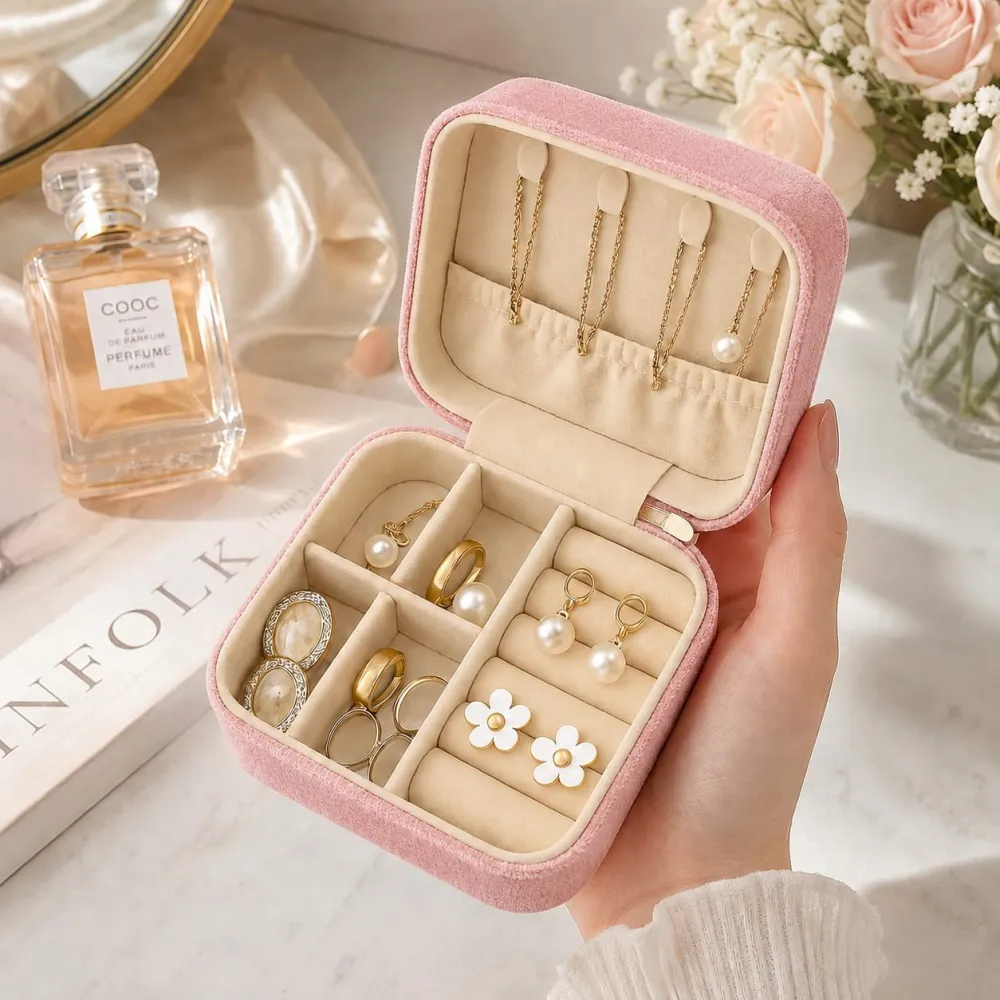
A small jewellery box is useful when you want to organise a limited daily collection, pack selected pieces for a trip or give a compact storage gift. Its value comes from using a small space well—not from trying to hold every necklace, bangle and occasion set you own.
Quick answer
For rings, studs, small earrings, pendants and a few fine chains, choose a mini box with separated sections, ring rolls or necklace hooks and a closure suited to how it will be used. Compare the external and usable internal dimensions with your jewellery. Most mini boxes are not suitable for wide bangles, tall jhumkas or bulky bridal sets.
What counts as a small or mini jewellery box?
There is no universal size standard for the words “small”, “mini” or “compact”. One seller may use mini for a palm-sized travel case, while another may use it for a small wooden box intended for a dressing table. Treat those words as descriptions, not measurements.
External dimensions include the lid, walls, hinges and outer covering. The usable interior will be smaller. Before ordering, compare the listed dimensions with the largest item you plan to store and allow enough room for your fingers to lift it out.
| Small-box style | Often suits | Main checks |
|---|---|---|
| Mini square organiser | Rings, studs, small earrings, pendants and selected chains | Internal layout, hooks, ring rolls, zip and lid clearance |
| 4×3-inch wooden box | A compact group of small daily items | Usable interior, depth, lining and latch |
| 6×4-inch wooden box | A somewhat larger mixed collection | Whether the open interior matches the jewellery mix |
| Travel jewellery case | A planned trip selection | Closure, movement control and chain separation |
What can fit in a small jewellery box?
Rings and stud earrings
Ring rolls or cushioned slots make good use of compact space. Check that thicker bands fit without forcing the slot and that earring posts do not press into the lid. Keep earring backs attached where practical or put spares in a tiny closed compartment.
Small hoops and drop earrings
Measure hoop diameter and total drop length. A box that works for studs may be too shallow for jhumkas or too narrow for hoops. Delicate drops need separation so hooks, chains and stones do not catch one another.
Pendants and fine chains
Necklace hooks can help, but only if there is enough drop length and a place to secure the loose chain. A miniature case may fit a short fine chain folded carefully; it is unlikely to suit several long or heavy necklaces. Use separate soft pouches when the layout does not keep chains apart.
Bangles, watches and bridal sets
Most genuinely mini boxes are the wrong shape for rigid bangles, watches and layered bridal jewellery. Do not rely on a close-up photograph. Measure the inner diameter and thickness of bangles, and choose a larger organiser when pieces would need to be stacked or compressed.
How to choose the right internal layout
List the exact pieces the box needs to hold. A compact layout with ring rolls, two or three necklace hooks and divided cells may suit a mixed set of small jewellery. An open wooden interior may be more flexible for a few larger objects, but it gives less built-in separation.
Look for these practical features:
- Ring rolls: useful for rings and some small stud pairs.
- Necklace hooks: helpful only when the chain can hang or fold without tangling.
- Dividers: reduce contact between earrings, pendants and small accessories.
- Soft lining: reduces direct rubbing against a hard base, but does not guarantee scratch prevention for every material.
- Lid clearance: prevents tall pieces from being pressed when the box closes.
- Closure: a zip or latch helps prevent accidental opening, but is not the same as theft-resistant security.
Compare current small jewellery boxes
Check each live listing for the latest dimensions, layout, material, colour, price, stock and delivery details. The compact square listings are described as 10×10×5 cm externally; usable internal space will be smaller.
- Baby-pink velvet mini square jewellery box ↗
- Green velvet mini square jewellery box ↗
- Light-teal rexine mini square jewellery box ↗
- 4×3-inch wooden jewellery box ↗
Seller disclosure: DigiRake Store Private Limited sells the products linked above. Prices and stock can change; verify the live listing before ordering.
Small home box or travel jewellery box?
A compact box is not automatically travel-ready. A home box mainly needs a sensible layout and a stable place on a shelf or dressing table. A travel case also needs a reliable closure and a layout that limits movement when the case changes orientation.
For travel, pack only the pieces you expect to wear. Fasten fine chains, attach earring backs and avoid placing hard or heavy items over delicate pieces. Put the organiser inside hand luggage where appropriate and follow airline, customs and security requirements. A case helps organise jewellery; it does not insure valuables or replace secure storage. See the full travel jewellery box guide before packing.
Rexine, velvet or wood?
Rexine-covered mini cases are typically easy to wipe externally and often use a zip, while velvet-covered cases offer a soft-looking finish that may hold surface dust. Wooden boxes are more rigid and work well as small dressing-table organisers, but their weight and undivided space may make them less convenient for some trips.
Material labels alone do not establish durability or jewellery compatibility. Examine the construction, lining, seams, hinge or zip, and follow the seller’s care directions. Our velvet, rexine and wooden jewellery-box comparison explains the trade-offs in more detail.
How to measure before buying
- Lay out only the jewellery the box must hold.
- Measure the longest, widest and tallest pieces.
- Note rigid shapes, including hoops and bangles, that cannot be folded.
- Measure the drawer, shelf, handbag or luggage space intended for the box.
- Compare those figures with the listing’s external and internal dimensions.
- Leave some free space so items can be removed without pulling against neighbouring pieces.
If you are deciding between several formats, use our jewellery-box size guide.
How to organise a mini jewellery box
Give the limited space a single purpose. One box might hold a weekly rotation; another might hold rings and small earrings only. Place frequently used pieces where they are visible. Keep chains on separate hooks or in individual pouches, and avoid putting loose earring backs into an open shared compartment.
Do not overfill the organiser. If the lid needs pressure to close, remove items and move them to a larger box. Separate broken jewellery and pieces awaiting repair so they do not snag other items. For a complete sorting method, read how to organise a jewellery box.
Cleaning and care
- Remove every item before cleaning the box.
- Use a clean, soft brush to lift dust from fabric lining.
- Follow the listing or maker’s directions for the outer material.
- Do not soak lined boxes or apply jewellery-cleaning liquid directly to them.
- Allow the box and jewellery to dry fully before storage.
- Check zips, latches, hooks and seams periodically.
Common mistakes to avoid
- Judging capacity from enlarged product photography.
- Confusing external dimensions with usable internal space.
- Buying a ring-and-stud layout for large jhumkas or bangles.
- Assuming a zip or decorative latch makes the box a safe.
- Using “mini” as proof that a product is child-safe.
- Overfilling the box until the lid presses the jewellery.
- Assuming ordinary lining completely prevents tarnish or scratches.
Is a small jewellery box a good gift?
It can be a useful gift for someone with a compact daily collection, a traveller or a person who wants a second organiser for selected pieces. Choose a neutral layout when you do not know the recipient’s exact collection, and avoid promising that a miniature case will hold bridal sets or a large assortment. Our jewellery-box gift guide covers recipient and presentation checks.
If the collection may need more than a compact case, compare earring, wooden and family formats in the jewellery-box-for-women guide.
Frequently asked questions
What size is a mini jewellery box?
There is no fixed standard. Always use the listing’s stated measurements. Even boxes with the same outer dimensions can have different usable interiors because of walls, padding and dividers.
Can a small jewellery box hold necklaces?
It may hold a few fine or short necklaces if it has hooks and enough space to secure the remaining chain. Long, heavy or multiple necklaces generally need a larger, purpose-designed layout.
Is a small jewellery box suitable for bangles?
Only when the usable width and depth exceed the bangle’s outer measurements. Many mini square cases are designed primarily for rings, earrings, pendants and fine chains.
Can a small box protect gold jewellery?
It can organise pieces and reduce casual dust and handling, but an ordinary jewellery box is not a safe, insurance policy or guaranteed anti-tarnish system. Use appropriate secure storage for high-value items.
Should I choose a soft case or wooden box?
Choose by use and layout. A zipped compact case can be convenient for a selected set; a rigid wooden box can suit a stable dressing-table position. Verify construction and dimensions in either case.
Final recommendation
Choose a small jewellery box only after defining its job. Measure the intended jewellery, inspect the internal layout and closure, leave spare space and confirm the live specification. When the box fits the collection—not merely the product photograph—it becomes a genuinely useful organiser.