


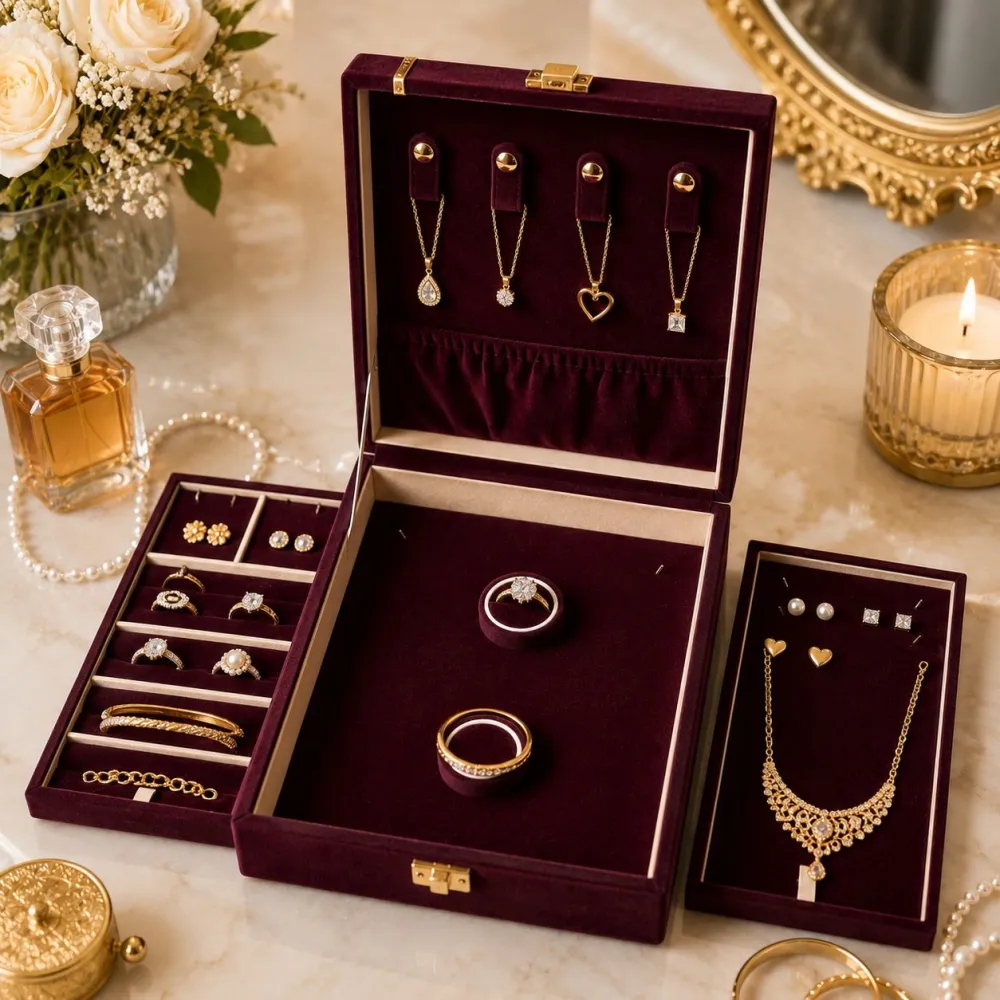
A jewellery box works best when its compartments match the jewellery you actually own. Before choosing one, count your rings, earrings, chains, necklaces and bangles; measure the bulkiest pieces; and check the shelf, drawer or locker where the organiser will stay. That simple inventory is more reliable than choosing by colour or outside dimensions alone.
Quick answer
For a few daily pieces, choose a compact jewellery organiser box with ring rolls, hooks and divided sections. A mixed collection usually needs a medium box or several category-specific organisers. Large, shared or bridal collections benefit from a family-size box plus separate storage for earrings, necklaces or bangles. Leave spare room so pieces can be lifted without rubbing or tangling.
Jewellery box selection at a glance
| Collection or use | Useful format | Check before buying |
|---|---|---|
| A few daily pieces | Mini or compact organiser | Ring rolls, hooks and lid clearance |
| Small mixed collection | 6 × 4 inch box | Usable depth and compartment mix |
| Growing mixed collection | 8 × 5 or 10 × 6 inch box | Largest pieces and shelf footprint |
| Many earrings | Dedicated earring box | Pair capacity and depth for jhumkas |
| Large or shared collection | Family jewellery box | Tray layout, access and placement |
| Travel selection | Compact closed case | Movement control and secure closure |
| High-value pieces | Organiser inside secure storage | Safe or locker dimensions |
What is a jewellery organiser box?
“Jewellery box,” “jewellery organiser” and the American spelling “jewelry organizer” often describe the same broad product category. A box refers to the container; an organiser emphasizes its internal system of rolls, hooks, trays, slots and open compartments. The useful distinction is not the label—it is whether the inside keeps different pieces separated and easy to retrieve.
A decorative empty box can hold loose accessories, but it may not organise chains or protect delicate surfaces from contact. Conversely, a slim earring organiser can be extremely efficient even though it stores only one category. Choose for the collection rather than assuming that more compartments always mean more usable capacity.
How to choose the right jewellery box
- Sort before counting: group rings, studs, jhumkas, hoops, chains, necklaces, bangles, watches and large sets.
- Measure the awkward pieces: record the widest bangle, tallest earring and largest rigid necklace component.
- Check the storage location: measure the available width, depth and height in the wardrobe, drawer, safe or bank locker.
- Match the insert: rings need cushioned rolls, chains need separation or hooks, and larger pieces need open space with lid clearance.
- Allow room to grow: an organiser packed to its limit becomes hard to use and can press pieces together.
- Verify the live listing: check current dimensions, material, colour, configuration, price, stock and delivery before ordering.
Choose the size by usable capacity
Product dimensions usually describe the outside. Walls, hinges, borders, trays and lining reduce the space inside, so two boxes with similar external measurements can hold very different collections. Compare the internal layout and depth wherever those details are available.
Compact and travel-size organisers
A compact jewellery box is useful for daily essentials, a handbag or a short trip. Look for a closure that stays shut and an interior that limits movement. Necklace hooks and ring rolls can make a small case more efficient, but bulky bangles and large bridal pieces may not fit. For trip-specific checks, use the travel jewellery box guide; for everyday small formats, see the small and mini jewellery box guide.
Medium wooden boxes
Sizes such as 6 × 4, 8 × 5 and 10 × 6 inches can suit mixed collections, keepsakes or small accessories, but size alone does not guarantee jewellery-specific compartments. A rigid wooden body is useful on a dressing table or shelf. If you are comparing nearby sizes, read the 6 × 4 vs 8 × 5 comparison and the broader wooden jewellery box guide.
Large and family jewellery boxes
A family box can consolidate a mixed or shared collection into trays. Removable trays improve access, but they also require a clear surface when opened. Check whether the box will remain on a dressing table, enter a wardrobe shelf or fit inside secure storage. A combination lock adds privacy and casual-access control; it does not make a portable box theft-resistant. See the large jewellery box guide and lockable jewellery box guide for those decisions.
Match compartments to each jewellery type
Rings and stud earrings
Cushioned rolls keep rings upright and visible. Check spacing if rings have broad bands or raised settings. Stud earrings can sometimes share ring rolls, but dedicated paired positions make matching faster and reduce the chance of losing a backing.
Hoops, jhumkas and larger earrings
An earring board or shallow slot system is efficient for studs and smaller hoops. Jhumkas and statement earrings need more depth and room between pairs. A box advertised by pair count may hold fewer bulky earrings than studs, so capacity numbers should be treated as a layout guide, not a universal guarantee. The earring box guide explains the trade-offs.
Chains and necklaces
Chains tangle when several pieces share one open compartment. Hooks, individual channels or separate pouches reduce contact and movement. Allow enough drop below hooks and avoid forcing pendants under a low lid. For long chains and sets, follow the necklace storage method.
Bangles and bracelets
Measure the widest rigid bangle rather than only counting pieces. A padded roll or rod keeps bangles grouped, while a broad open compartment can suit mixed shapes if pieces are separated. Do not assume a medium rectangular box will accept a full bangle stack; verify internal width and access.
Bridal and heavy sets
Large necklaces, waist belts and layered sets often need wide, flat support. One oversized box may still be less practical than a family organiser plus specialist cases. Photograph the arranged set or keep a simple inventory so every component is returned after use. The bridal jewellery box guide covers this category in detail.
Compare jewellery-box materials
| Material or finish | Strength | Care consideration |
|---|---|---|
| Wood | Rigid, durable body and furniture-like appearance | Keep dry; dust gently; protect finish from harsh cleaners |
| Velvet exterior or lining | Soft presentation and cushioned contact | Attracts lint and dust; avoid soaking |
| Rexine exterior | Wipeable surface and structured appearance | Avoid heat, prolonged dampness and strong solvents |
| Plastic | Lightweight and sometimes transparent | Hard surfaces may need soft separators |
Evaluate the body, outer covering, lining, inserts, hinges and closure separately. A wooden body can have a fabric lining; a velvet-covered box may rely on a different internal structure. The jewellery-box materials comparison provides a closer breakdown.
Does a jewellery box prevent tarnish?
Not automatically. A closed organiser can reduce dust, handling and rubbing, but tarnish also depends on humidity, air exposure, residue, metal composition, plating and nearby materials. Store jewellery clean and dry. Keep wet pieces, perfume, cosmetics and household chemicals away from the box. Use anti-tarnish products only when they are compatible with the specific metal, plating and stones. Read the tarnish-prevention guide for realistic expectations.
Jewellery boxes to compare by collection size
The examples below represent different current formats in the DigiRake retail catalogue. They are comparison starting points, not a claim that one box fits every collection.
Shop current jewellery-box formats
- Compact velvet mini-square jewellery box — ring rolls, necklace hooks and divided storage for a selected collection.
- Teal earring box — dedicated positions listed for up to 24 pairs; confirm suitability for bulky earrings.
- Wooden jewellery box, 6 × 4 inch — compact wooden storage for jewellery and small essentials.
- Wooden jewellery box, 8 × 5 inch — a larger wooden footprint for a mixed collection.
- Wooden jewellery box, 10 × 6 inch — the largest of these three wooden size options.
- Family jewellery box, velvet maroon — a 12 × 8 inch, four-tray format with a resettable lock.
Seller disclosure: DigiRake Store Private Limited sells the products linked above. Prices, stock, colours and listing details can change; verify the live product page before ordering.
Online buying checklist
- Confirm whether dimensions are external or internal.
- Inspect every product image for tray layout, hooks, rolls and usable depth.
- Check which accessories or removable trays are actually included.
- Verify the closure type and use a safe or locker for genuine security.
- Read the material description for the body, exterior and lining.
- Review the current return, delivery and damage-reporting terms.
- Compare delivered price and capacity, not just the discount percentage.
How to organise and maintain the box
Assign each compartment one job and return pieces to the same place. Keep chains separate, pair earrings immediately and avoid stacking hard pieces directly on delicate finishes. Leave the lid open briefly only when the jewellery and room are dry; otherwise store the closed box away from bathrooms, windows and direct sunlight.
For cleaning, empty the box and follow the care requirements of each surface. Use a soft brush or low-suction method for dusty fabric, a barely damp suitable cloth for wipeable surfaces, and a dry or product-appropriate cloth for finished wood. Never saturate the lining. Let every part dry completely before replacing jewellery. See how to clean a jewellery box and how to organise one.
Common buying mistakes
- Choosing by exterior colour without checking the inside.
- Treating external dimensions as usable capacity.
- Buying one compact case for bulky Indian jewellery.
- Assuming a small lock replaces a safe.
- Expecting any ordinary box to prevent tarnish by itself.
- Overfilling trays until pieces touch the lid.
- Ignoring the space needed to remove or stack trays.
Frequently asked questions
Which jewellery box is best?
The best jewellery box has compartments sized for your actual pieces, fits its intended storage location and leaves spare capacity. There is no single best layout for every collection.
What is the difference between a jewellery box and a jewellery organiser?
The terms overlap. “Box” describes the container, while “organiser” emphasizes divided storage such as hooks, slots, rolls and trays.
What size jewellery organiser box should I buy?
Measure the largest jewellery pieces and available shelf or locker space. Compact collections may suit a mini or 6 × 4 inch format; growing collections may need 8 × 5, 10 × 6, family-size or specialist storage.
Should I buy one large box or several smaller organisers?
One large box is convenient for a balanced mixed collection. Separate earring, necklace, bangle or travel organisers can use space better when one category dominates.
Is a lockable jewellery box secure?
A small lock provides privacy and casual-access control. It does not replace an appropriate safe, bank locker or other security arrangement for valuable jewellery.
Can I keep gold, silver and artificial jewellery together?
They can share an organiser if pieces are clean, dry and individually separated, but material-specific care still applies. Avoid direct contact, trapped moisture and chemical residue.
Can a jewellery box be used as a gift?
Yes. Choose according to the recipient’s collection rather than appearance alone, and verify the product dimensions, packing, availability and delivery date before buying.
Final recommendation
Start with a five-minute inventory. Match each jewellery category to the right compartment, measure both the largest pieces and the storage location, then compare current listings. A thoughtfully sized jewellery organiser box is easier to maintain than an oversized box with the wrong layout.