


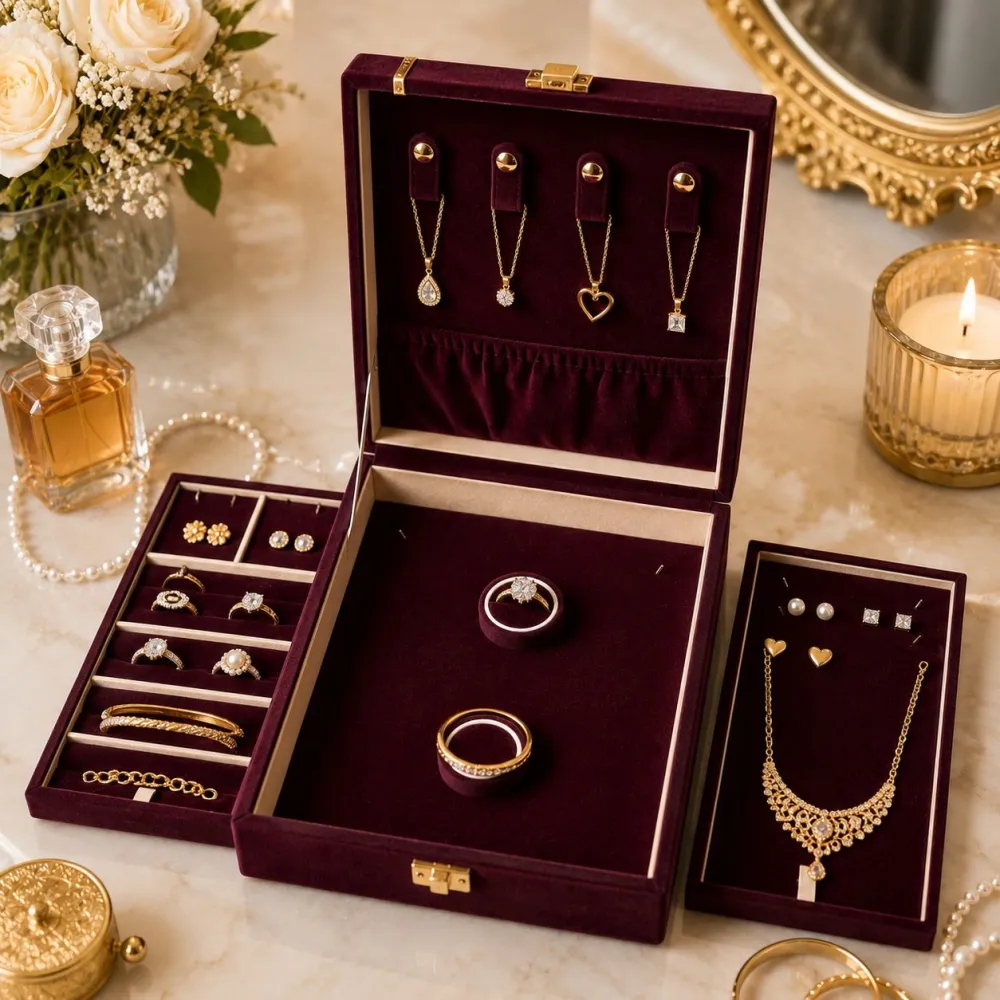
A jewellery box with a lock can keep a lid closed, provide privacy and discourage casual access. It should not be confused with a safe. Most jewellery organisers are portable, and their small key, button or combination mechanisms are not designed to resist determined theft, fire or flooding.
Quick answer
Choose a key lock for simple familiar operation, a resettable combination when you do not want to manage a key, a button latch for convenient closure, or a zip for a compact travel case. Verify the exact mechanism, instructions, alignment and backup plan before storing jewellery. Use an appropriate safe, locker and insurance arrangement for high-value items.
Lock and closure types compared
| Closure type | Practical advantage | Main limitation |
|---|---|---|
| Key lock | Simple privacy and positive closure | Key can be lost; small lock is not safe-grade security |
| Resettable combination | No loose key to carry | Code and reset method must be managed correctly |
| Button or snap latch | Fast access and accidental-opening control | Usually offers closure, not meaningful access security |
| Decorative latch | Keeps a wooden lid aligned and shut | May have little or no locking resistance |
| Zip closure | Useful around compact cases and travel organisers | Zip strength and internal movement control vary |
What a jewellery-box lock can do
A small lock or closure can stop the lid opening accidentally during normal handling. It may provide personal privacy in a shared room and deter someone from casually opening the organiser. A fitted closure can also help keep removable trays seated.
Those benefits are useful, but they do not establish theft resistance. A portable box can be removed as a whole, and a light mechanism may be defeated or damaged. Buy the lock for its real level of convenience and privacy.
What it cannot do
- Turn a portable jewellery organiser into a burglary-resistant safe.
- Protect jewellery from fire, flooding or every form of moisture.
- Guarantee that children cannot access the contents.
- Prevent tarnish merely because the lid is locked.
- Replace valuation records, insurance or an appropriate security plan.
How to choose a key-lock jewellery box
Check that the lid meets the base evenly before the key is turned. A lock should not need pressure on an overfilled lid to engage. Inspect the keyway, latch plate and surrounding finish for rough edges. Ask whether a spare key is included and whether replacements are available.
Store any spare key away from the box, but in a place the authorised user can retrieve. Avoid hanging a heavy keychain from a small mechanism. If the key begins to bind, stop and check alignment instead of forcing it.
How to choose a combination-lock jewellery box
Read the seller’s instructions for the default code, reset procedure and recovery limitations before changing anything. Reset the code with the organiser open, then test it several times before closing jewellery inside. Keep a private record away from the box.
Do not assume every numbered closure works the same way. Some are resettable; others are preset. If a listing does not explain the mechanism, confirm it with the seller before ordering.
Compare current jewellery boxes with closures
The two 12×8-inch family organisers are listed with resettable locks; the 4×3-inch wooden box is listed with a brass-finish lock. Check each live page for the current mechanism, dimensions, instructions, price, stock and delivery details.
- 12×8-inch maroon family jewellery box with resettable lock ↗
- 12×8-inch blue family jewellery box with resettable lock ↗
- 4×3-inch wooden jewellery box with brass-finish lock ↗
Seller disclosure: DigiRake Store Private Limited sells the products linked above. A product lock is for closure and privacy; it is not represented here as safe-grade security. Prices and stock can change, so verify the live listing before ordering.
Capacity and layout still come first
A lock does not make an unsuitable layout useful. Count and measure the jewellery, then check ring rolls, necklace sections, bangle space, tray depth and lid clearance. A large lockable family box can be wasteful for a few studs, while a tiny locked box may compress jhumkas or necklace sets.
External dimensions include walls, covering and hardware. Confirm usable interior measurements whenever available. If the collection is changing, leave enough free space to lift pieces without scraping their neighbours. Use our jewellery-box size guide for the full measurement process.
Jewellery box with a lock for gold
Searches for a locked gold-jewellery box often combine two different needs: orderly storage and physical security. A lined organiser can separate chains, bangles, rings and earrings. Its small lock may provide privacy, but high-value gold requires a storage decision based on value and risk, not the decorative box label.
Consider an appropriately rated and installed safe or an eligible bank-locker arrangement where suitable, maintain records, and review insurance terms. The jewellery box can sit inside a secure location if its size fits and it can be removed without catching. Read our gold-jewellery box guide for layout and handling considerations.
Using a locked box around children
Do not rely on a small jewellery-box lock as a child-safety device. Jewellery, loose backs, keys and tiny components can present hazards, and a portable organiser can be moved or dropped. Keep it in an inaccessible location appropriate to the household and supervise children around jewellery and small parts.
Can a locked jewellery box be used for travel?
A lock may keep the lid closed, but travel suitability also depends on weight, closure strength, internal restraint and the rules that apply to the journey. A large home organiser can be awkward in luggage, while a compact zipped case may handle movement better.
Pack a limited selection, fasten chains, attach earring backs and keep items separated. Follow airline, customs, accommodation and security guidance. A locked organiser does not insure the contents. Compare the trade-offs in our travel versus family jewellery-box guide.
How to set and test a combination safely
- Remove jewellery and keep the box open.
- Read the exact model’s instructions completely.
- Set a code that is memorable to the authorised user but not obvious to others.
- Return the reset control to its normal position as instructed.
- Test locking and opening several times with the lid open or empty.
- Record the code privately away from the organiser.
- Only then add jewellery and close the box.
If instructions are missing or the mechanism behaves unexpectedly, contact the seller or manufacturer. Do not improvise a reset procedure from a different model.
Maintenance and troubleshooting
Keep jewellery from blocking the latch path and avoid overfilling trays. If the lid does not align, remove contents and inspect the tray position, hinges and closing edge. Never press the lid down and force the key or combination mechanism.
Dust external hardware with a soft dry cloth. Do not apply oil, graphite, jewellery cleaner or solvent unless the manufacturer specifically recommends it; these products can stain fabric, damage finishes or attract dirt. For a jammed or broken mechanism containing valuable items, use the seller’s support or a qualified professional rather than prying the box open.
Where to place a lockable jewellery box
Choose a dry, stable location where the box cannot fall and the lid has room to open. Avoid damp walls, direct heat and obvious public display. If it must fit inside a wardrobe, locker or safe, measure the full exterior and the clearance needed to grip and remove it.
Do not hide a spare key in or immediately beside the box. Keep an inventory or photographs of valuable contents separately and protect sensitive records. Our jewellery-box storage planning guide compares dressing tables, wardrobes and lockers.
Common mistakes
- Assuming the word “lock” means burglary resistance.
- Buying for the closure while ignoring internal dimensions.
- Changing a combination with the box shut.
- Keeping the spare key next to the organiser.
- Forcing a misaligned mechanism over an overfilled tray.
- Using lubricant without product-specific instructions.
- Relying on a small lock for child safety.
- Assuming a locked lid prevents tarnish or moisture exposure.
Frequently asked questions
Is a jewellery box with a lock secure?
It can provide privacy and casual-access control, but a typical portable jewellery box is not equivalent to a tested, installed safe. Match the security arrangement to the value and risk.
Which is better: a key or combination lock?
A key lock is simple but requires key management. A resettable combination avoids a loose key but requires careful setup and code recovery planning. Construction quality and alignment matter in both.
What should I do if the lock will not close?
Remove pressure from the lid, empty or reposition trays and check alignment. Follow the exact product instructions and do not force the mechanism.
Can I keep a locked jewellery box in a bank locker?
Only if the bank’s rules allow it and the box fits with enough clearance for safe placement and removal. Confirm the current terms directly with the bank.
Does a lock stop jewellery from tarnishing?
No. Tarnish depends on metal, finish, moisture, air and chemicals. A standard lock does not make the box airtight or anti-tarnish.
Can I repair a jewellery-box lock myself?
Simple external alignment checks may help, but avoid forcing, drilling or adding chemicals—especially with valuables inside. Use seller support or a suitable professional when the mechanism is damaged.
Final recommendation
Choose a lockable jewellery box for its real benefits: convenient closure, privacy and organised storage. Verify the exact mechanism and instructions, test it empty, and keep a backup key or code record separately. For valuable jewellery, place the organiser within a security and insurance arrangement designed for the risk.