


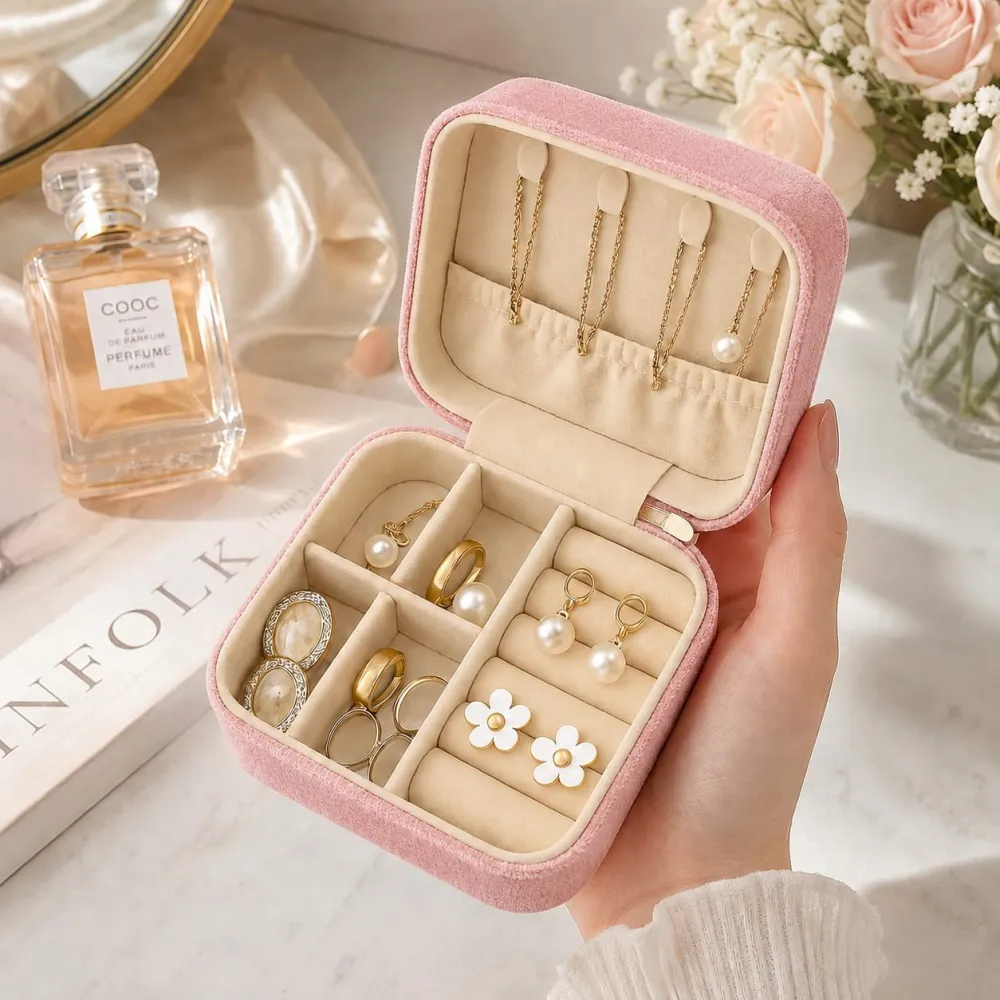
A travel jewellery box is a compact organiser for the pieces you plan to wear on a trip. The right case keeps rings, earrings and chains separated, limits movement and fits inside your chosen bag. It is an organisation tool—not a substitute for careful handling, insurance or secure storage.
Quick answer
Choose the jewellery after planning your outfits, then choose the smallest organiser that holds those pieces without crowding. Look for ring rolls, necklace hooks, divided spaces, a soft interior and a closure that stays shut. Keep bulky or high-value sets in storage designed for their size and follow current carrier and insurance requirements.
Travel jewellery organiser selection at a glance
| Trip or collection | Useful format | Main check |
|---|---|---|
| Weekend with daily pieces | Mini divided case | Ring rolls, hooks and closure |
| Mostly earrings | Slim earring organiser | Pair capacity and jhumka depth |
| Fine chains | Hooked case or separate pouches | Drop length and pendant space |
| Wedding guest | Compact case plus flat pouch | Room for one planned occasion set |
| Bridal or temple sets | Specialist wide, flat storage | No folding or lid pressure |
| Long stay | Modular small organisers | Category separation and bag space |
What makes a jewellery box suitable for travel?
A travel jewellery organiser must work while it is being carried, not only while it is open on a dressing table. Its compartments should limit movement when the case changes orientation. A compact outside shape is useful only when the inside fits the selected jewellery.
- Secure closure: a zip, button or fitted closure should remain shut during normal handling.
- Internal separation: hooks, ring rolls and dividers keep incompatible shapes apart.
- Soft contact surfaces: lining reduces rubbing, although delicate finishes may still need individual pouches.
- Useful lid clearance: raised rings, jhumkas and pendants should not be pressed when the case closes.
- Bag-compatible dimensions: measure the pocket or section where the box will travel.
- Low unnecessary bulk: avoid carrying empty capacity that displaces other essentials.
Choose the organiser by jewellery type
Rings
Cushioned rolls help keep rings upright and separate. Check whether broad bands and raised settings fit without forcing. Place only clean, dry pieces in the case and avoid pressing a tall setting against the lid.
Studs, hoops and jhumkas
Attach every earring backing before packing. Studs and smaller hoops can use paired slots efficiently; large jhumkas and statement earrings need open depth. A “24-pair” layout may hold fewer bulky pairs, so inspect the compartment dimensions and product images rather than relying only on the advertised count.
Chains and necklaces
Fasten each clasp before packing. Use separate hooks, channels or small pouches so chains do not cross. Pendants need their own space below the hook. For detailed methods, see how to store necklaces without tangling.
Bangles and bracelets
Rigid bangles often exceed the usable width of a mini organiser. Measure the widest piece and do not force it diagonally under the lid. Soft bracelets may fit an open compartment, while a larger bangle group is better in a padded roll or dedicated box.
Watches and delicate pieces
Watch faces, gemstones and polished metal can rub against nearby jewellery. Use a dedicated cushion or individual soft pouch and check the maker’s care guidance. Do not assume the lining alone prevents all scratching.
How much jewellery should you take?
Start with the itinerary rather than the home collection. Choose jewellery for each planned outfit, add one versatile backup pair of earrings if useful, and remove duplicates. This makes the case smaller, simplifies the inventory and reduces the number of pieces that need attention.
- List travel days, events and outfits.
- Assign one jewellery combination to each event.
- Reuse neutral pieces across several outfits.
- Remove items that have no planned use.
- Photograph or list what remains before packing.
Compact case, roll or pouch?
| Format | Works well for | Trade-off |
|---|---|---|
| Structured mini box | Mixed rings, earrings and short chains | Fixed shape occupies the same bag space |
| Jewellery roll | Flat packing and separated pockets | Less rigid protection from pressure |
| Individual pouches | Delicate or unusually shaped pieces | Harder to see the whole inventory |
| Earring organiser | Trips with many planned pairs | Limited use for necklaces and bangles |
| Home-size box | Long stays with substantial collections | Bulky and not necessarily movement-resistant |
If your decision is mainly about dimensions, compare the small and mini jewellery box guide. For a broader home-versus-trip decision, use the travel versus family jewellery box comparison.
How to pack a travel jewellery box
- Clean and dry each piece: do not trap moisture, perfume or cosmetics in the organiser.
- Fasten chains and bracelets: closed clasps are easier to separate and less likely to catch.
- Attach earring backs: keep each pair together before it enters a slot.
- Fill fitted sections first: use ring rolls, hooks and earring positions for their intended shapes.
- Separate delicate surfaces: add suitable soft pouches where pieces could rub.
- Check lid clearance: close the organiser gently; never force the top over raised jewellery.
- Test movement: turn the closed case gently over a soft surface and listen or feel for loose pieces.
Wedding and function travel
A mini jewellery box can hold daily pieces and smaller components for a wedding trip, but broad necklaces, waist belts and rigid bridal sets need wider flat support. Avoid folding structured jewellery merely to fit a compact case. Photograph multi-part sets before packing, keep components grouped and count them again after the function. For larger collections, read the bridal jewellery box guide.
Travel security and handling
A small case with a closure or tiny lock is not theft-resistant. Current airline, rail, hotel, customs and insurer requirements can vary, so verify the rules that apply to your journey and valuables. Keep an inventory and purchase or valuation records where appropriate. Avoid labelling the outside with its contents, and do not leave valuable jewellery unattended merely because it is organised.
Current travel-friendly formats to compare
These live DigiRake products illustrate two different travel use cases. Verify current dimensions, colour, stock, price and delivery on the product page.
Shop compact jewellery organisers
- Compact velvet mini-square jewellery box — a mixed organiser with necklace hooks, ring rolls and divided sections for selected small pieces.
- Teal earring box — a slim 31 × 20.5 × 3.5 cm case listed for up to 24 pairs; check depth for bulky styles.
Seller disclosure: DigiRake Store Private Limited sells the products linked above. Prices, stock and listing details can change; verify the live page before ordering.
After the trip
Remove every piece, compare it with the inventory and check the case for moisture, makeup or loose earring backs. Clean jewellery according to its specific care guidance. Dust or wipe the organiser only with a method suitable for its lining and exterior, let it dry completely, and return jewellery to its normal home storage. The jewellery-box cleaning guide covers common finishes.
Common travel-jewellery mistakes
- Packing the entire collection before planning outfits.
- Leaving chains unclasped in one shared compartment.
- Counting earring slots without checking their depth.
- Forcing rigid bangles or bridal pieces into a mini case.
- Packing damp jewellery or cosmetic residue.
- Assuming a zip or small lock provides genuine security.
- Using outside dimensions as proof of internal capacity.
Frequently asked questions
What should a travel jewellery box hold?
It should hold a selected set for the itinerary: planned daily pieces, small occasion jewellery and only the accessories that fit without crowding.
How do I stop necklaces tangling during travel?
Fasten clasps and keep each necklace on a separate hook, channel or suitable pouch. Do not let loose chains cross in an open compartment.
Can I put bangles in a travel jewellery organiser?
Only if the usable internal width and lid clearance fit the widest bangle. Many mini cases are designed mainly for rings, earrings and short chains.
Can a compact case hold bridal jewellery?
It may hold rings, earrings and small components. Broad, rigid or stone-heavy sets usually need wider flat support and specialist packing.
Should valuable jewellery go in checked luggage?
Follow the current requirements of the carrier, insurer and relevant authorities for your journey. A jewellery box organises pieces but does not make them secure.
Is a jewellery roll better than a box?
A roll packs flatter; a structured box resists some pressure and offers fitted sections. The better choice depends on the jewellery shapes, bag space and handling conditions.
Final recommendation
Plan the jewellery first and buy the organiser second. Choose secure separation, test the case with the actual pieces, keep bulky sets in appropriately sized storage and treat the travel jewellery box as organisation—not security.