


Seller disclosure: DigiRake Store Private Limited sells the DigiRake Retail products linked in this guide. Prices and stock can change; verify each live listing before ordering.
A jewellery box for women should be chosen by collection, available space and routine—not by a generic gender label. Someone with many earrings needs a different layout from someone who stores necklace sets, bangles, rings or only a few daily-wear pieces. A frequent traveller may need a compact zip case while a home collection may need removable trays.
This guide explains how to match capacity, compartments, material and closure to real use. It also separates organisation from security: a jewellery box can reduce clutter and rubbing, but a portable box is not a substitute for a safe or bank locker.
Quick answer
List the jewellery categories first, measure the intended drawer or shelf, then choose the layout. Pick an earring box for many pairs, a compact case for selected travel jewellery, a medium wooden box for mixed daily pieces, or a family organiser for a larger home collection. Check usable internal dimensions, lid clearance, lining, closure and tray depth before buying.
Choose by collection and lifestyle
| Primary need | Useful box direction | What to verify |
|---|---|---|
| Mixed home collection | Family box with multiple trays | Necklace, ring, earring and bangle spaces |
| Mostly earrings | Dedicated pair organiser | Slot count, cell depth and jhumka clearance |
| Daily-wear pieces | Small or medium box | Quick access and separated spaces |
| Frequent travel | Compact zip case | Hooks, ring rolls, closure and luggage fit |
| Bangles or broad bracelets | Deep open section or bangle-specific storage | Internal width, rod or roll diameter |
| Traditional wooden décor | Carved wooden box | Usable cavity, lining, hinges and moisture care |
| Valuable jewellery | Organiser used within a secure system | Safe/locker fit, documentation and security limits |
Count jewellery categories before choosing
Make a rough inventory of rings, stud earrings, hoops, long drops, jhumkas, pendants, chains, necklaces, bangles, bracelets, watches and loose accessories. Identify the categories that are difficult to store now. A box that improves the largest problem is usually more useful than one with many irrelevant compartments.
Measure the largest pieces. Long necklaces need either hooks with enough drop length or separate pouches. Tall earrings need lid clearance. Broad bangles need real internal width. A headline such as “large” or “24-slot” cannot replace usable measurements.
Compare current jewellery-box formats
These products were in stock when this guide was updated. Match the format to the collection, then confirm the current dimensions, layout, material, colour and availability.
- Family Jewellery Box Velvet Maroon — large mixed collection ↗
- Earring Box Teal — 24-pair organiser ↗
- Compact Velvet Mini Square — selected or travel pieces ↗
- Jewellery Box 6×4 Inch — medium wooden format ↗
- Jewellery Box 8×5 Inch — larger wooden format ↗
Seller disclosure: DigiRake Store Private Limited sells these products. A size or capacity label is not a guarantee that a particular jewellery collection will fit.
Small jewellery box for daily use
A small box can organise rings, studs, pendants and a few daily-wear chains without occupying much surface area. It is useful when the wearer rotates a limited selection and stores ceremonial jewellery elsewhere. Look for divisions that prevent small pieces from collecting in one pile.
“Small” is relative. Check external dimensions against the drawer or shelf, then inspect the cavity and lid clearance. Thick walls, padding and hardware reduce internal space. Our small jewellery-box guide explains compact and mini formats.
Large family jewellery box
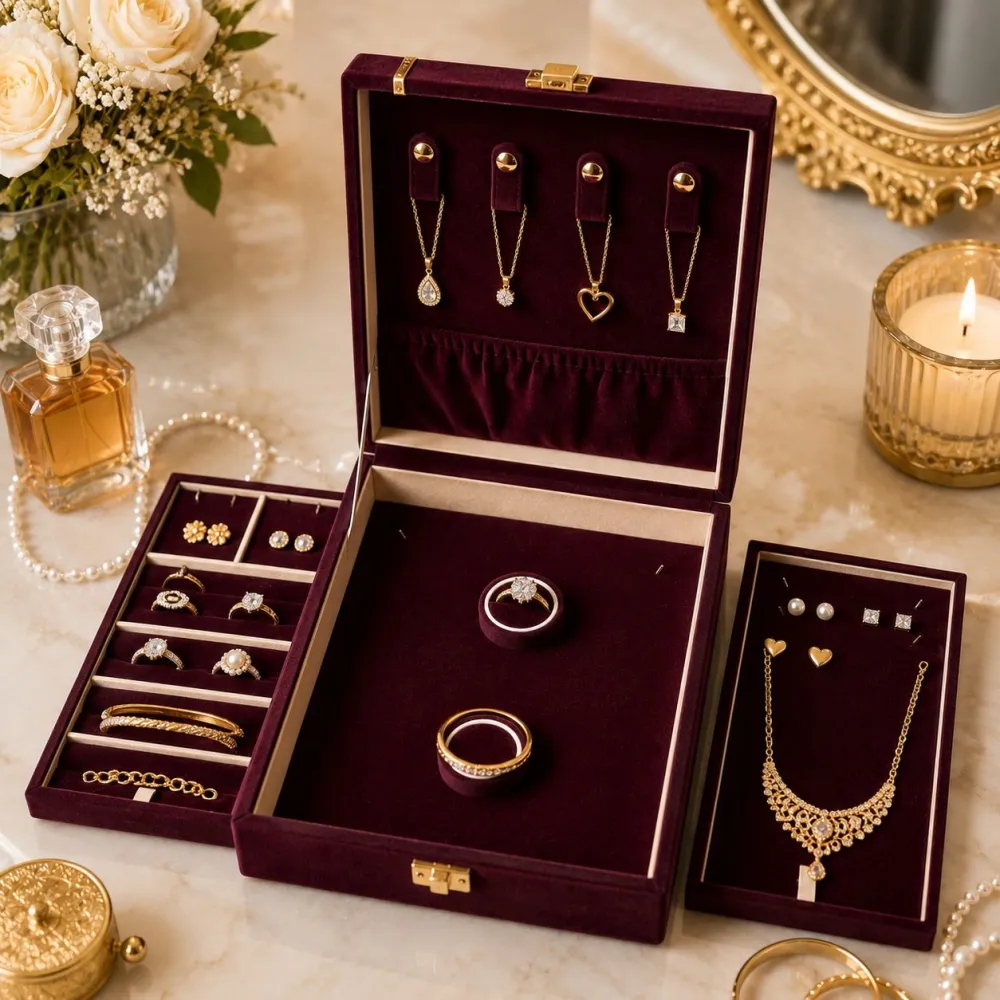
A family box uses a wider footprint and several fixed or removable trays to separate a mixed collection. It may suit necklaces, earrings, rings and bangles when the actual compartments match those items. Removable trays add flexibility but must lift without rubbing the jewellery below.
Measure the surface and vertical opening space. A broad box can fit on a shelf but become unusable if the lid hits the shelf above. Check total loaded weight if the box will be moved between a wardrobe and dressing table. See the large jewellery-box guide for tray and capacity decisions.
Earring organiser for women
A dedicated earring box gives each pair a visible position. Studs can use small paired slots, while hoops, drops and jhumkas need wider or deeper cells. The nominal pair count usually assumes efficient use of the intended slots; oversized earrings may reduce practical capacity.
Check whether backs remain attached, whether long pieces can lie without bending and whether the lid clears raised jewellery. The earring-box buying guide compares 12-slot and 24-pair layouts.
Travel jewellery case
A travel case should hold selected pieces securely enough that they do not move freely when the case changes orientation. Look for a reliable zip or closure, ring rolls, necklace hooks, small divided spaces and a soft interior. A compact case may fit inside a handbag, but it should not be assumed crush-proof.
Pack only pieces that fit without pressure. Keep chains fastened and separated, and follow appropriate security guidance for valuable jewellery. Do not rely on a small lock or zip as theft protection.
Wooden jewellery box for women
A wooden box can suit a traditional or carved décor preference and often provides an open cavity or simple divisions. Confirm the lining, hinge movement, lid fit and whether the internal layout actually supports the collection. External wood dimensions can overstate usable space because of wall thickness.
Keep finished wood away from prolonged moisture and direct heat. Dust with a soft cloth and follow product-specific care rather than soaking or scrubbing. Compare construction and size in the wooden jewellery-box guide.
Velvet, rexine and wood compared
| Material or finish | Strength | Care consideration |
|---|---|---|
| Velvet-covered box | Soft, formal appearance | Can hold dust; blot moisture and avoid aggressive rubbing |
| Rexine-covered box | Structured outer surface | Check seams and avoid harsh solvents or prolonged moisture |
| Finished wood | Rigid traditional form | Use minimal moisture and protect hinges and lining |
| Compact fabric/zip case | Portable and lightweight | Inspect zip, compression and interior restraint |
Material names describe construction or finish, not automatic durability or anti-tarnish performance. Inspect the exact product and use the velvet, rexine and wood comparison for detailed care.
Essential compartment features
- Ring rolls: useful for rings and some stud earrings when spacing is suitable.
- Necklace hooks: should provide enough drop length and a lower pocket or restraint.
- Earring board or cells: need the right depth and pair arrangement.
- Open sections: flexible for bangles and watches but may allow mixed pieces to rub.
- Removable trays: improve access when they lift smoothly and do not press the lower level.
- Dividers: should remain seated when the box moves.
- Mirror: can be convenient but adds breakage and cleaning considerations.
Does a jewellery box prevent tarnish?
A normal jewellery box reduces dust and physical contact but does not automatically create an airtight or anti-tarnish environment. Tarnish depends on metal composition, humidity, chemicals, storage materials and exposure. Do not assume velvet, wood or a closed lid prevents oxidation.
Store clean, dry jewellery separately and follow care appropriate to the metal, stones and finish. Keep perfumes, cosmetics and damp cloth away. If anti-tarnish protection is claimed, check the specific liner or product documentation rather than relying on the box category.
Locks, privacy and valuable jewellery
A key lock, button or combination closure can keep a lid shut and discourage casual opening. It does not make a portable box resistant to theft, fire or forced access. Resettable locks also require instructions and responsible code handling.
High-value gold, diamond or heirloom jewellery may need a safe, bank locker, inventory, photographs and suitable insurance. A jewellery box can organise pieces within that broader system. Read the gold jewellery-box guide for security boundaries.
Measure the storage location
- Measure available width, depth and height.
- Allow space for the lid to open fully.
- Check whether drawers or doors can close without contact.
- Consider the box’s loaded weight and how often it will move.
- For a locker, verify both entrance clearance and interior shelf dimensions.
- For travel, measure the handbag or luggage compartment.
Buying a jewellery box online
- List the jewellery categories and largest pieces.
- Choose the intended location: dresser, wardrobe, drawer, locker or luggage.
- Compare external dimensions and usable internal layout.
- Inspect tray depth, ring rolls, hooks, earring spaces and lid clearance.
- Verify material, colour, closure and package contents.
- Read return terms and damage-reporting instructions.
- Inspect the delivered box while the return window is open.
Product photographs can hide scale. Use written measurements and current listings rather than estimating from hands, jewellery props or staged furniture.
Cleaning and routine maintenance
Remove jewellery before cleaning. Dust interiors with a soft brush or low-suction method suitable for the lining. Blot, rather than rub, velvet. Use minimal moisture on finished wood and rexine, and keep water away from hinges, locks and glued lining. Dry every part before returning jewellery.
Inspect the closure, tray supports, hinges and dividers periodically. Repair or replace a box if rough edges, exposed adhesive, broken hardware or unstable trays could damage jewellery.
Common buying mistakes
- Choosing a generic “for women” box without checking the collection.
- Using external size as a substitute for internal capacity.
- Buying many small slots for a collection of large bangles or jhumkas.
- Ignoring lid-opening clearance on a wardrobe shelf.
- Expecting a decorative lock to provide serious security.
- Assuming a normal lining prevents tarnish.
- Buying a travel case that compresses raised stones or tall earrings.
- Cleaning velvet, rexine and wood with the same method.
Frequently asked questions
Which jewellery box is best for women?
The best box matches the person’s jewellery categories, collection size, storage location and routine. There is no universal layout based on gender alone.
What size jewellery box should I buy?
Measure both the jewellery and the available shelf, drawer or locker. Allow room for future pieces without choosing a box too large to open or move conveniently.
Is a wooden jewellery box suitable for daily use?
Yes when its layout fits the collection and its lining, hinges and finish are maintained. Keep it dry and prevent jewellery from rubbing in an undivided cavity.
Can a jewellery box store gold safely?
It can organise gold jewellery, but a portable box is not a substitute for secure storage, documentation or insurance.
Should necklaces hang or lie flat?
Either can work when chains remain separated and unsupported weight does not strain them. Hooks need enough drop length; flat storage needs individual spaces or pouches.
Is a 24-pair earring box suitable for jhumkas?
Only when the cells and lid clearance fit the actual jhumka width and height. Bulky pairs can reduce practical capacity.
Can the same box be used at home and for travel?
A compact case may serve both roles, but a dressing-table box may not restrain pieces when moved. Verify closure, internal hold and portability.
Final recommendation
Choose a jewellery box for women by the real collection and location, not the label. Prioritise usable compartments, lid clearance, stable trays and material-appropriate care; then select the size and style that fits the person’s daily routine.