


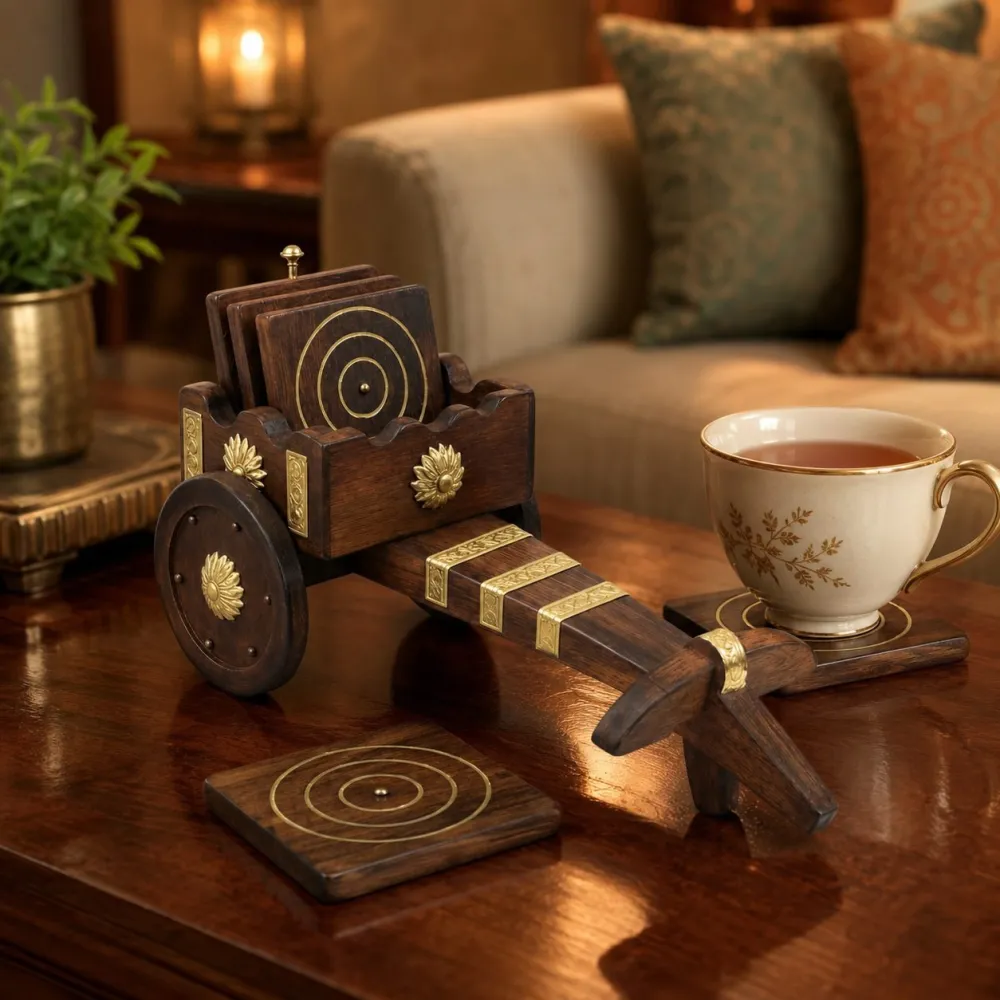
A wooden tea coaster can protect a tabletop from everyday drips while adding a warm, decorative element to a tea or coffee setting. But wood is not automatically waterproof or heatproof. Finish quality, coaster size, underside design and day-to-day care determine how useful the set will be.
This guide explains how to choose wooden coasters, what they can and cannot protect against, how to clean them and what to check when buying a decorative coaster set as a gift.
What does a tea coaster actually do?
A coaster creates a barrier between a cup or glass and the table. It can catch condensation, small drips and residue that might otherwise leave rings or stains. It may also reduce direct contact between a warm cup and a finished surface.
A drinks coaster is not the same as a trivet. A trivet is intended for larger, hotter cookware and normally has different size and heat-resistance requirements. Do not place a hot pan, kettle or cooking vessel on a wooden tea coaster unless the manufacturer explicitly says it is suitable for that temperature and load.
How to choose the right coaster size
Measure the widest cups and glasses used at home, including their base or foot. The drinkware should sit comfortably inside the coaster edges without rocking. A very small coaster may disappear under a mug and fail to catch condensation; an oversized one may occupy unnecessary space but is usually easier to position.
Also check thickness. A thin coaster may feel unobtrusive, while a thicker one can appear more substantial. Thickness alone does not establish durability: the wood species, grain direction, construction and finish all matter.
Solid wood, engineered wood and bamboo
| Material | Typical character | Buying checks |
|---|---|---|
| Solid wood | Natural grain and variation; can feel substantial | Even surface, sealed edges, cracks, warping and finish instructions |
| Engineered wood or MDF | Consistent shape and suitability for printed decoration | Moisture-resistant finish and completely sealed edges |
| Bamboo | Light appearance and uniform laminated construction | Bonding quality, flatness and coating care |
| Wood with metal decoration | Traditional or ornamental presentation | Stable attachments, smooth contact points and cleaning limitations |
Descriptions such as “natural,” “handcrafted” or “premium” do not replace material and care details. Look for clear photographs of the top, underside, edges and holder.
Finish and moisture resistance
Unsealed wood can absorb condensation and develop stains or raised grain. A suitable finish slows moisture absorption and makes wiping easier, but no finish should be assumed permanently waterproof. Check whether the seller specifies varnish, lacquer, oil, wax or another coating and follow the corresponding care instructions.
Dark finishes can disguise tea or coffee marks, while pale finishes make dust and some stains easier to notice. Glossy coatings are easy to wipe but may show scratches; matte finishes can look natural but may need more careful cleaning.
Does a wooden coaster protect against heat?
It can separate an ordinary warm cup from the tabletop, but its safe temperature cannot be determined by appearance. Very hot vessels may damage the coating, scorch the wood or transfer enough heat to affect the surface below. Heat-sensitive polished, laminated or painted furniture deserves extra caution.
For normal tea and coffee service, let unusually hot drinkware settle briefly and follow the coaster maker’s directions. Use a purpose-rated trivet for kettles, serving pots and cookware.
Check the underside
The underside affects both table protection and stability. A completely smooth wooden base can slide on glass or glossy stone. Cork, felt or rubber feet may improve grip and reduce scratches, but these materials also have care and heat limits.
Whatever the design, check that:
- the coaster lies flat without rocking;
- there are no rough edges or exposed fasteners;
- protective pads are aligned and firmly attached;
- the base is clean before use on a delicate table.
Coaster holders and decorative sets
A holder keeps the set together when it is not being used. Simple vertical or box holders save space, while figurative designs—such as carts, animals or houses—double as tabletop decoration. Before choosing an ornamental holder, compare its complete footprint with the available shelf or table space.
Count the included coasters and check whether replacements are available. For a household that regularly serves four people, a six-piece set leaves a useful margin. For office or event use, multiple simple sets may be easier to clean and replace than one elaborate display.
How to clean wooden tea coasters
- Wipe spills promptly with a soft cloth.
- Use a slightly damp cloth only if permitted by the finish instructions.
- Dry the top, edges and underside immediately.
- Let every piece air-dry separately before returning it to the holder.
Do not soak wooden coasters or put them in a dishwasher unless the manufacturer specifically approves it. Avoid abrasive pads, harsh cleaners and prolonged direct sunlight. Moisture trapped between stacked coasters can lead to odour, finish damage or deformation.
If the surface becomes rough, cracked, sticky or persistently stained, stop using it with drinkware until you know whether the finish can be safely repaired. Food-contact claims should come from the maker; a coaster normally supports the outside of a vessel and should not be used as a plate.
Wooden tea coasters as gifts
A coaster set is a practical option for housewarmings, host gifts, office desks and festive hampers. Choose a design that suits the recipient’s available space rather than selecting only by visual detail. A compact holder, straightforward cleaning and a neutral finish generally make the gift easier to use.
For a coordinated wooden gift, avoid assuming that every wood product is automatically environmentally preferable. Ask about material source, packaging, durability and repairability. The wooden return-gift guide explains these checks in more detail, while the housewarming gift guide covers recipient and quantity planning.
Frequently asked questions
Are wooden coasters waterproof?
Not necessarily. A coating may improve resistance to brief spills, but exposed edges, scratches and prolonged moisture can still allow absorption. Follow the product’s specific care directions.
Can I place a hot tea cup directly on one?
A normal warm cup may be within the intended use of a tea coaster, but temperature tolerance varies. Do not use it for cookware or unusually hot vessels without an explicit rating.
Why did my wooden coaster warp?
Common contributors include soaking, uneven drying, persistent humidity or heat exposure. Store coasters only after both sides are fully dry.
How many coasters should a set contain?
Choose at least as many as the maximum number of drinks usually served together. Two spare pieces are useful for guests or while another coaster is drying.
Will a wooden coaster scratch a glass table?
A smooth, clean base reduces the risk, but grit trapped underneath can scratch delicate surfaces. Inspect and wipe both the table and coaster before use; consider a suitable protective backing where needed.
Final buying checklist
- Diameter or width comfortably fits your drinkware
- Surface is flat and edges are smooth
- Finish and cleaning instructions are clearly stated
- Underside suits the intended tabletop
- Holder fits the available storage space
- Set contains enough pieces for normal serving
- No unsupported heatproof or waterproof assumption
- Current product, return and delivery details reviewed
Choose a wooden tea coaster as a small piece of protective tableware first and a decoration second. Correct sizing, prompt drying and realistic heat expectations will do more for long-term usefulness than an elaborate design alone.