


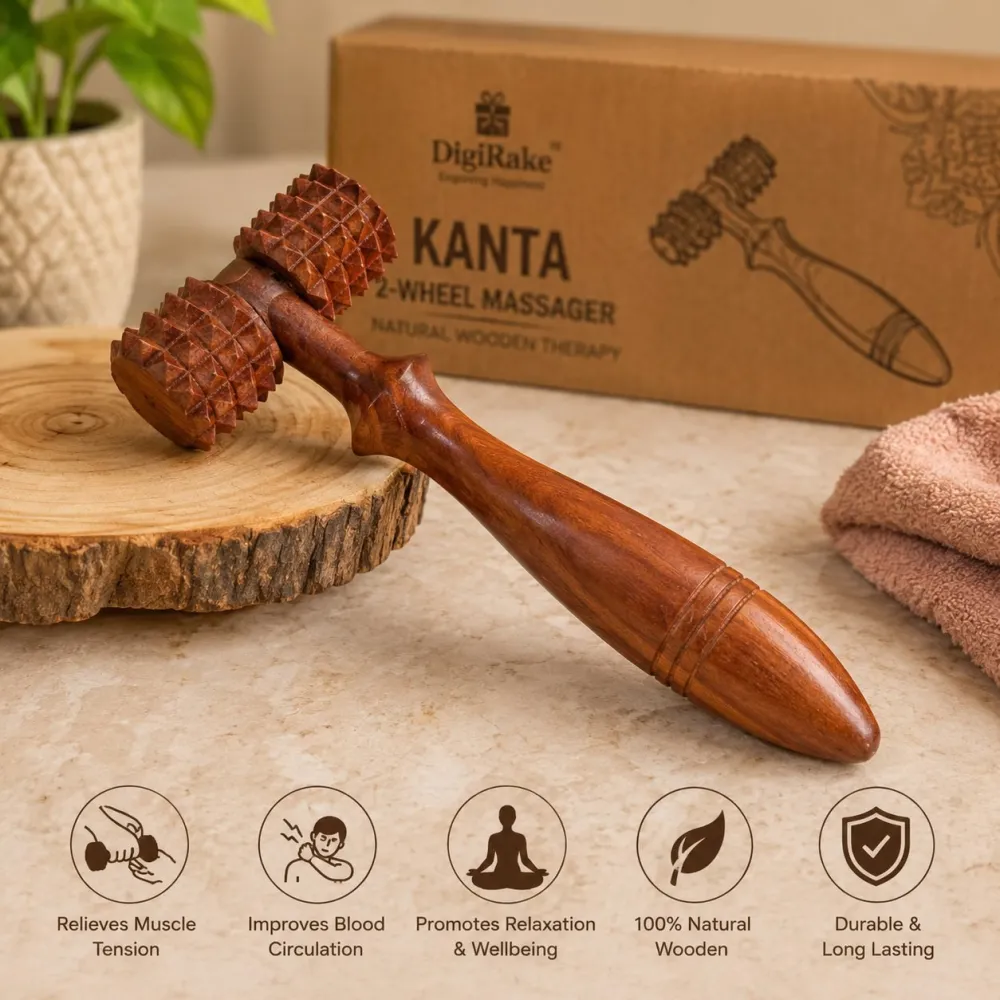
A wooden roller massager is a simple handheld tool that moves textured wheels across the skin. It needs no battery, is easy to store and lets the user control where and how lightly it rolls. That simplicity does not make forceful massage appropriate for every person or every area of the body.
This guide explains how to choose and use a wooden roller conservatively for general comfort. It does not diagnose or treat pain, injury or disease. Persistent or unexplained symptoms need advice from a qualified health professional.
What is a wooden roller massager?
The common design consists of a handle, one or more rotating wooden wheels and an axle. Smooth wheels provide broad contact, while wheels with rounded raised points create a more noticeable sensation. Two-wheel tools are compact; wider multi-wheel rollers cover more area with each pass.
Unlike an electric massager, a manual roller has no preset speed or force. The user creates both. This can make it easier to stop immediately, but it also means pressure is not measured or automatically limited.
Choose the roller by shape, not by dramatic claims
| Feature | What it changes | What to check |
|---|---|---|
| Smooth wheel | Broader, less concentrated contact | Even surface without splinters or rough seams |
| Textured wheel | More concentrated sensation at each raised point | Rounded tips and comfortable contact at very light pressure |
| Two wheels | Compact contact area and portability | Both wheels rotate freely without excessive side movement |
| Multiple wheels | Covers a larger area per pass | Balanced rotation and a handle wide enough for control |
| Curved handle | May improve grip angle | No sharp edges; comfortable for the intended hand size |
Avoid relying on promises that a roller will “cure,” “detoxify,” “break down fat,” improve a specific disease or permanently remove pain. A consumer massage tool should be selected for construction, control and comfort—not unsupported medical outcomes.
Construction and quality checks
Inspect the wheel edges, raised points, axle and handle. The wood should feel smooth and dry, with no cracks, loose fragments or sticky finish. Wheels should turn without catching. Excessive wobble can produce uneven contact or allow a wheel to rub against the frame.
Check how the axle ends are secured. Exposed sharp metal or loose caps are reasons not to use the tool. If the product has a coating, follow the maker’s cleaning instructions; soaking can swell wood and damage joints even when the surface appears sealed.
How to use a wooden roller gently
- Read the product directions and inspect the roller before every use.
- Try it over clothing or on a small area using almost no pressure.
- Use slow, short passes over a broad, comfortable soft-tissue area.
- Keep the pressure light enough that you can breathe normally and do not tense against it.
- Stop immediately if you notice sharp pain, numbness, tingling, dizziness, skin damage or worsening discomfort.
Do not force the tool across bones, joints, the front or side of the neck, the spine, the abdomen or another sensitive area. Never ask another person to press hard simply because they can create more force. Longer and harder are not measures of a better session.
When not to self-massage
Do not roll over broken or infected skin, a rash, a fresh bruise, unexplained swelling, a recent injury, a suspected fracture or an area with reduced sensation. Avoid forceful massage if you have a bleeding disorder or take anticoagulant medicine unless your clinician says it is appropriate. Pregnancy, recent surgery, cancer treatment, fragile bones, circulation problems or another significant health condition also warrant professional guidance before massage.
The US National Center for Complementary and Integrative Health says massage generally has a low risk of harm, but rare serious effects have been reported, particularly with vigorous massage or in people at increased risk of injury. It advises people not to delay medical care for a health problem and to discuss suitability with a healthcare provider when unsure. See the NCCIH massage-therapy guidance.
Sudden swelling, redness, warmth, severe pain, weakness, chest pain, breathlessness or other alarming symptoms are not a reason to experiment with a roller. Seek appropriate medical care.
Can it be used on the back?
A handheld tool may be awkward to control on parts of your own back. Twisting to reach can create strain, while another person may apply more force than expected. Do not roll directly over the spine or ribs. If back pain is persistent, severe, follows an injury or comes with weakness, numbness, bladder/bowel changes or fever, obtain medical advice rather than self-treating it with a product.
Using it on arms and legs
Broad muscular areas are easier to reach and control, but the same precautions apply. Roll lightly, avoid a recently injured or swollen area and stop at discomfort. Never massage a limb with signs that could indicate a blood clot or infection. A clinician or physiotherapist can provide instructions appropriate to an existing diagnosis or rehabilitation plan.
Cleaning and storage
Wipe the contact surfaces after use with a clean soft cloth. If the manufacturer permits damp cleaning, use as little moisture as possible and dry the tool promptly. Do not soak it, boil it, place it in a dishwasher or share it when there is a skin-infection concern.
Store the roller in a clean, dry place away from bathroom humidity and direct heat. Keep it where children cannot use the textured wheels roughly on themselves or another person. Stop using it if the axle loosens, the finish flakes, the wood cracks or a rough surface develops.
Manual wooden roller versus electric massager
A wooden roller is compact, quiet and fully hand-controlled. An electric device can provide repetitive movement but introduces charging, speed, heat and electrical considerations. Neither category is automatically more effective or medically appropriate. The safer choice is the one whose instructions, intensity and contact shape match the user—and which a healthcare professional considers suitable when a health issue exists.
Is a wooden massager a suitable gift?
It may suit an adult who already enjoys light manual massage and can comfortably grip the handle. It is not an ideal surprise for someone with unexplained pain, reduced sensation, fragile skin or an unknown medical history. Include the instructions and avoid promising therapeutic results.
For non-health-focused alternatives, see the wooden gift guide or the broader return-gifts-for-adults guide.
Frequently asked questions
Should a textured roller hurt?
No. Do not use pain as a target. Start with minimal pressure and stop if the sensation is sharp, unpleasant or followed by bruising, numbness or worsening symptoms.
How long should I use it?
There is no universal duration appropriate for everyone. Begin with a brief trial, follow the maker’s directions and stop before irritation or soreness develops. A clinician should guide use for a diagnosed condition.
Can it remove muscle knots?
“Knot” is an informal description, not a diagnosis. A roller should not be advertised as removing an underlying injury or condition. Persistent focal pain deserves professional assessment.
Can I use massage oil with a wooden roller?
Only if the manufacturer approves it. Oil can affect a wooden finish, collect residue and make the handle slippery. Clean and dry the tool according to its instructions.
Can children use it?
It is better treated as an adult-controlled tool, not a toy. A child’s symptoms or need for massage should be discussed with an appropriate healthcare professional.
Final buying checklist
- Smooth wood with rounded contact points
- Wheels rotate freely and the axle is secure
- Handle is comfortable and easy to control
- Cleaning and material instructions are available
- No reliance on unsupported cure or pain-relief promises
- Health conditions and medicines considered before use
- Current product and return details reviewed
A wooden roller massager is best approached as a simple personal-comfort tool. Choose sound construction, use light controlled pressure and treat pain or other concerning symptoms as a reason for professional advice—not a reason to press harder.