


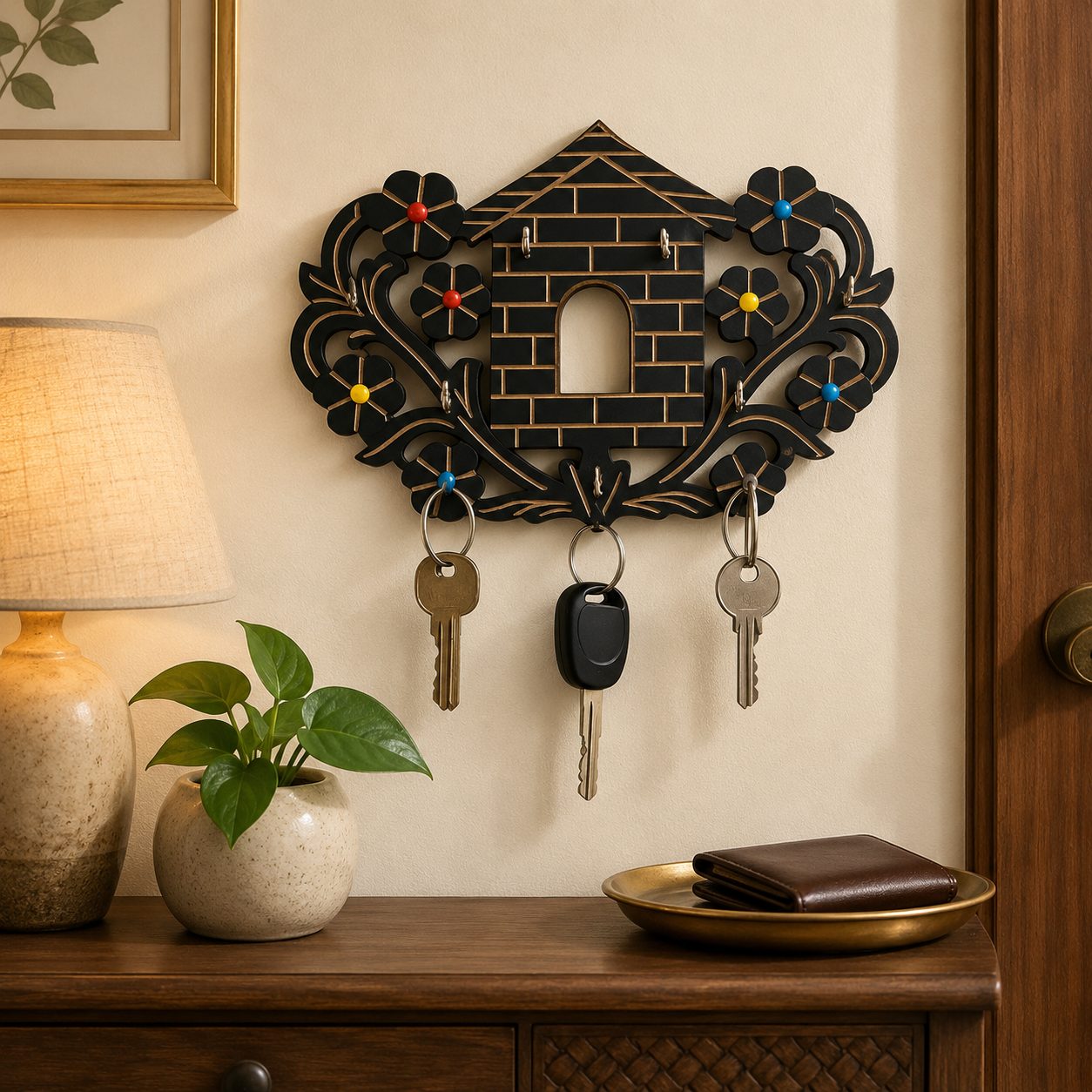
A wall key holder gives frequently used keys one visible, repeatable home. The best choice is not simply the design that looks attractive: it must have enough hooks, suit the weight of your key sets, fit the available wall space and use mounting hardware appropriate for that wall.
This guide explains how to choose a wall key holder for a home entrance, where to position it, what to check before mounting it and how to keep keys organised without creating a security problem.
What is a wall key holder?
A wall key holder is a small rack or decorative panel fitted with hooks for house, vehicle, office and utility keys. Unlike a bowl or drawer, it separates key rings so they are easier to identify and less likely to become tangled. A decorative holder can also function as an entrance-wall accent.
Open-hook holders are convenient because the keys remain visible. Cabinet-style holders conceal them, while shelf or tray models add space for small everyday items. There is no universally best type: the right format depends on how many people use it, how much visual clutter you tolerate and who can see the entrance from outside.
Choose the number of hooks from your real key routine
Count key sets, not individual keys. A ring containing four house keys normally occupies one hook. Make a quick list of the sets used in a typical week:
- main-door and secondary-door keys;
- car, scooter or bicycle keys;
- office, shop or cabinet keys;
- mailbox, terrace, gate or utility keys;
- a spare set that should remain separate from daily-use keys.
Leave at least one free hook if space permits. An overloaded rack makes labels harder to read, allows bulky key rings to overlap and encourages people to hang several heavy sets from the same hook.
Wall key holder materials compared
| Material | Useful qualities | What to check |
|---|---|---|
| MDF or engineered wood | Supports decorative cutwork, printed designs and lightweight wall panels | Keep away from persistent dampness; inspect edges and the rear mounting points |
| Solid wood | Warm appearance and a substantial feel | Finish quality, possible movement in humid conditions and the strength of hook fixings |
| Metal | Can provide slim profiles and strong hooks | Sharp edges, coating quality, rust protection and wall contact points |
| Plastic or resin | Lightweight and available in many shapes | Hook flexibility, brittleness and suitability for heavy key rings |
Material alone does not establish capacity. A sturdy panel with poorly attached hooks can fail before a lighter panel with well-secured hardware. Check the product instructions or seller specifications for mounting method and load guidance rather than estimating from appearance.
Where should a key holder be placed?
For most homes, the practical position is inside the entrance and close to the path people naturally follow when arriving or leaving. It should be easy for household members to reach but not visible or reachable through a window, open grill or letter slot.
Aim for a comfortable height for the regular users. Avoid positioning it directly behind a door where keys or the holder could be struck. Also avoid damp walls, the splash zone of a washbasin, cooking steam and locations immediately above electrical switches.
If young children are present, place vehicle keys, access fobs and keys to restricted cupboards beyond their reach. A key holder is an organiser, not a secure key safe; high-risk or rarely used spare keys may belong in a separate locked location.
Measure before buying
Measure the usable wall width and height, then mark the proposed outline with low-tack painter’s tape. Open the nearby door fully and check that bags, jackets or furniture will not collide with hanging key rings. Remember that keys extend below the product, so the panel dimensions are not the complete occupied area.
Also consider hook spacing. Wide vehicle fobs and decorative keychains require more room than slim household keys. If the listing does not state dimensions or show a scale reference, request those details before ordering.
Mounting checklist
First identify the wall material: masonry, plaster, tile, wood and hollow drywall require different anchors and tools. Confirm what hardware is supplied and whether it is intended for your wall. Adhesive mounting should be used only when the product and adhesive manufacturer explicitly support the combined weight and surface.
- Check the wall for concealed wiring, plumbing and other hazards before drilling.
- Use a level and mark the mounting points accurately.
- Use anchors and screws appropriate for the wall and expected load.
- Fit the holder firmly, then test it gradually before adding every key set.
- Recheck the mounting points periodically, especially if the holder moves or feels loose.
If you are uncertain about the wall construction or safe drilling location, use a qualified installer. Do not treat decorative product photographs as installation instructions.
Decorative, modern or concealed: which style fits?
A modern wall key holder usually uses simple lines and neutral finishes, making it easier to blend with compact entrances. Decorative styles—such as floral, house or animal motifs—act more like wall art and can suit traditional or eclectic rooms. A concealed cabinet is useful when visual tidiness and privacy matter more than instant visibility.
Choose according to the room rather than a trend label. Match one existing element, such as the door colour, metal hardware or furniture tone. Trying to match every surface often makes future redecorating unnecessarily difficult.
A simple household key system
Assign each hook a role rather than letting everyone choose a random space. For example, reserve one row for daily keys and another for less frequent sets. Use small, legible tags, but do not write a full address or sensitive access information on them. Remove obsolete keys instead of allowing the holder to become permanent storage.
Once a month, wipe the holder with a method appropriate for its finish, tighten loose hook hardware where the design permits and check that no key ring is pulling sideways. MDF and wooden surfaces generally benefit from a soft dry or barely damp cloth; avoid soaking edges or using abrasive cleaners.
Can a wall key holder be given as a housewarming gift?
It can be a practical housewarming gift when the design is neutral enough for the recipient’s home. Before choosing one, consider the likely household size, number of vehicles and whether the recipient rents or owns the property. Renters may prefer a lighter design, but any no-drill installation still needs approval from both the product and adhesive instructions.
For more occasion ideas, see the housewarming return-gift guide. If organisation is the main goal, the same principle applies to smaller valuables: give each type a defined place, as explained in the jewellery-box buying guide.
Frequently asked questions
How many hooks should a family key holder have?
Count the household’s separate key rings and add at least one spare hook. Hook spacing and load guidance matter as much as the headline hook count.
Is it safe to keep car keys near the front door?
Convenience must be balanced with security. Keep keys out of external sight and reach, and follow the vehicle manufacturer’s security guidance. A decorative open rack does not replace secure storage where theft risk is a concern.
Can an MDF key holder be installed in a kitchen?
Only if it can remain away from steam, grease, heat and splashes. An interior entrance or dry hallway is usually easier to maintain.
Can I use adhesive strips instead of screws?
Only when the holder, wall finish and adhesive instructions are compatible and the rated capacity exceeds the complete loaded weight. Painted, dusty, textured, damp or recently finished walls may not provide reliable adhesion.
Final buying checklist
- Enough hooks for key sets, with room for bulky fobs
- Dimensions checked against the wall and door swing
- Material and finish appropriate for the location
- Mounting points and supplied hardware clearly shown
- Wall-compatible installation method
- Keys kept away from outside sight and children’s reach
- Returns, delivery and current product details reviewed
A good wall key holder succeeds when everyone uses it without thinking. Start with the household’s real key sets and entrance layout, then choose the design. That order produces a more useful result than buying by appearance alone.