


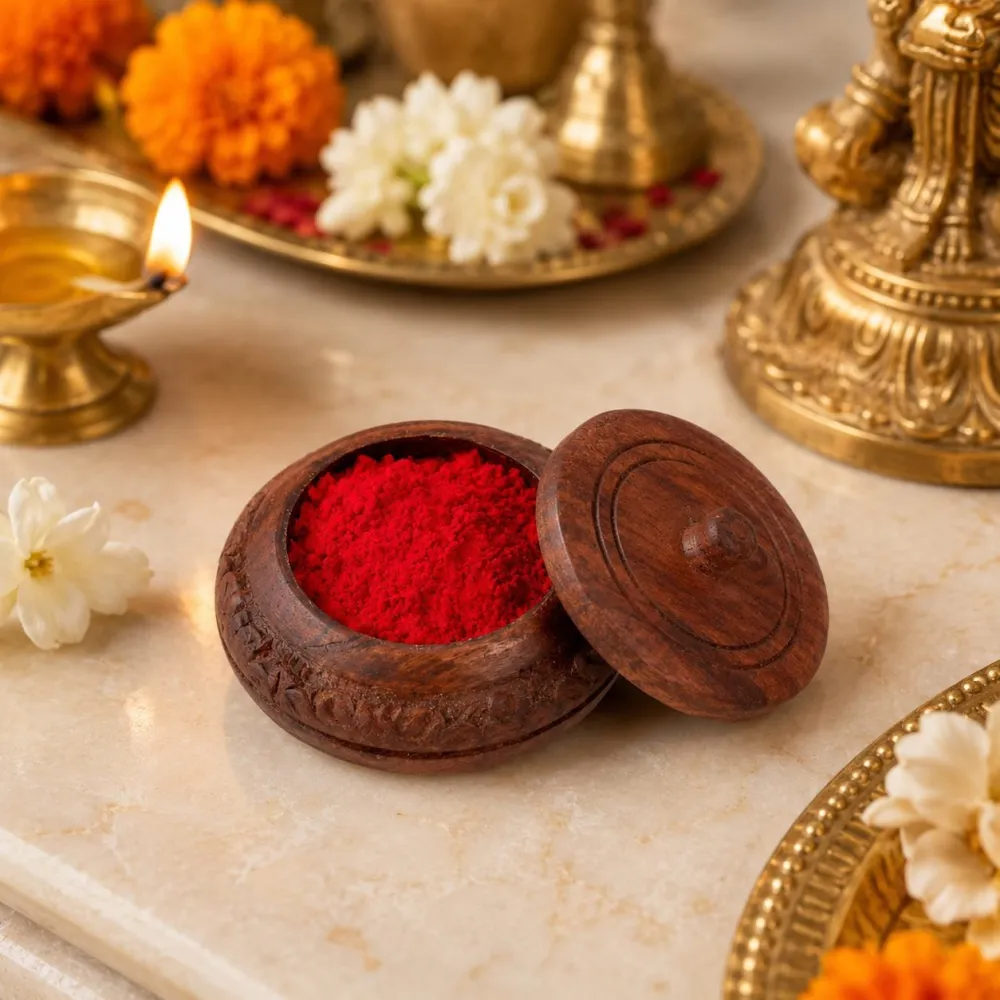
Pooja return gifts are small thank-you gifts offered to guests after a religious or community gathering. The best choice depends on the occasion, local custom, guest mix, quantity, practical use and delivered cost. Traditions vary by family and region, so confirm expectations with the host or elders instead of treating any one gift as compulsory.
Quick answer
First decide whether the gift is one per person, married woman, couple or family. Then shortlist two or three products that suit the event, approve a physical sample, calculate the complete delivered cost and order a modest buffer. Compact kumkum boxes and incense holders suit individual distribution; torans, storage boxes and larger devotional items can work better per family.
Pooja return-gift choices at a glance
| Gift direction | Useful for | Check before ordering |
|---|---|---|
| Kumkum or sindoor box | Compact traditional gifting | Cavity size, lid, material and powder packing |
| Agarbatti stand | Practical pooja-room use | Stick fit, ash coverage and cleaning |
| Toran or thoranam | One-per-family festive décor | Width, hanging points and actual material |
| Small jewellery or utility box | General personal storage | Usable internal space and finish |
| Deity-themed décor or holder | Occasion-aligned gifting | Recipient preference, size and listed composition |
| Premium family organiser | Hosts, organisers or a smaller guest list | Capacity, packing and delivered cost |
How to choose pooja return gifts
- Define the recipient unit: count gifts per guest, household, couple or another clearly stated group.
- Respect the occasion: choose an item that fits the gathering without assuming every recipient follows the same practice.
- Prefer practical fit: consider whether guests can use, display or store the item easily.
- Fix the delivered budget: include product, tax, packing, tag, transport and a damage buffer.
- Approve the exact SKU: verify dimensions, colour, material, configuration and stock in writing.
- Test one sample: inspect finish, closure, stability, packing and actual size before ordering quantity.
- Allow inspection time: receive the order early enough to count, check and replace damaged units.
Choose by recipient, not stereotypes
A return-gift plan works best when the distribution rule is simple and respectful. A women-focused gathering may make a kumkum or sindoor box appropriate, but mixed groups may prefer a neutral household, décor or pooja-room utility item. Couples and families can receive one larger product rather than several tiny duplicates.
| Distribution rule | Possible direction | Planning note |
|---|---|---|
| One per individual | Compact box or incense holder | Keep the SKU and packing consistent |
| One per invited household | Toran, storage box or devotional décor | Track households separately from headcount |
| One per couple | Shared home-use item | State the rule before ordering |
| Children or students | Age-appropriate neutral utility gift | Avoid flame-use items for unsupervised children |
| Organisers or close family | Separate premium tier | Label discreetly to prevent distribution errors |
For a more focused discussion, see pooja return gifts for ladies and return gifts for couples and families.
Useful pooja return-gift categories
Kumkum and sindoor boxes
These are compact and easy to distribute, but the box and the powder should be treated as separate decisions. Check whether the product has one or more cavities, how the lid moves, and whether the listing identifies the material clearly. Do not assume a gold or silver colour indicates precious metal. If including haldi, kumkum or another powder, use suitable separate sealed packing and confirm local practice.
The kumkum and sindoor box guide explains materials and formats; the haldi-kumkum return-gift guide covers that specific gathering.
Incense and agarbatti holders
A compact incense holder can be practical, but match it to the intended incense format. Stick, cone, dhoop cup, sambrani and backflow products are not automatically interchangeable. Check hole diameter, surface stability, usable ash-catching area, heat-safe placement and cleaning. Include no incense unless its ingredients, labelling and packing are suitable for the recipients.
Use the incense-holder return-gift guide for bulk decisions and the incense-holder guide for format selection.
Torans and doorway décor
A reusable toran can work as one gift per home, especially around festivals or housewarming-related events. Measure the product itself rather than assuming it fits every main door. Verify whether leaves, flowers, beads or metallic elements are artificial, natural or decorative representations. Check hanging loops, loose parts, storage and fire-safe placement.
The toran buying guide covers materials, width and installation.
Jewellery and utility boxes
A small wooden box is a neutral storage gift when guests may not need a ritual-specific item. Compare usable internal dimensions, compartment layout, lid clearance and finish. A box described for jewellery can also store keys or small accessories, but do not imply food safety or airtightness unless the listing explicitly supports it.
Deity-themed products
Idols, plates and deity-themed holders can feel closely aligned with an event, but recipient preference matters. Verify which figures are included, the product’s listed composition, dimensions, colour or finish and intended function. Avoid describing a gold-coloured product as gold or a brass-finish product as solid brass without evidence.
Current in-stock gift directions
These live DigiRake examples cover different functions and recipient units. Prices and stock change, so use each product page for current details rather than treating this article as a quotation.
Compare current pooja return gifts
- Round single kumkum box — a compact covered format for individual gifting.
- Wooden sindoor box — a small wooden storage format with a handled lid.
- Simple wooden agarbatti stand — listed for incense sticks and a cone; verify placement and care.
- Stainless-steel agarbatti plate — a compact 10 cm ash-catching format.
- Antique-gold-finish thoranam — reusable doorway or pooja-room décor; confirm dimensions.
- Wooden jewellery box, 6 × 4 inch — a neutral personal-storage gift.
- Lakshmi-Ganesh gold-coloured holder — deity-themed décor and holder format; verify composition on the live listing.
Seller disclosure: DigiRake Store Private Limited sells the products linked above. Prices, stock, colours and product details can change; verify the live listing before ordering.
How to plan the return-gift budget
Start with the maximum delivered budget for the entire order, not only a per-piece product price. A simple planning formula is:
Total estimate = (gift quantity × current unit price) + individual packing + labels + transport + applicable taxes + contingency.
Use a quantity based on recipient units. If 80 people represent 46 invited households and the rule is one per household, the base quantity is 46—not 80. Then add a modest buffer for late confirmations, damage or counting errors. The correct buffer depends on attendance uncertainty, product fragility and replacement availability.
For a strict lower ceiling, use the pooja return gifts under ₹150 and ₹200 guide, which separates product price from delivered and ready-to-give cost.
Displayed retail prices are not automatically wholesale prices. For quantity purchasing, request a written quote for the exact SKU, colour, quantity, packing and destination. The wholesale pooja return-gifts guide provides a fuller procurement process.
Sample approval checklist
- Measure the sample and compare it with the written listing.
- Check material, colour, finish and included parts.
- Open and close lids, trays or hinges several times.
- Test stability on a level surface.
- For holders, inspect openings and ash-catching area without unsafe improvisation.
- Review individual and outer-carton packing.
- Photograph the approved sample and record the SKU.
- Confirm the dispatch and delivery schedule in writing.
Ordering timeline
Work backwards from the event date. Allow time to shortlist, receive a sample, approve a written specification, confirm stock, pack, transport, inspect and replace damaged pieces. Handmade or colour-sensitive items may need extra lead time. Do not schedule bulk delivery so close to the event that there is no inspection window.
Packing and distribution
Keep powders, food and fragranced items separately sealed and away from surfaces they could stain or affect. Avoid heavy packaging that makes a low-cost gift expensive to transport. Add a small readable label only after confirming it does not damage the product.
Prepare a distribution sheet showing guest or household name, gift tier and collection status. Store premium or organiser gifts separately and label cartons by category. This prevents accidental mixing during a busy event.
Choose by pooja or occasion
A broad cornerstone cannot define every ceremony. Use the narrower guides where the occasion changes the decision:
- Lakshmi Pooja return gifts
- Gowri and Gauri Pooja return gifts
- Varalakshmi Vratham return gifts
- Navratri and Golu return gifts
- Bhoomi Pooja return gifts
- Saraswati Pooja return gifts
Common mistakes
- Ordering by headcount before defining the recipient unit.
- Choosing an arbitrary numbered list without checking guest fit.
- Treating a retail catalog price as a confirmed bulk quotation.
- Skipping the physical sample for a large order.
- Assuming metallic colour proves precious-metal composition.
- Including incense, food or powders without suitable separate packing.
- Ordering so late that damaged items cannot be replaced.
- Using flame-related gifts for children without considering supervision.
Frequently asked questions
What is a useful pooja return gift?
A useful gift matches the recipient unit and occasion. Compact boxes or incense holders can suit individuals; torans and household storage may suit families.
How many pooja return gifts should I order?
Calculate the base quantity from the stated distribution rule, then add a modest buffer based on attendance uncertainty, fragility and replacement availability.
Are the displayed prices wholesale rates?
No. Treat a live product price as a retail reference unless the seller provides a written quantity quotation covering the exact SKU, packing and delivery destination.
What should I include with a pooja return gift?
This depends on local practice. If including haldi, kumkum, fruit, food or another item, pack it appropriately and separately from surfaces it could stain, contaminate or damage.
How early should I order?
Allow enough time for sample approval, stock confirmation, packing, delivery, full inspection and replacements. Required lead time varies by product and quantity.
Can every guest receive the same gift?
Yes, if one neutral product suits the entire group. Otherwise define clear individual, household or premium tiers before calculating quantity.
Final recommendation
Decide who receives each gift, shortlist a practical occasion-appropriate format, approve the exact sample and calculate the delivered total. A smaller, verified and well-packed gift is more successful than a larger list of untested ideas.
Related DigiRake guides
Compare return gifts under ₹100 and return-gift ideas for every occasion before you order.