


Seller disclosure: DigiRake Store Private Limited sells the DigiRake Retail product linked in this guide. Price and stock can change; verify the live listing before ordering.
A haldi kumkum box is a container used to organise turmeric, kumkum or related dry ritual materials. It may have one compartment, two separate cavities, a roli-chawal arrangement or several small boxes on a tray. Product names overlap, so the actual compartment layout matters more than the title.
The right box should provide usable access, keep materials separate, fit the pooja shelf and be practical to clean. It should not be assumed airtight, spill-proof or suitable for liquids. This guide compares the common formats and explains how to choose, fill, place and maintain them.
Quick answer
Choose a single box for one dry powder, a true double box for haldi and kumkum, and a two-part roli-chawal set when powder and rice must remain separate. Check the internal cavity, divider height, lid movement and material. Leave space below the rim, use clean dry tools and add secondary sealed packing if a filled box must travel.
Haldi kumkum box types compared
| Format | Suitable use | Important check |
|---|---|---|
| Single compartment | One dry powder such as kumkum | Usable cavity and comfortable finger or spoon access |
| Double compartment | Haldi and kumkum in one unit | Divider height and whether each cavity closes cleanly |
| Two separate boxes | Strong separation and flexible placement | Matching size, labels and stable tray |
| Roli-chawal set | Powder and dry rice or akshata | Independent dry spaces and tray stability |
| Multi-box tray | Several materials or ceremonial presentation | Complete footprint, removable parts and packing |
| Box with applicator | Controlled powder handling | Separate applicator storage and cleaning access |
Single-compartment box
A single box is compact, has fewer corners to clean and suits one dry material. It can also be given empty so the recipient decides how to use it. Check the internal diameter and depth; ornate borders and thick walls can make the usable cavity much smaller than the outside measurement.
A lift-off lid is simple but may be misplaced. A hinged lid stays attached but needs clearance to open. A threaded lid may reduce accidental opening, yet powder can collect in the threads. None should be described as leakproof without explicit documentation.
Double haldi kumkum box
A double box is useful when turmeric and kumkum are presented together. Verify that there are two real cavities rather than one decorative form, and check whether the divider rises high enough to limit ordinary mixing. Each compartment should be accessible without tipping the whole unit.
Leave clear space below the top of the divider. Powder filled to the rim can cross over when the lid closes or the box moves. If each cavity has a separate lid, check that both open easily without catching on the other side.
Roli-chawal and multi-part sets
Roli-chawal sets commonly pair a red ritual powder with dry rice. Rice should remain dry and free from oil or moisture. A shared decorative tray helps presentation but does not make the containers safe to carry while full. Use secondary packing when the setup must move.
Multi-part sets can organise several powders or ceremonial items, but they occupy more shelf space and include more lids or small components. Measure the full assembled footprint and check whether removable boxes sit securely on the base.
Measure the usable cavity
- Measure the available shelf or tray space.
- Check the product’s external width, depth and height.
- Look for the internal cavity diameter and usable depth.
- Allow space behind a hinged lid to open fully.
- Confirm that a finger or intended spoon can enter comfortably.
- For a double box, inspect divider height and access to both sides.
- For travel, measure the secondary sealed container as well.
Photographs can make a small decorative box appear larger. Never estimate powder capacity from the outside design alone.
See a current wooden kumkum box
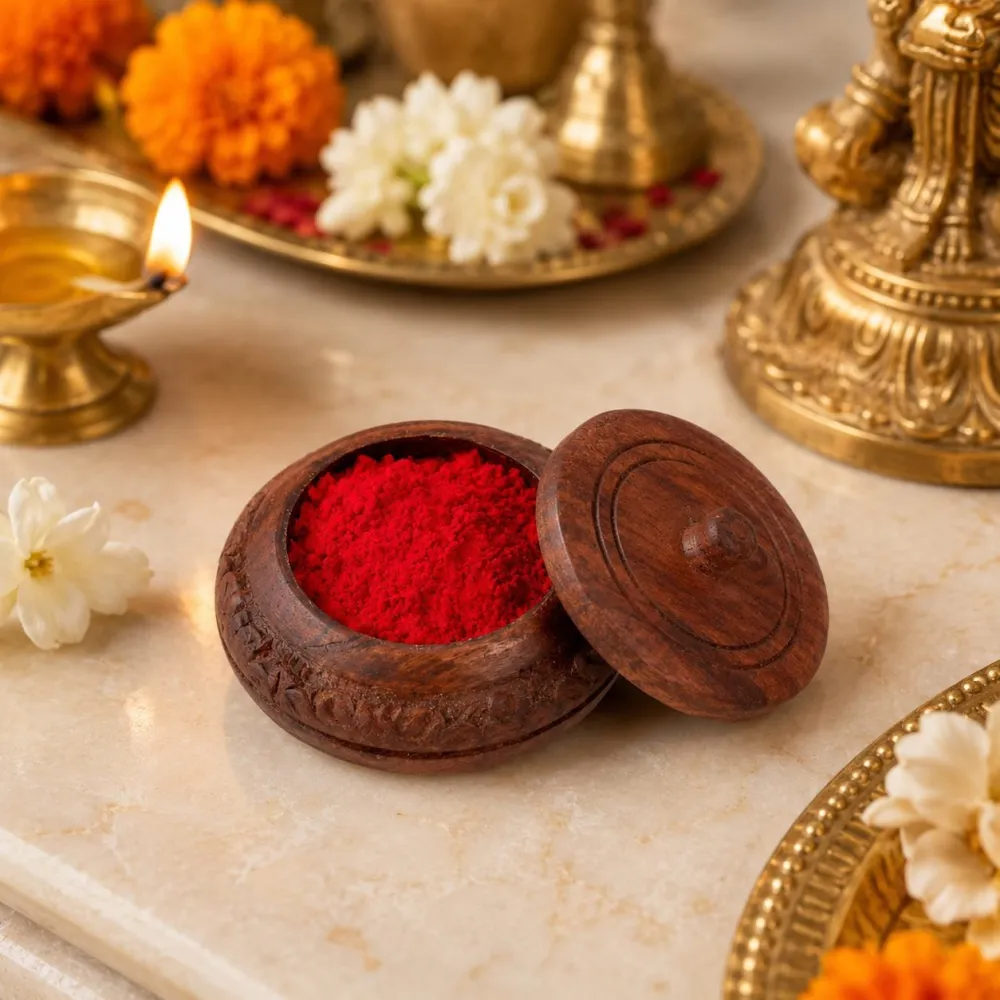
The current DigiRake Sindoor Box is a covered wooden single-box format described for sindoor and kumkum. It is not presented as a double haldi-kumkum set. Check its live dimensions, cavity, lid and finish before ordering.
Seller disclosure: DigiRake Store Private Limited sells this product. Confirm suitability for the exact dry material and use you intend.
Choosing material
Wood
Wood offers a warm, traditional appearance and is lightweight. It can absorb moisture or stain, so use it only for appropriate dry material, avoid soaking and remove powder with a soft dry brush before any permitted surface cleaning.
Brass and other metal
Metal boxes can provide more weight and detailed shapes. Verify whether the product is solid brass, another alloy, plated metal or simply brass colour. Finish care differs, and abrasive polish can damage coatings or painted details.
Silver and silver-colour products
Solid silver, silver plate and German silver are different categories. Genuine silver should be evaluated using fineness, net weight, hallmarking where applicable and invoice documentation. A silver-colour title is not evidence of precious-metal content.
Plastic, resin or ceramic
These materials can support colourful or detailed forms. Check food/ritual suitability claims, hinges, glued decoration and breakage risk. Use water only when the maker’s care instructions permit it. The kumkum-box material guide provides a fuller comparison.
How to set up the box
- Inspect the new box for dust, loose finish, sharp edges or damage.
- Clean it using a method suitable for the actual material.
- Let every cavity, lid and applicator dry completely.
- Assign one material to each compartment.
- Transfer a modest amount with a clean dry spoon.
- Wipe the divider, rim, hinge and threads before closing.
- Place the box on a stable dry shelf away from flame and water.
How much powder should you add?
Add only enough for normal use and leave visible space below the rim. Smaller refills reduce the amount exposed to humidity, dust and accidental mixing. Keep the main powder in its original labelled package so ingredient and intended-use information remains available.
Do not press powder into corners or compact it under the lid. Use a dedicated dry spoon for each material and clean the rim after every refill. Wet fingers can create clumps and contaminate the remaining contents.
Powder ingredients and skin contact
Kumkum, sindoor and other red powders are not guaranteed to have the same composition. Keep the original label, follow the maker’s intended-use directions and do not make purity or health claims without documentation. Turmeric can stain skin, fabric and porous surfaces.
Ask before applying powder to another person. Avoid the eyes, broken skin and any use that conflicts with the product instructions. Someone with known sensitivity may prefer a no-contact way to participate. For terminology and ingredient considerations, read kumkum versus sindoor.
Pooja-room placement
- Use a level shelf with enough room to open the lid.
- Keep the box away from diya, camphor and incense embers.
- Prevent incense ash from falling into an open cavity.
- Separate it from water vessels, fresh flowers and oil.
- Keep lightweight boxes away from shelf edges.
- Store small applicators beyond the reach of young children.
- Close the lid gently after use without compressing powder.
Can a filled box travel?
A decorative box should be treated as a tabletop organiser unless its closure is specifically designed for travel. A button, hinge, thread or latch can still open or allow fine powder to escape. Empty the box before travel when possible.
If it must remain filled, leave headroom, close it as directed, place it upright inside an appropriate secondary sealed container and keep it separated from clothing, jewellery and food. Do not rely on gift wrap to contain a spill.
Haldi kumkum boxes as gifts
A compact single or double box can be suitable for haldi-kumkum gatherings, weddings, pooja occasions or thamboolam bags when it fits the guest group. Cultural practices differ, and not every recipient uses these powders. A neutral household or pooja accessory can be offered where appropriate.
For quantity orders, verify exact dimensions, compartment count, colour, material, individual packing and total delivered cost. Approve a sample and decide whether gifts will be distributed empty. See the haldi-kumkum return-gift guide for procurement planning.
Cleaning the box
- Empty reusable dry powder into an appropriate labelled container only if it remains clean.
- Remove loose residue with a soft dry brush.
- Keep separate tools for yellow and red powder.
- Use only material-appropriate surface cleaning.
- Avoid abrasives on plating, paint, stones and decorative finishes.
- Do not soak wood or trap water inside a hinge.
- Dry every part fully before adding fresh powder.
Discard contents contaminated by water, food, dirt or unknown residue. Do not mix new powder into an unclean cavity.
Common buying mistakes
- Choosing by outer size instead of usable cavity.
- Buying one compartment when two materials need separation.
- Assuming a shared lid prevents powder mixing.
- Calling gold or silver colour the base material.
- Assuming a decorative box is airtight or travel-safe.
- Ignoring applicator storage and cleaning access.
- Ordering quantity without checking one current sample.
- Filling the box before it is cleaned and fully dried.
Frequently asked questions
What is the difference between a kumkum box and a haldi kumkum box?
A kumkum box may have one cavity. A haldi-kumkum box often implies two spaces, but titles are inconsistent; inspect the actual compartment count.
Should haldi and kumkum be stored together?
They can be kept in the same outer unit when separate cavities and adequate divider height limit mixing. Two independent containers provide stronger separation.
Can roli and rice share one compartment?
Separate spaces are more practical because powder and rice have different textures and should remain dry and distinct.
Can I store liquid kumkum in a regular box?
Use a box only for the substances explicitly allowed by its manufacturer. Many decorative products are intended for dry powders.
How do I reduce turmeric staining?
Use dry tools, avoid overfilling, clean spills promptly and keep turmeric away from unfinished porous surfaces and fabric.
Can the box be given empty as a return gift?
Yes. Empty gifting simplifies hygiene and transport and lets the recipient choose the material and use.
Does a hinged lid make the box spill-proof?
No. A hinge keeps the lid attached but does not establish an airtight or powder-proof seal.
Final recommendation
Choose a haldi-kumkum box by the number of materials, usable cavity, lid design, shelf space and cleaning method. Keep powders labelled, dry and below the rim; use separate tools; and add secondary sealed packing whenever a filled box must be transported.