


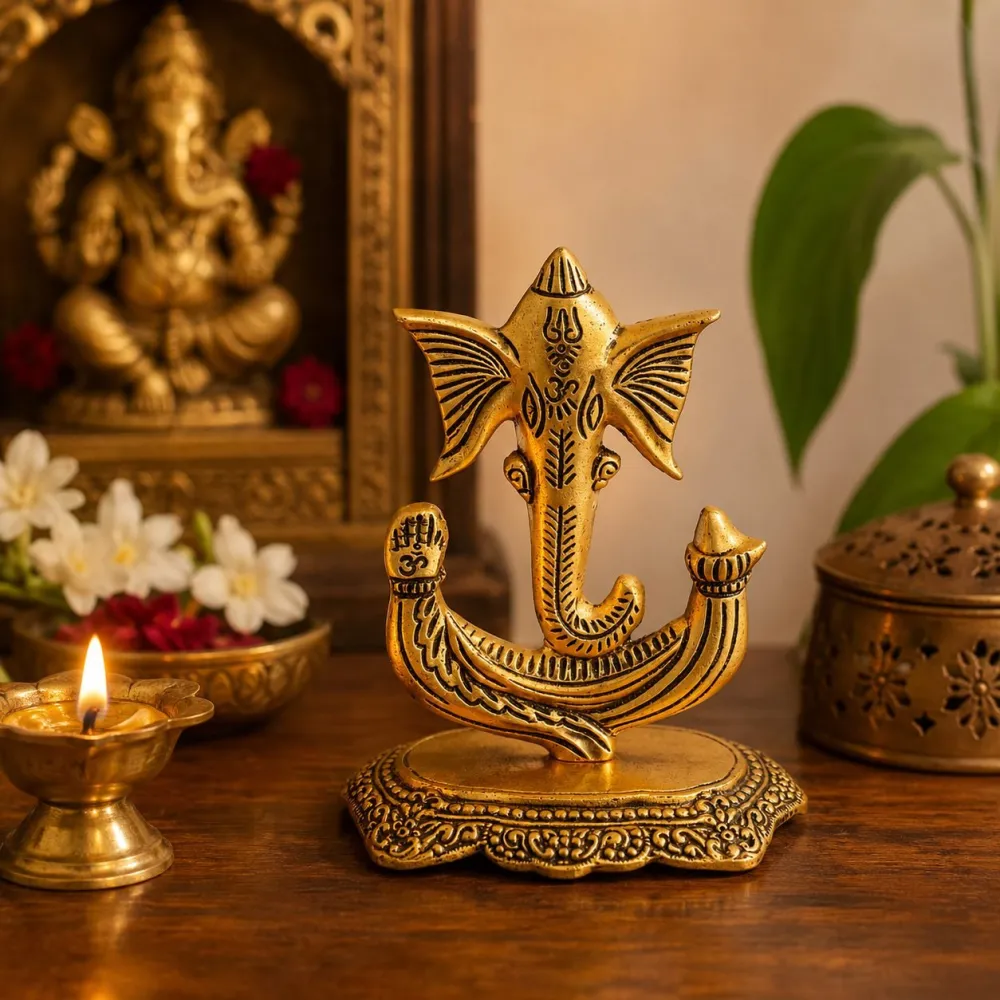
A Ganesh idol for home may be chosen for a mandir, entrance console, study, office or gift. The figure’s posture and symbolism matter to many households, while its size, material, base and finish determine whether it fits and can be cared for safely.
This guide focuses on practical product comparisons and respectful decision-making. Customs concerning form, trunk direction, ritual and placement vary, so follow a trusted elder or religious guide familiar with your household rather than treating online shopping advice as a universal rule.
Decide the purpose before choosing a design
Start by identifying where and why the figure will be used:
- a primary or additional figure in a home mandir;
- a devotional figure for a study or office;
- a decorative entrance or living-room accent;
- a housewarming, wedding, festival or business-opening gift;
- a compact return gift for an event.
A product intended for a shelf is not automatically suitable for a vehicle. Dashboard items need secure installation and must not affect visibility, controls or airbag deployment.
Seated, standing and decorative forms
Ganesh figures appear in seated, standing, reclining, dancing and highly stylised forms. A seated figure often has a broad footprint and low centre of gravity. A tall standing or dancing design may need more vertical clearance and a proportionately wider base.
Decorative plate or arch designs combine the figure with a background, creating a single display unit. Measure the complete outer edge, not only the central figure. Inspect whether the plate is self-standing, wall-mounted or supported by a separate easel.
What about trunk direction?
Many buyers consider the direction and shape of the trunk important. Interpretations differ across sources and traditions, and a product page should not promise prosperity or another result based on a visual feature. If trunk direction matters to your practice, confirm it from a clear front photograph and consult a trusted religious source.
Also check whether listing images are mirrored. Ask the seller to confirm the supplied orientation rather than assuming from one promotional image.
Measure the mandir or shelf
Measure usable internal height, width and depth, including the opening through which the idol must pass. Leave space around the crown, ears, hands and base for safe handling and dusting. Check that doors and curtains can close without touching the figure.
Ask the seller to label height, width and depth. Dimension strings in titles are often ambiguous. Mark the confirmed footprint on paper, place it on the intended surface and check the view from normal sitting and standing positions.
Material comparison
| Material | Common qualities | Buying checks |
|---|---|---|
| Brass | Traditional metallic appearance and weight | Solid brass versus brass finish, weight and approved polish |
| Metal alloy | Detailed casting with many surface finishes | Actual alloy, coating, sharp edges and corrosion care |
| Resin | Complex forms and painted colour | Chips, heat limits, paint quality and fragile projections |
| Stone or marble | Solid feel and natural variation | Weight, shelf capacity, repaired cracks and paint care |
| Wood | Carved detail and natural grain | Wood species, cracks, sealed finish and humidity |
| Clay or ceramic | Handmade or glazed presentation | Fragility, base stability and water sensitivity |
“Gold,” “silver,” “antique” and similar words often describe colour or finish. They do not establish precious-metal content, age or manufacturing method.
Inspect the face, hands and base
Look beyond the first front photograph. Zoom in on the face, trunk, hands, crown and any objects held by the figure. Then inspect the side, rear and underside. A stable base and secure joins matter more to daily handling than an elaborate front finish.
Small handcrafted variation can be expected, but visible cracks, peeling colour, sharp casting flash, exposed adhesive and loose decoration should be clarified. Ask whether the photograph shows the exact piece or a representative unit.
Safe placement in the home
Use your household’s trusted guidance for religious placement. For physical safety, choose a level, load-bearing surface away from edges, door swings and loose curtains. Consider children, pets and vibration from frequently closed cupboards.
Keep diyas, camphor and incense in separate, purpose-made holders on a heat-resistant surface. Flames, heat and concentrated smoke can damage painted, resin or plated finishes. Maintain ventilation and never leave a flame unattended.
See the god-idols-for-home guide for broader material and mandir-sizing comparisons, and the pooja-room incense-holder guide for ash and fire precautions.
Cleaning and handling
Move the piece by supporting its base rather than holding the trunk, ears, hands or crown. Remove dust with a soft dry brush or microfiber cloth. Clean intricate areas slowly so the brush does not catch on fine projections.
Use water, oil or metal polish only when the product’s material and coating instructions permit it. Brass polish can strip paint or plating from an alloy figure. Moisture can enter joins and damage wood, clay, adhesive and some stone finishes.
Stop cleaning if colour transfers to the cloth or the surface becomes sticky. Frequent gentle dusting is safer than occasional aggressive scrubbing.
Choosing a Ganesh idol as a gift
Confirm that the recipient welcomes a devotional figure and, if possible, ask about their preferred form and material. A compact stable piece is easier to place than a tall or fragile design. Include care information and avoid attaching promises of guaranteed luck, wealth or business success.
For bulk gifting, request a sample, inspect the packed size, agree on acceptable finish variation and confirm the transit-damage process before ordering the full quantity.
Frequently asked questions
Which Ganesh idol is best for a home?
There is no single choice for every household. Use your tradition to choose the form, then compare measurable factors such as available space, base stability, material and cleaning needs.
Which trunk direction should I choose?
Interpretations vary. Consult a religious source trusted by your household and verify the supplied product with a clear, non-mirrored photograph.
Can a Ganesh idol be placed at the entrance?
Many people use devotional or decorative figures near an entrance, but custom-based guidance differs. Physically, keep it on a secure surface away from weather, impact and external reach.
Does a gold-coloured Ganesh contain real gold?
No, not unless precious-metal content and purity are explicitly documented. In most decor listings, “gold” refers to colour or coating.
Can I use brass polish on it?
Only when it is confirmed as compatible solid brass and the care instructions permit that polish. Painted, plated and metal-alloy pieces can be permanently damaged.
Final buying checklist
- Purpose and household tradition considered
- Form, posture and trunk orientation verified
- Usable shelf and opening dimensions measured
- Actual material separated from colour description
- Base and support method checked
- Front, side, rear and underside photographs reviewed
- Cleaning method confirmed
- Availability, return and delivery terms reviewed
Choose a Ganesh idol for home by combining respect for the household’s tradition with clear product information. Verify the form, measure the real space and confirm the material and base before comparing decorative finishes.