


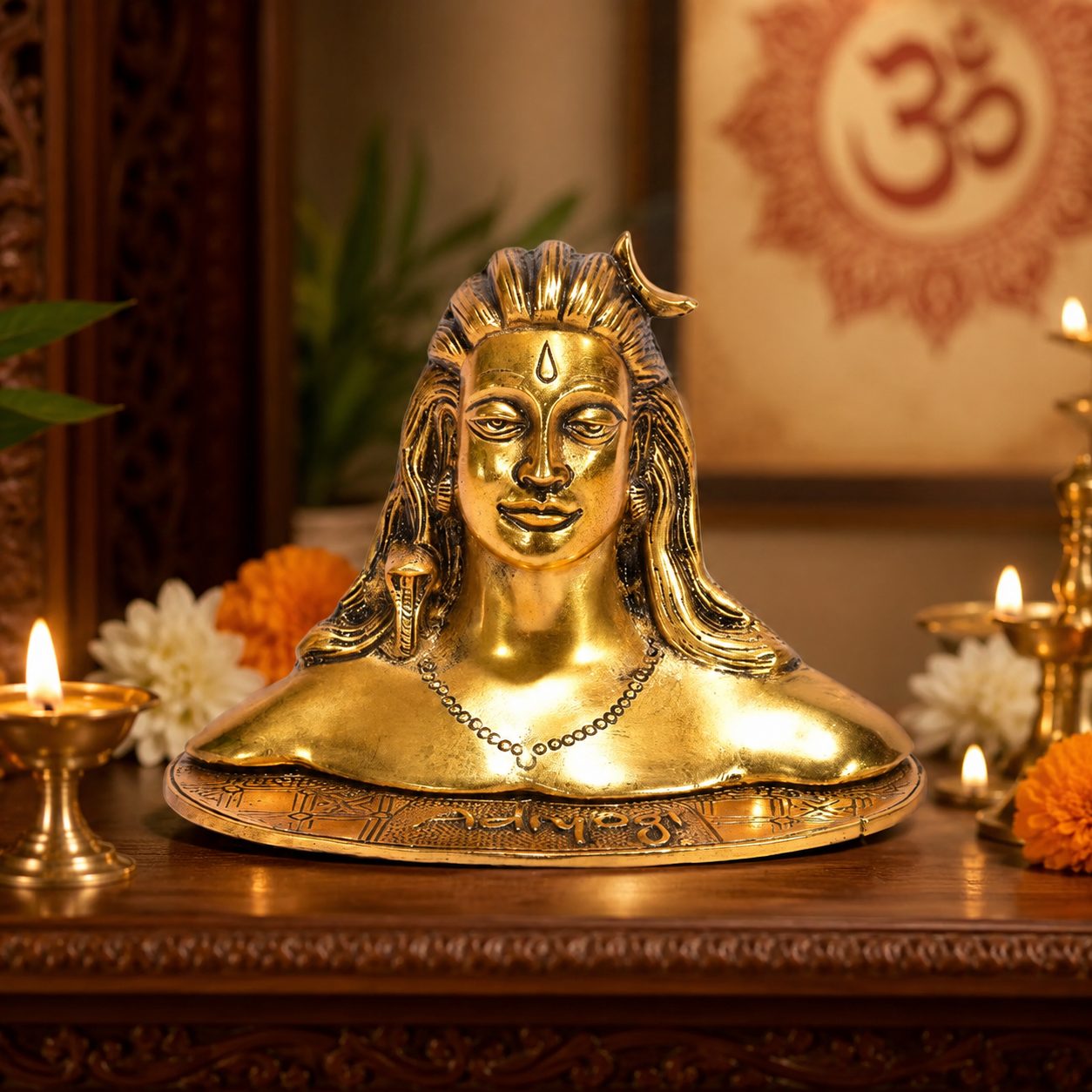
An Adiyogi statue is usually recognised by Shiva’s composed face, closed or meditative eyes, long hair and characteristic ornaments. Buyers choose the form for a yoga or meditation space, home mandir, study, office or meaningful gift. The right piece must also fit its surface, remain stable and have a finish that can be maintained safely.
This guide explains how to identify and compare an Adiyogi statue for home without turning personal belief or online placement advice into a universal rule.
What does “Adiyogi” mean?
Adiyogi means “the first yogi.” In yogic tradition, Shiva is understood as Adiyogi, associated with the origin of yoga. Isha Foundation’s introduction describes Adiyogi as the first yogi and originator of yoga in that tradition. Readers who want the tradition’s own account can consult its Adiyogi overview.
A decorative product does not itself guarantee meditation, wellbeing or another personal outcome. Choose it as a symbolic or devotional object according to your own practice.
Decide where the statue will be used
The location changes the buying criteria:
- Home mandir: measure internal space and follow the household’s tradition.
- Meditation or yoga area: prioritize a calm sightline, stable shelf and easy dusting.
- Study or office: choose a compact base that does not crowd working space.
- Entrance or living room: consider visibility, traffic, children and pets.
- Gift: confirm the recipient welcomes spiritual décor and has room for it.
A shelf statue is not automatically suitable for a car dashboard. Vehicle objects must be securely installed and must not obstruct visibility, controls or airbag deployment.
Measure height, width and depth
Measure usable shelf dimensions and any door opening through which the statue must pass. Allow space for hair, earrings, a base or decorative elements that extend beyond the face. Confirm which number in the product dimensions means height, width and depth.
Use a paper template matching the confirmed footprint. Place it on the shelf and check the view from sitting and standing positions. A sculpture that looks proportionate in a close-up listing photograph may be much smaller or larger than expected.
Full figure, bust or face sculpture?
| Form | Space requirement | Buying checks |
|---|---|---|
| Face sculpture | Often shallow and suitable for compact shelves | Rear support, earring clearance and base depth |
| Bust | Moderate depth with shoulders or pedestal | Weight distribution and stable base |
| Seated full figure | Wider footprint | Complete width, fragile limbs and level seating base |
| Wall hanging | Uses vertical rather than shelf space | Wall weight rating, fixing points and suitable anchors |
Do not hang a shelf sculpture unless the manufacturer provides mounting points and instructions.
Materials and finishes
Adiyogi statues are available in metal alloys, brass, resin, stone, ceramic and wood. Material affects weight and cleaning, while the coating determines the visible colour.
- Metal alloy: can hold fine cast details; verify the alloy and coating.
- Brass: has a traditional metallic appearance; distinguish solid brass from brass-finished material.
- Resin: supports complex shapes but may chip and should be kept away from heat.
- Stone: can be heavy and needs a load-bearing shelf.
- Wood: requires protection from persistent humidity and rough cleaning.
“Gold,” “silver,” “black” and “antique” often describe appearance, not material or age. Precious-metal claims require explicit documentation.
Inspect facial detail and stability
The face is normally the visual focus. Review close-up photographs for symmetry, surface texture, paint consistency and clean edges. Then examine the less glamorous areas: base, back and underside. A beautiful face does not compensate for an unstable stand.
Check that the base sits flat, the sculpture does not lean unexpectedly and projecting hair or ornaments are protected for shipping. Ask whether photographed variations are expected in a handmade or hand-finished item.
Placement and physical safety
Online sources offer many direction-based recommendations, but customs vary. Follow a trusted source familiar with your own tradition rather than treating a product guide as ritual authority.
For practical safety, use a stable surface away from an edge, door swing or loose curtain. Keep it where children and pets cannot pull it down. Separate it from candles, diyas, camphor and incense heat, particularly if the finish is painted, resin-based or plated.
For broader mandir measurements and material comparisons, see the god-idols-for-home guide. For smoke, ash and flame precautions, use the pooja-room incense-holder guide.
How to clean an Adiyogi statue
Lift the statue by its base, not by hair, earrings or another projection. Begin with a soft, dry brush or microfiber cloth. Work gently around facial lines and fine ornaments.
Use moisture or polish only when the exact material and finish instructions permit it. Brass cleaner can damage a painted or plated metal-alloy piece. Water can enter joins, affect adhesive or stain porous materials. If damp wiping is approved, apply moisture to the cloth and dry immediately.
Choosing one as a gift
An Adiyogi statue may suit someone interested in Shiva, yoga or meditation, but confirm their preferences. Select a size that is easy to place and provide the care information. Avoid promising that the object will produce health, success or spiritual results.
For quantity gifts, order a sample, check packed dimensions, confirm finish variation and agree on damage reporting before placing the full order.
Frequently asked questions
Is Adiyogi the same as Shiva?
In yogic tradition, Adiyogi refers to Shiva as the first yogi. Artistic forms and ways of understanding the representation can vary.
Can an Adiyogi statue be kept at home?
Many people choose one for a home, meditation area or mandir. Follow your household’s tradition and use a stable, appropriately sized location.
Which direction should it face?
There is no placement statement this buying guide can make for every tradition. Seek guidance from a trusted religious or yogic source familiar with your practice.
Does “gold Adiyogi” mean real gold?
Usually it describes colour or finish. Treat it as a precious-metal item only when material and purity are explicitly documented.
Can I place it next to burning incense?
Keep adequate separation from flame, heat, ash and concentrated smoke. Use a stable purpose-made incense holder and follow the statue’s material-care instructions.
Final buying checklist
- Intended location and symbolic purpose decided
- Height, width, depth and complete base measured
- Face, side, rear and underside photographs reviewed
- Actual material distinguished from finish colour
- Base stability and shelf capacity checked
- Fine ornaments protected for handling and transit
- Cleaning method confirmed
- Availability, returns and damage terms reviewed
A suitable Adiyogi statue should align with the buyer’s meaning and the home’s physical space. Confirm the form, dimensions, material and base before choosing the finish that appeals most.