


Personalized return gifts can make an event feel considered, but personalisation adds decisions that ordinary bulk buying does not: whose name appears, how spelling is approved, whether the mark is removable, how late changes are handled and what happens to unused pieces. The safest plan starts with a useful base product and adds only the amount of personal detail the recipient will value.
This guide compares product-level customisation with tags, sleeves and cards. It also explains proof approval, privacy, quantities and current DigiRake products that can be used as unpersonalised base gifts. DigiRake’s retail listings do not promise engraving, printing or custom packing unless a product page explicitly says so.
Four Levels of Personalisation
Occasion-level
The same message appears on every gift, such as the hosts’ names, event and date. This is the easiest format to proof and distribute. It also creates fewer unusable leftovers than recipient-specific printing.
Group-level
Different tags identify groups such as family, colleagues or the wedding party. Group-level personalisation helps when product tiers differ, but transport cartons should be coded discreetly so guests are not invited to compare values.
Recipient-level
Each gift carries the recipient’s name or initials. This can feel personal, but it requires accurate spelling, final attendance and a reliable distribution system. Build a few unprinted spares for unexpected guests.
Product-level
Engraving, printing or embroidery is applied permanently to the item. Ask for an actual proof and material-specific sample. A digital mock-up cannot show engraving depth, print adhesion, colour variation or how a mark sits on a curved surface.
When a Removable Tag Is Better
A removable paper band, card or hang tag preserves the product’s everyday appearance. It is easier to correct, lets spare gifts be reused and avoids permanently placing the host’s event details in the recipient’s home. Tags are often the practical choice for coasters, key holders, storage boxes and other household items.
Use permanent personalisation when the recipient will value the mark itself—for example, initials on a personal organiser—not simply because it is available. Avoid printing a full address, phone number, child’s school or other unnecessary personal information.
Choose a Useful Base Product
Personalisation cannot rescue a product that does not suit the recipient. First evaluate function, dimensions, material, finish and durability. Then decide where a tag or mark can sit without blocking a closure, mounting hole, ventilation opening or useful surface.
For different colours or styles, approve the exact product code. Do not let a supplier substitute a similar-looking item after tags or sleeves have been produced; a small size change can make the packaging unusable.
Current Unpersonalised Base Gift Options
The following live products may be paired with a separate tag or card, but the listings should be treated as standard products. Verify current stock, specifications and price. Confirm any custom service separately in writing.
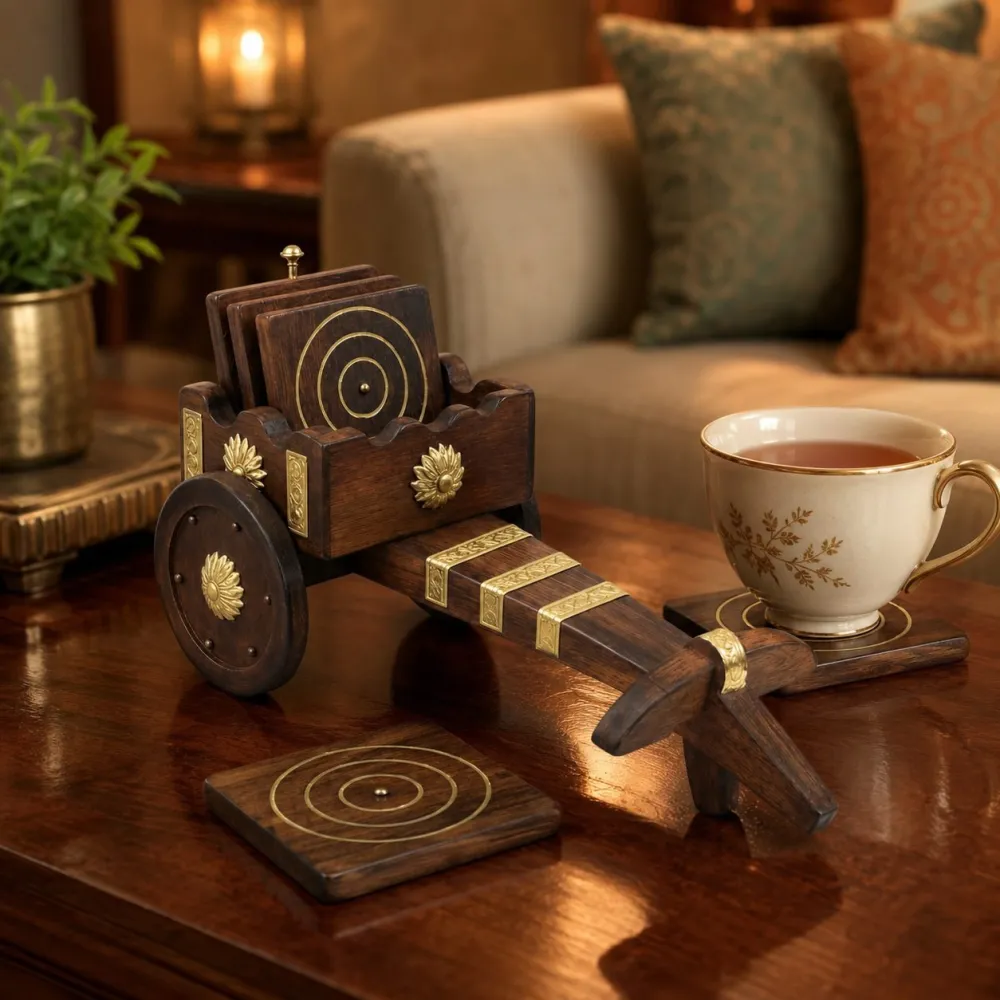
- Wooden bullock-cart tea coaster set — use a removable band or card without covering the working surfaces.
- Jewellery box, 6 × 4 inch — keepsake base that needs closure and surface checks.
- Jewellery box, 8 × 5 inch — larger surface and storage format.
- Compact velvet jewellery box — small organiser suited to a fitted outer sleeve.
- Wooden bowl with cap — keep labels clear of the opening edge.
- Hut-shaped MDF key holder — use a hang tag that does not obstruct mounting.
Seller disclosure: DigiRake Store Private Limited sells these standard products. Personalisation, printing, engraving, tags and gift packing are not included unless stated on the live listing. Prices, stock and specifications can change.
Create a Clean Personalisation Brief
A written brief should contain the exact product code, personalisation method, printable area, text, typeface, colour, placement, quantity and deadline. Supply names in a spreadsheet with one row per gift. Lock the spelling column after approval so accidental sorting or auto-correction does not change it.
Specify how blank spares will be handled and whether the supplier may replace damaged pieces. If a local printer receives the products separately, confirm who is responsible for loss or surface damage during the second production step.
Proofreading and Approval
- Check every name against the source supplied by the recipient or organiser.
- Print a paper proof at actual size.
- Review contrast, margins and punctuation.
- Approve one physical sample where the method is permanent.
- Photograph and sign off the final position and colour.
- Do not approve the full run through an informal message with ambiguous changes.
For Indian-language text, use a typeface that supports the full script and ask a fluent reader to proof it. Transliteration is not a substitute for correct spelling. Check that vowel marks and conjunct characters render properly in the final artwork.
Quantity, Lead Time and Budget
Calculate product, personalisation, setup charge, proof, packing, delivery and replacement pieces separately. Permanent recipient-level work normally needs a stable guest list earlier than shared occasion tags. Do not advertise a fixed turnaround; use the supplier’s written production and dispatch estimate for the exact method and quantity.
Keep blank spares for unexpected guests. If someone cancels, a removable name tag can be changed; a permanently engraved item may not be reusable. This waste risk belongs in the budget decision.
Privacy and Respect
Collect only the information required to make and distribute the gifts. Restrict spreadsheet access, avoid sharing home addresses in group chats and delete working copies when they are no longer needed. For children, obtain parent approval and avoid full names combined with school or location details.
Common Mistakes
- Assuming a standard retail product includes personalisation.
- Approving only a digital mock-up for permanent work.
- Printing before the guest list and spelling are stable.
- Covering hinges, closures, mounting holes or ventilation.
- Using the host’s branding so prominently that the recipient will not reuse the item.
- Ignoring setup, rejected pieces, packing and delivery in the budget.
Frequently Asked Questions
What can I write on a personalized return gift?
Use the host names, occasion, date or a short thank-you. Recipient initials work when spelling and distribution are reliable.
Is engraving better than a printed tag?
Engraving is permanent; a tag is easier to correct and remove. Choose based on how the recipient will use the item, not perceived prestige alone.
How many blank spares should I keep?
Use a modest number based on attendance uncertainty and production risk. Blank extras are more reusable than permanently named pieces.
Does DigiRake personalize these products?
Do not assume so. The linked retail products are standard listings. Any personalisation must be explicitly confirmed with method, proof, quantity, price and lead time.