


Good corporate client gifts strengthen a relationship without creating pressure, clutter or compliance problems. The best choice is rarely the most expensive item. It is the one that fits the business moment, the recipient’s rules, the delivery setting and the sender’s ability to fulfil consistently.
Start with the relationship stage
Choose the purpose before browsing products. A welcome gift introduces the working relationship; a project-completion gift marks a shared result; a service-anniversary gift recognises continuity; and a year-end gift expresses thanks. Do not use a gift to accelerate a decision, obtain access or influence an active tender. If timing could be misunderstood, send a sincere message now and consider a gift after the decision process closes.
Segment recipients by use case rather than perceived status. A useful matrix includes relationship stage, recipient organisation, number of recipients, delivery location, permitted value, preference status and approval owner. This prevents a sales team from making inconsistent choices account by account.
Check whether the client can accept a gift
Ask for the client’s current gifts-and-hospitality rules. Public-sector bodies, regulated industries and organisations with active procurement may prohibit or tightly restrict gifts. Some clients allow an item only if it is shared by a team; others require disclosure or manager approval. A low price does not override the recipient’s policy.
Provide a graceful opt-out. The recipient should be able to decline, select a neutral alternative or choose no physical item without an awkward explanation. Never send a religious, health-related, food, fragrance or wearable item based only on assumptions about a person’s name, role or location.
A practical client-gift selection matrix
Useful desk and meeting-room items
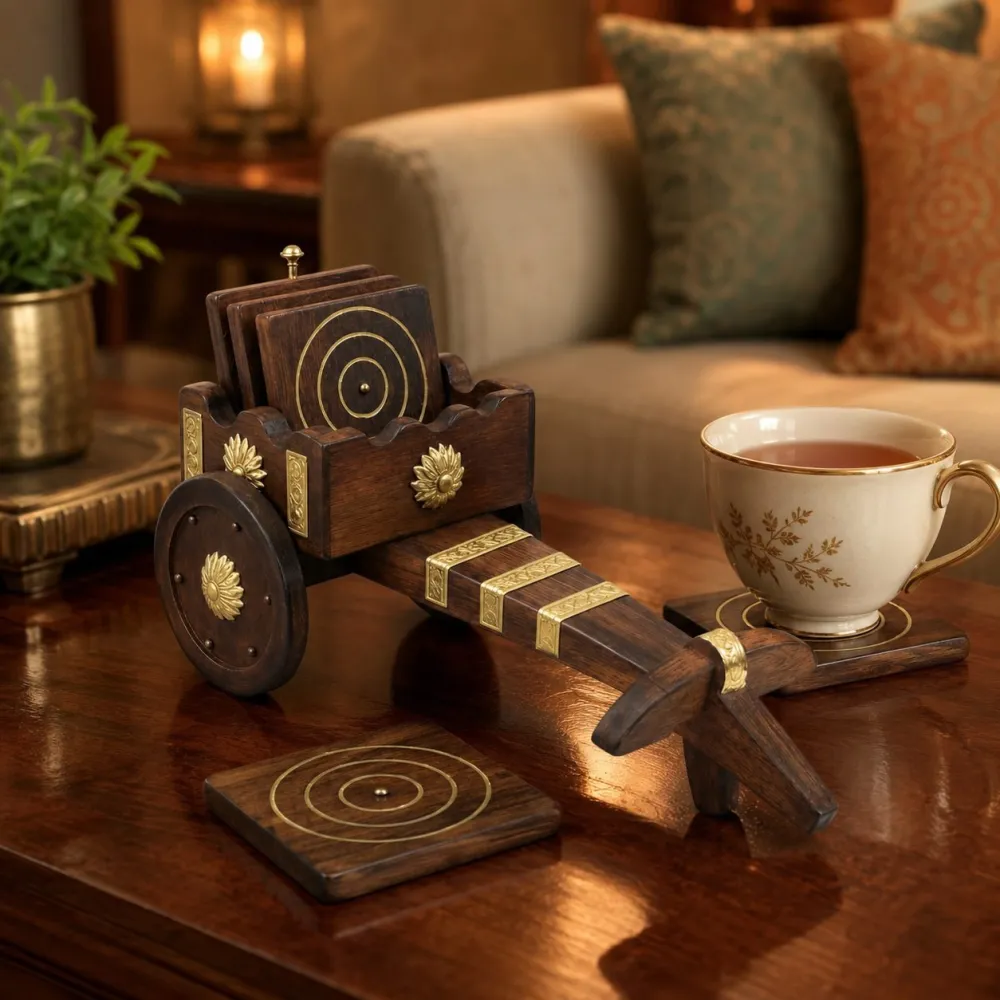
A wooden tea coaster set is easy to understand and can serve a desk, meeting room or home. Confirm dimensions, finish and care before ordering. Coasters work especially well when the business message relates to hosting or shared conversations rather than personal taste.
Compact storage gifts
A 6×4 wooden jewellery box has practical storage value, but the category can feel personal. Offer it as one option alongside a neutral household or desk item. Confirm internal layout because an attractive exterior does not tell the buyer what types of jewellery will fit.
Small wellbeing items
A two-wheel wooden roller massager is compact and non-sized. Describe it as a manual comfort accessory, not a treatment, and include basic cleaning guidance. Give recipients a different choice if a wellbeing item would be unsuitable.
Decorative choices
An antique-style toran can suit an opt-in festive collection. Confirm length, colour, hanging method and indoor or sheltered-use expectations. For international delivery, check whether decorative plant-like materials or components face customs restrictions.
Devotional choices
A Ganesh idol or a 3-in-1 dhoop stand should be offered only where the recipient has expressed the relevant preference. Verify materials and usage instructions, pack fragile pieces carefully and avoid presenting belief-specific products as universal corporate gifts.
Set the real budget per delivered gift
Product price is only one line. Calculate sample cost, taxes, artwork, personalisation, inner packaging, outer carton, pick-and-pack labour, address collection, shipping, remote-area charges, failed-delivery handling, replacements and a contingency. Divide the complete programme cost by the number of successfully delivered gifts, not merely the initial order quantity.
Create a ceiling for each approved segment and a substitution rule. A replacement should preserve the purpose and approximate value, not simply resemble the original item. Require approval before the supplier substitutes a colour, material, size or component.
Order samples and test the experience
Inspect a sample in the same form the client will receive. Check finish, sharp edges, moving parts, odour, colour variation, closures and whether the item matches the listing. Then close, shake and reopen the packed sample. If the gift arrives untidy, the client experiences the packaging failure as part of the brand.
For a multi-address campaign, run a small pilot. Measure address errors, dispatch time, delivery success, damage, support contacts and recipient feedback. A pilot reveals operational problems before they affect an entire account list.
Use branding with restraint
The recipient is more likely to keep an item that works in their space. A removable note, sleeve or tag often carries the campaign message without turning the product into an advertisement. If the product itself is branded, specify logo dimensions, colour mode, print position, contrast and tolerance. Approve the final proof and retain it with the purchase record.
Avoid printing sensitive account details, individual performance information or an unexpected personal message. Confirm spelling and honorifics directly from an authorised source. When uncertainty remains, use the person’s preferred name or omit individual printing.
Plan ethical data collection and delivery
Collect only the name, delivery details, contact information and preferences needed for fulfilment. Tell recipients why the data is required, who will process it and when it will be deleted. Restrict spreadsheet access, transfer addresses securely and require the logistics partner to use the data only for the shipment.
Give recipients an address deadline and a way to correct errors. Do not surprise people with a package at home when they have provided only a work relationship. If delivery fails, define the number of attempts and whether the item returns, is held or is redirected with fresh consent.
Measure outcomes without intruding
Useful programme measures include successful-delivery rate, damage rate, support cases, opt-out rate, cost per delivered gift and on-time completion. A brief optional feedback question can ask whether the choice and delivery were convenient. Do not treat public social posting, reviews or referrals as an implied condition of receiving a thank-you gift.
Common mistakes
- Ordering before checking the client’s acceptance rules.
- Sending the same belief-specific or personal item to everyone.
- Budgeting only for the catalogue price.
- Skipping the production sample and packing test.
- Using a logo so prominently that the item loses usefulness.
- Keeping recipient addresses after the fulfilment purpose ends.
Frequently asked questions
What is the safest client gift?
No product is universally safe. A modest, useful item selected after a policy check, with a neutral alternative and easy opt-out, is usually lower risk than a personal or high-value choice.
Should every client receive the same gift?
Use consistent rules rather than forced identical products. Different locations, acceptance policies and preferences may require choices, while the budget and approval logic remain fair.
When should a company avoid gifting?
Avoid or defer a gift when the recipient prohibits it, an active decision could be influenced, consent is missing for delivery, or the organisation cannot verify the product and fulfilment claims.
Corporate client gifts work best as a carefully governed service moment. Begin with purpose and permission, then choose, sample, pack and deliver an item that respects the recipient’s space and rules.