


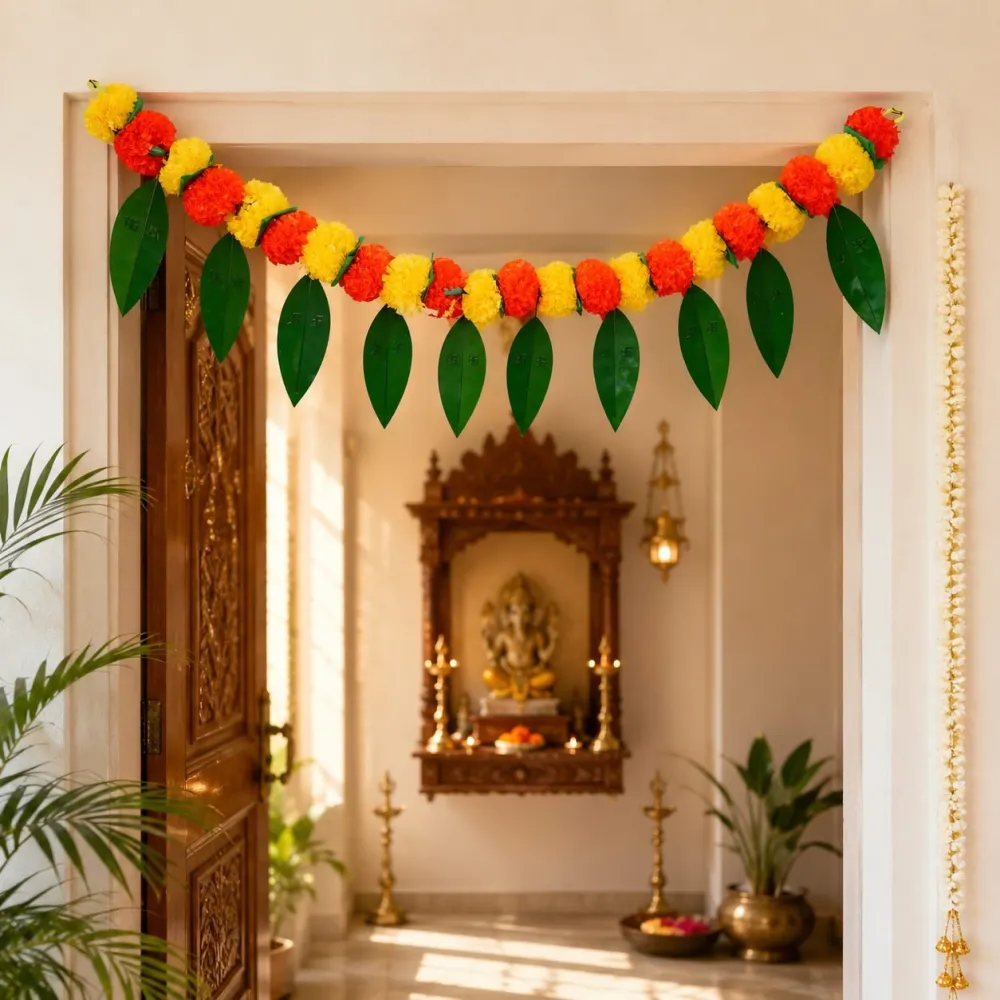
Real versus artificial flower toran is a choice between short-term natural material and predictable reusable décor. Fresh flowers suit an occasion where local sourcing and same-day preparation are possible. Artificial flowers suit advance ordering, standard dimensions, transport and repeated use—provided they are maintained and stored properly.
Quick answer
Choose a real flower toran when natural texture, local tradition and a short display period are priorities. Choose an artificial toran when you need a known size, early delivery, quantity consistency or reuse. Compare the complete lifecycle: sourcing, installation, display conditions, cleaning or disposal, storage and number of expected uses.
Real and artificial flower torans compared
| Factor | Real flowers | Artificial flowers |
|---|---|---|
| Appearance | Natural variation, texture and fragrance | Consistent colour and repeated pattern |
| Planning time | Usually sourced close to the event | Can be ordered and inspected in advance |
| Display period | Short and condition-dependent | Potentially repeated across occasions |
| Dimensions | Can vary with flowers and assembly | Usually standardised by product model |
| Transport | Sensitive to heat, moisture and crushing | Easier to ship but can still be compressed |
| After use | Requires locally appropriate plant disposal | Needs cleaning, dry storage and eventual material disposal |
| Best value | When one short natural display is the goal | When it survives and is genuinely reused |
When a real flower toran works best
Fresh flower torans work well for locally managed weddings, housewarming functions, poojas and other short events where someone can source or assemble them close to installation time. They offer natural differences in flower size and colour rather than product-level uniformity.
Choose fresh flowers only with a realistic plan for transport, timing and cleanup. Cut flowers change with temperature, humidity, handling and age, so no universal freshness duration should be assumed. Protect stain-sensitive door surfaces from moisture and plant residue.
When an artificial flower toran works best
Artificial torans suit online ordering, advance preparation, return gifts, multi-day festivals and households that reuse decorations. A product model can provide repeatable dimensions and colour, which helps when several doors or gift packs must match.
Quality varies. Inspect petal attachment, supporting cord, end loops, exposed wire or hard plastic, colour transfer and whether compressed flowers can be reshaped safely. “Artificial” does not automatically mean washable, weatherproof, fade-resistant or fire-resistant.
Appearance and photography
Fresh flowers offer irregularity, natural texture and fragrance, but their exact appearance changes from batch to batch. Artificial flowers can produce an even repeated pattern, though close-up realism depends on material, construction and lighting.
Marketplace photographs may be styled, enlarged or colour-adjusted. Look for a straight-on image of the complete toran, close-ups of flower heads and attachment points, and a photo that shows scale on a doorway. Use stated dimensions rather than estimating from props.
Timing and event logistics
Fresh décor needs a short sequence between sourcing, assembly, transport and installation. Build contingency time for damaged flowers, weather and access to the venue. Confirm who removes and disposes of the toran afterward.
Artificial décor can arrive earlier, allowing a full measurement and hook test. Inspect it while returns are still possible. If it has been compressed in shipping, follow the maker’s reshaping instructions rather than applying heat or steam automatically.
Compare a current artificial flower-and-leaf toran
DigiRake currently lists an artificial yellow-orange marigold-style toran with mango leaves. Use it as the reusable option in this comparison and verify its live dimensions, materials, loops, price, stock and delivery before ordering.
Seller disclosure: DigiRake Store Private Limited sells the artificial product linked above. This comparison does not claim that artificial is universally better. Prices and stock can change; verify the live listing before ordering.
Compare cost per event, not only purchase price
A fresh toran has a cost for each occasion, including flowers, labour, travel, delivery and installation where applicable. Seasonal availability and local supply can affect price. Ask for a complete quote rather than comparing only a per-length flower rate.
An artificial toran spreads its purchase cost across multiple events only if it remains in good condition and is actually reused. Include delivery, cleaning time, repair and storage space. A cheap product discarded after one use may provide worse value than a durable item used repeatedly.
Environmental claims need evidence
Fresh plant material is not automatically impact-free, and an artificial product is not automatically wasteful. Relevant factors include cultivation, water and inputs, transport distance, refrigeration or packaging, artificial-material composition, durability and end-of-life handling.
A reusable product must be reused to realise that benefit. A fresh toran still requires locally appropriate disposal. Avoid broad labels such as “eco-friendly”, “biodegradable” or “sustainable” unless the seller provides specific material and supply-chain evidence.
Door and surface protection
Fresh stems and flowers can carry moisture or natural colour that may mark some painted, wooden or fabric surfaces. Use a suitable barrier or attachment arrangement and remove wilted material promptly. Do not let water drip near electrical fittings.
Artificial flowers can also transfer dye, scratch with exposed wire or soften near heat. Inspect the back of the product and keep hard components from rubbing against the door. Test any cleaning or contact method only as recommended for the finish.
Indoor, covered and outdoor entrances
Fresh flowers can wilt faster under heat, sun or strong air movement. Artificial flowers may fade, absorb moisture, rust at hidden metal parts or release colour. Neither option should be assumed suitable for direct outdoor exposure.
Check the actual entrance: an indoor corridor, covered porch and directly exposed doorway present different conditions. Use a toran outdoors only when its materials and fixing system are specified for that environment.
Fire and electrical safety
Keep fresh flowers, dry plant material, fabric petals, thread, plastic leaves and supporting cord away from diyas, candles, camphor, incense, hot lamps and damaged wiring. Natural material can dry during use, and artificial components may soften, melt or burn near heat.
Do not adjust the toran while carrying an active flame. Ensure hanging elements cannot swing toward a lamp when the door or a fan moves. Decorations must not cover switches, cameras, smoke alarms, emergency lighting or other safety equipment.
Fresh toran care during an event
- Install as close to the event as practical.
- Keep it out of direct heat and harsh sunlight where possible.
- Protect the door and floor from moisture and falling plant material.
- Remove visibly deteriorated or detached components.
- Avoid unapproved sprays near people, food, pets and worship areas.
- Plan timely removal and appropriate disposal.
Artificial toran cleaning and storage
Dust using a soft brush or another material-appropriate low-contact method. Do not soak a mixed-material toran unless the maker permits it. Let all flowers, leaves, cords and metal-look pieces dry completely before storage.
Store the design flat or in a loose curve inside a labelled container. Support flower heads and prevent hard beads or hooks from crushing petals. Keep the container away from dampness and strong heat. Read our detailed artificial-toran care guide.
Which is better for a wedding?
Fresh flowers suit a locally managed, short-duration wedding where natural material is part of the desired aesthetic and a florist or organiser can coordinate timing. Artificial flowers suit advance shipment, repeat events, standard sizing and décor that needs to be prepared before venue access.
Large backdrops may combine both, but mixed installations need clear responsibility for structure, flame clearance, removal and waste. Confirm venue rules and installer scope before purchase.
Which is better for Diwali and pooja?
Fresh flowers fit short traditional use when sourcing is convenient. Artificial marigold and mango-leaf designs work when the household wants to prepare early and reuse the decoration. In either case, keep the toran well away from diyas, camphor and electrical lights.
Which is better for return gifts?
Artificial torans are generally more practical for return gifts because they can be counted, packed and distributed without the same-day handling required by fresh flowers. Choose a compact standard design and confirm individual packaging, dimensions and quantity tolerance.
Do not assume every guest has the same doorway size or storage space. A small decorative strand is often easier to gift than a dense full-width entrance piece.
Decision checklist
- How long will the toran be displayed?
- Can fresh flowers be sourced and installed close to the event?
- Do you need exact repeatable dimensions?
- Will the artificial toran genuinely be reused?
- Is dry, crush-free storage available?
- Does the entrance receive direct sun, wind or rain?
- Who will install, inspect, remove and dispose of the decoration?
- What is the complete cost across the expected uses?
Common mistakes
- Assuming fresh flowers will last a fixed number of days.
- Calling an artificial toran reusable without planning storage.
- Comparing only the purchase price instead of complete event cost.
- Making environmental claims without material or sourcing evidence.
- Using artificial flowers outdoors without a weather-suitability claim.
- Applying heat to reshape artificial petals without instructions.
- Letting fresh moisture or exposed wire damage the door surface.
- Placing either type near flames, hot lamps or unsafe wiring.
Frequently asked questions
Which type lasts longer?
An artificial toran can last longer when its construction is durable and it is cleaned and stored correctly. Fresh flowers have a short, condition-dependent display period.
Can artificial torans look realistic?
Some reproduce flower shapes and colours closely, but quality varies. Inspect material descriptions, close-up images, dimensions and product-specific reviews when available.
Can fresh leaves or flowers stain a door?
Moist plant material and natural colour can mark some surfaces. Protect the finish, monitor the installation and remove the toran promptly after use.
Is an artificial toran cheaper?
It may have a lower cost per use when it survives and is reused. Compare product, delivery, cleaning, repair and storage against the repeated sourcing and installation cost of fresh flowers.
Can both types be used together?
Yes, when the structure supports the combined weight and the materials remain safely clear of flames, moisture-sensitive surfaces and electrical equipment.
Which is more environmentally friendly?
There is no universal answer without lifecycle evidence. Consider sourcing, transport, materials, number of reuses, packaging and end-of-life handling rather than relying on the fresh or artificial label alone.
Final recommendation
Select real flowers for a short, locally coordinated natural display. Select artificial flowers for advance planning, repeatable dimensions and genuine reuse. Whichever you choose, measure the doorway, calculate complete cost, protect the surface, keep the toran away from heat and flame, and plan its removal or storage before the event.