


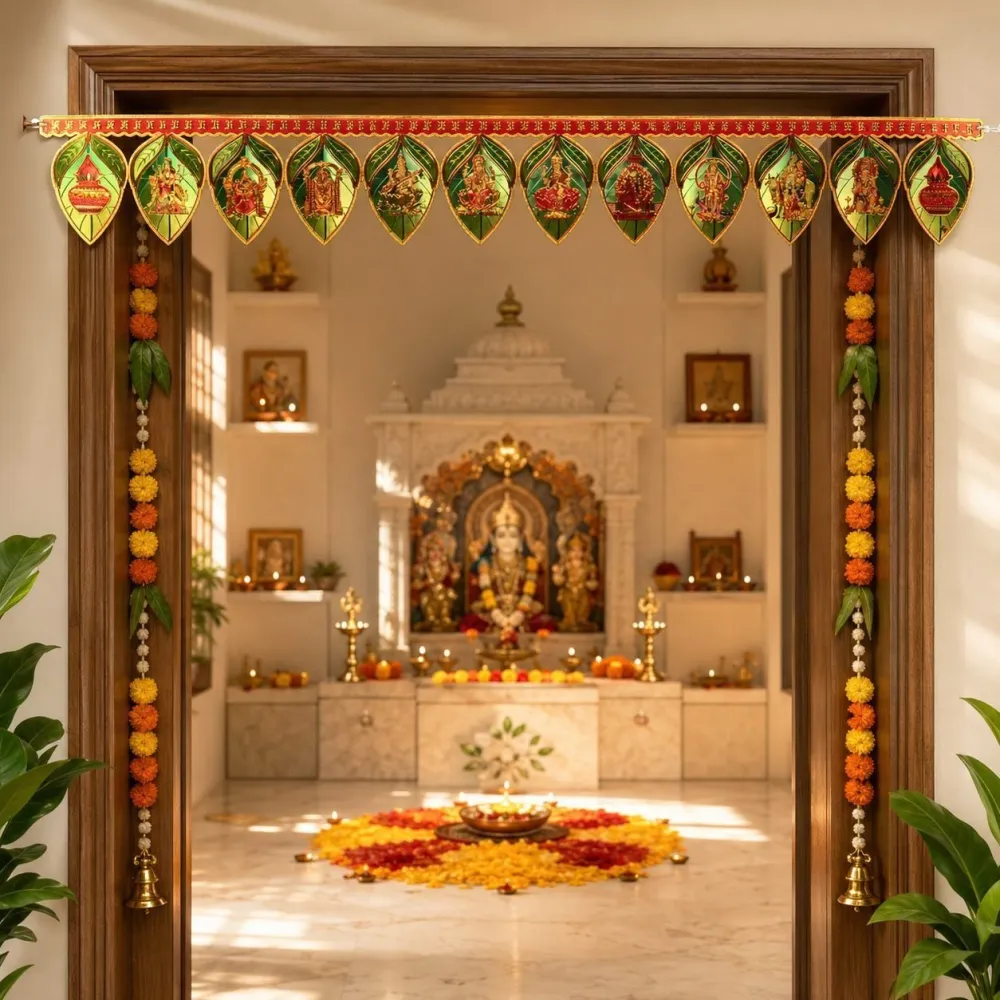
Latest toran designs for door are more useful when understood as durable design directions rather than a short-lived list of “trending” products. A good design guide helps you compare visual density, colour, shape, material and maintenance, then choose a toran that still suits the entrance after the festival or trend has passed.
Quick answer
For a modern entrance, consider a clean leaf rhythm, limited colour palette or shallow geometric drop. For a traditional or festive look, choose mango leaves, marigold colours, lace or layered flowers. For texture, consider shells or antique-finish components. Whatever the style, confirm the actual width, lowest drop, material, weight and hanging loops before ordering.
Toran design families at a glance
| Design family | Visual character | Often suits | Check carefully |
|---|---|---|---|
| Minimal leaf | Clean, repeated elements | Daily main-door décor | Scale on a wide frame |
| Marigold floral | Bright yellow-orange festival palette | Diwali, pooja and housewarming | Flower density and storage |
| Layered leaf and flower | Fuller traditional appearance | Functions and broad entrances | Weight and fixing strength |
| Gold-lace or antique look | Compact ornamental detail | Apartment entrances and gifting | Material wording and edge finish |
| Shell, bead or mirror | Texture, movement and reflection | Covered decorative entrances | Tangling, impact and loose pieces |
| Fabric or woollen | Soft, colourful craft aesthetic | Indoor seasonal use | Dust, moisture and cleaning |
Modern toran designs
Modern-looking torans often use fewer colours, consistent spacing and a controlled drop. They may repeat one leaf, disc, tassel or geometric component rather than combining many motifs. This visual restraint can work well with plain doors, compact apartment entrances and contemporary interiors.
Minimal does not mean undersized. A short, sparse toran can disappear visually on a wide or heavily detailed frame. Measure the entrance and consider the design at full doorway scale, not as an isolated product photo.
Traditional toran designs
Mango-leaf forms, marigold colours, textile work, lace and devotional motifs create a traditional visual language. These designs are often selected for festivals, pooja rooms, weddings and housewarming entrances. Traditions vary by household and region, so choose motifs appropriate to the practice you follow.
A traditional look can be simple or elaborate. An evenly spaced artificial mango-leaf strand creates a quieter result, while flowers, tassels and lace build a denser entrance. Evaluate construction and maintenance alongside symbolism.
Flower and marigold designs
Artificial marigold torans range from a single flower line to layered arrangements with green leaves. Yellow and orange combinations create a familiar festive palette, while single-colour or alternating strands look more controlled. Compare the spacing, visible cord, flower size and maximum drop.
Dense flowers add weight and can be crushed in storage. If the product arrives compressed, use only the reshaping method recommended for its material. Do not expose unknown plastic, fabric or adhesive components to high heat.
Mango-leaf and gold-lace combinations
Artificial mango leaves offer a repeated natural form, while gold-coloured lace adds a more decorative edge. This combination can bridge daily and festival use. “Gold” normally describes appearance unless a listing explicitly identifies the material, so do not infer precious-metal content.
Inspect how the lace, leaves and hanging loops connect. Multiple material types may need gentler cleaning than a simple single-material strand.
Shell, bead, mirror and antique styles
Textured designs add movement and focal detail. Shells and beads create dimensional shadows; mirror pieces reflect light; antique-finish elements offer a compact ornamental look. These styles work best where they will not strike the door, wall or one another in strong air movement.
Check for sharp edges, fragile thread, loose rings and small detachable components. Keep the toran out of reach of small children and pets, and choose a storage container that does not crush or tangle the hanging elements.
Compare current toran design directions
Use these live products as examples of floral, leaf, lace, antique and shell design families. Verify dimensions, material, loops, colour, price, stock and delivery on the product page.
- Layered mango-leaf and marigold toran ↗
- Minimal plain mango toran ↗
- Mango-leaf toran with gold lace ↗
- Antique-gold thoranam ↗
- Sea-shell thoranam ↗
Seller disclosure: DigiRake Store Private Limited sells the products linked above. “Latest” describes current design directions, not a guarantee that availability will remain unchanged. Verify the live listing before ordering.
How to choose colours
Photograph the complete entrance straight-on in ordinary daylight. Note the door colour, wall colour, hardware and any permanent nameplate or rangoli area. Then choose whether the toran should blend with the entrance or create deliberate contrast.
A limited palette often gives a calmer everyday look. Bright yellow, orange, red and green can create a festival focal point. Screen settings and lighting affect product colours, and handmade or batch-produced items may vary, so read the seller’s colour description and return terms.
Choose visual density for the doorway
Visual density means how much of the frame is occupied by leaves, flowers, tassels and other components. A compact entrance can feel crowded under a very deep layered design. A broad double door may make a short sparse strand look accidental.
Measure the width and safe drop, then compare the pattern repeat. A centred low point can create a classic curve; evenly repeated short drops feel more structured; long side elements frame the entrance but need clearance from handles and people.
Daily, festival and event designs
For daily use, favour a design that is easy to dust, light enough for the attachment and visually comfortable with the permanent entrance. Plain leaf, simple lace and compact antique styles can be easier to maintain than very dense floral designs.
For a festival or wedding, a fuller design can create more impact for a short period. Consider installation time, photography, transport and storage after the event. Reusability depends on careful removal and packing, not merely on the word “artificial”.
Match design to the entrance type
Apartment entrance
Compact leaf, lace or antique designs can suit an indoor corridor where projection and door clearance matter. Check building rules before drilling or placing decorations around common-area equipment.
Wide or double door
Use a sufficiently long strand or a coordinated arrangement that centres on the complete frame. Confirm side-loop allowance and avoid placing vertical elements in the path of either shutter.
Pooja-room doorway
A smaller traditional design can frame the doorway without crowding it. Keep every material well away from diyas, camphor, incense and hot electrical lamps.
Covered outdoor entrance
Choose only a material suited to the actual dust, wind, moisture and sunlight. A covered entrance is not necessarily dry during wind-driven rain. Do not assume an indoor decorative toran is weather-resistant.
How to compare online product photos
- Look for a straight-on full-product image, not only close-up details.
- Check stated total width and maximum drop.
- Confirm whether loops and cords are included in those measurements.
- Inspect close-ups of knots, stitching, rings and back surfaces.
- Compare customer images only when they clearly show the same variant.
- Read material and quantity fields rather than inferring them from styling props.
- Verify return conditions in case scale or colour differs from expectations.
Evergreen design versus a passing trend
A toran is more likely to remain useful when it fits the doorway, uses a colour palette you already enjoy and can be cleaned and stored. Trend labels change faster than entrances. Buy a design because its proportions and material suit your home, not simply because a marketplace calls it new.
Current examples can still be helpful: they reveal popular combinations such as leaves with flowers, botanical forms with metallic lace, or minimal repeated motifs. Treat those as adaptable design principles. Our complete toran buying guide covers the practical selection process.
Installation and safety checks
Design weight affects the hanging method. Match hooks or fixtures to the surface and total load, follow their installation directions and keep the toran clear of hinges, closers, cameras and locks. Test the door slowly after installation.
Keep fabric, dry natural material, thread, paper, plastic flowers and other decorative components away from open flames, incense, hot lamps and electrical faults. Do not allow long tassels to swing toward a diya or candle. See the secure hanging guide.
Cleaning and storing detailed designs
Dust gently according to the stated material. Mixed-media torans may combine fabric, plastic, coating, thread, adhesive and shell, so soaking can damage colour or construction. Do not apply heat or cleaning chemicals unless the seller recommends them.
Allow the product to dry fully, untangle hanging parts and store it flat or loosely supported. Place tissue or another suitable soft separator around fragile components when appropriate. Never pack flowers, mirrors or shells under heavy items. Read our artificial-toran care guide.
Design mistakes to avoid
- Choosing from a close-up without checking full doorway scale.
- Using a dense deep design on a very compact frame.
- Buying a short strand for a wide double door.
- Combining several unrelated motifs around one entrance.
- Ignoring product weight while selecting appearance.
- Assuming “gold” or “antique” identifies the underlying material.
- Using an indoor design in direct weather exposure.
- Storing flowers, shells or mirrors under crushing weight.
Frequently asked questions
What are the latest toran design directions?
Current ranges commonly combine artificial leaves with flowers, botanical forms with gold-coloured lace, minimal repeated leaves, or shell and antique-look details. Availability changes, so focus on the design family rather than one temporary listing.
Are simple torans better for daily use?
They are often easier to dust, install and store. Suitability still depends on material, size, location and household preference.
Should toran colour match the door?
It can complement or contrast with the entrance. Evaluate the whole frame, wall and hardware in normal lighting rather than matching one isolated colour.
Which design suits a small apartment door?
A lightweight design with controlled width and a shallow drop often works well. Measure the frame and ensure it does not cover the bell, nameplate, peephole or closer.
Are handmade torans always unique?
Handmade products may show variation, but uniqueness depends on the maker and production method. Read the actual listing rather than assuming every handmade item is one of a kind.
How often should a “latest designs” guide be reviewed?
Product examples should be checked periodically for stock and changed listings. The underlying selection principles—fit, material, density, safety and care—remain useful much longer.
Final recommendation
Choose a design direction first: minimal, floral, traditional, metallic or textured. Then compare real products by measured width, drop, weight, material and maintenance. A “latest” toran is worthwhile when it fits the entrance safely and still suits your home after the trend label disappears.